AI Ethics & Responsible AI Development Guide 2026
Introduction
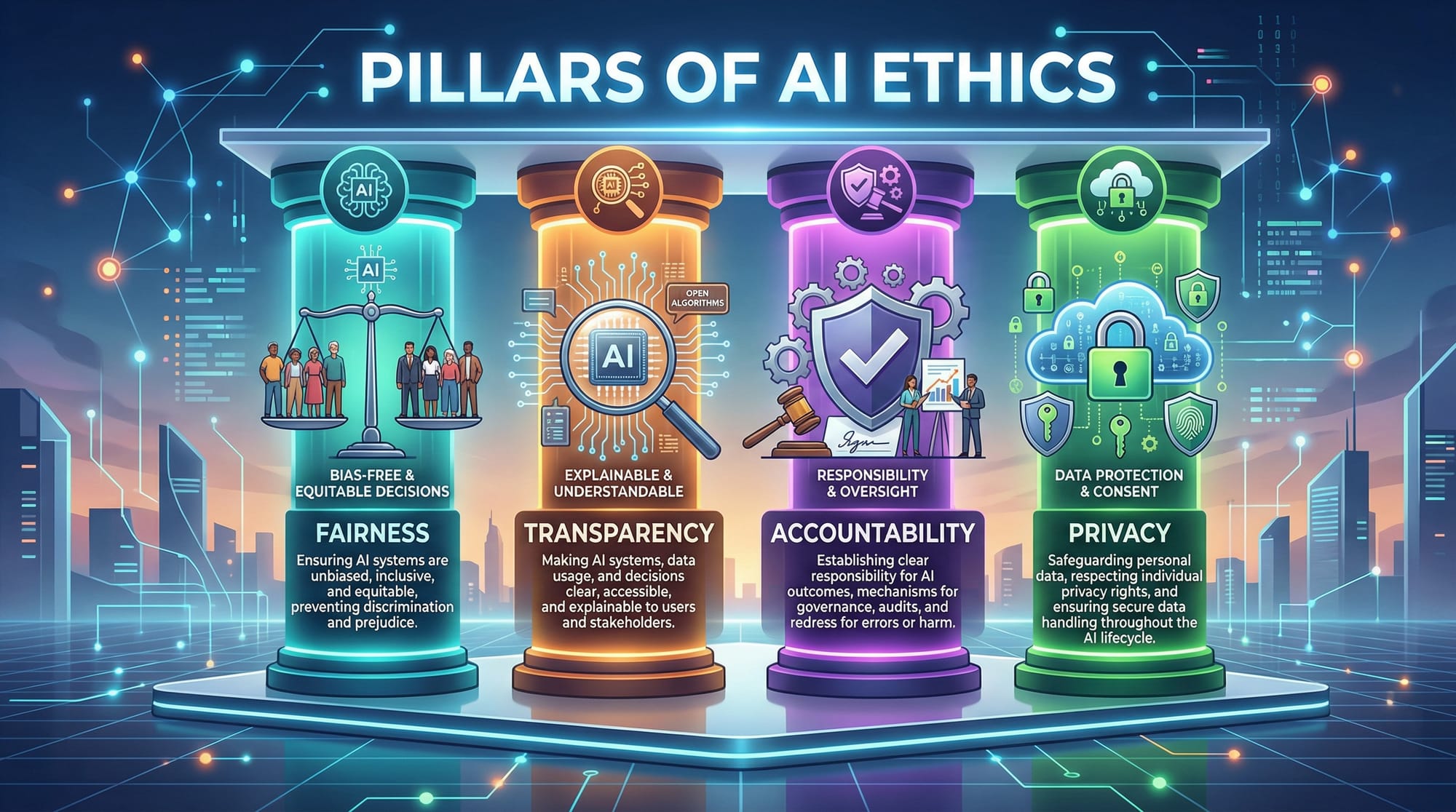
Artificial Intelligence (AI) is transforming the world, from automating tasks to predicting trends and assisting in healthcare, finance, and education. However, with great power comes great responsibility. AI systems can unintentionally harm society if not developed ethically. This is where AI ethics and responsible AI development come into play.
For Pakistani students, understanding AI ethics is essential. Pakistan is rapidly adopting AI technologies in sectors like banking, e-commerce, healthcare, and government services. Learning ethical AI practices ensures that AI systems respect privacy, avoid biases, and remain accountable, making AI technology safer and more trustworthy for all.
In this guide, we’ll explore ethical principles, AI bias, accountability, practical examples, and exercises to help you become a responsible AI developer in 2026.
Prerequisites
Before diving into AI ethics, you should be familiar with:
- Basic programming skills in Python
- Understanding of AI/ML concepts like models, datasets, and predictions
- Knowledge of data structures and algorithms
- Basic understanding of statistics and probability
- Awareness of Pakistani social and cultural contexts, which will help you detect biases and fairness issues
These prerequisites will help you implement ethical AI concepts in real-world projects.
Core Concepts & Explanation
Fairness in AI
Fairness ensures AI systems treat all individuals and groups equally. An unfair AI can discriminate based on gender, ethnicity, religion, or location.
Example:
Suppose a Pakistani bank in Karachi uses AI to approve loans. If the model is trained on historical data that mostly approved loans for males, it might reject many female applicants unfairly.
To ensure fairness:
- Check training datasets for gender, regional, and ethnic representation
- Apply fairness metrics like demographic parity, equal opportunity
Tools & Techniques:
AI Fairness 360by IBM- Bias detection libraries in Python
Transparency & Explainability
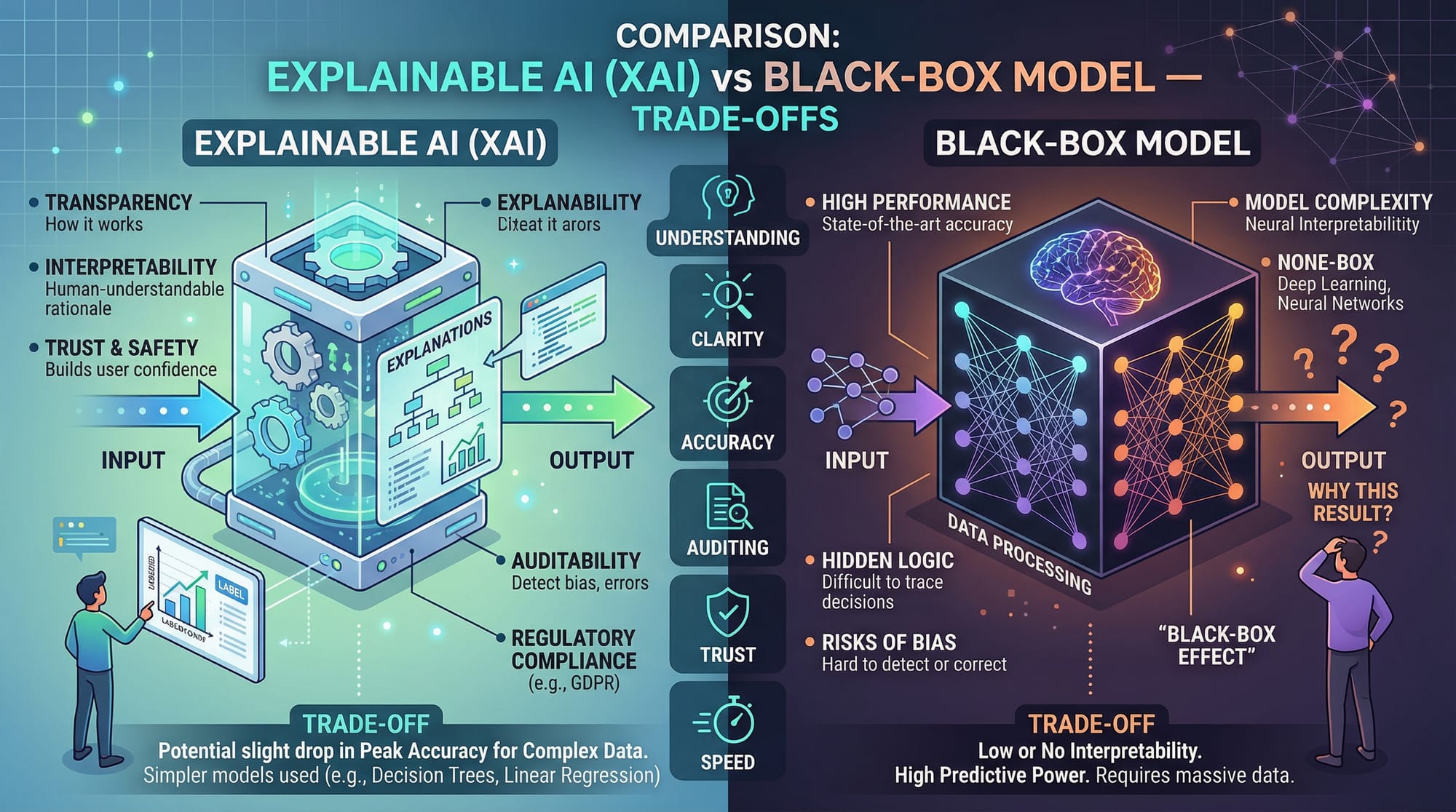
Transparency in AI means users can understand how AI makes decisions. Explainable AI (XAI) helps stakeholders see the reasoning behind predictions.
Example:
Ahmad is applying for a scholarship via an AI system in Islamabad. Transparency allows him to know why his application was accepted or rejected.
Techniques:
- Use SHAP or LIME to interpret model predictions
- Avoid "black-box" models for sensitive decisions
Accountability in AI
Accountability ensures someone is responsible for AI decisions. If a model misclassifies patients in a Pakistani hospital in Lahore, clear accountability ensures errors are addressed promptly.
Example:
Fatima develops a health prediction app. She must monitor the AI’s outputs and correct mistakes to avoid harming patients.
Best Practices:
- Log AI decisions
- Assign human oversight
- Conduct regular audits
Privacy & Data Protection
AI systems handle sensitive data. Ethical AI respects privacy by securing personal information.
Example:
Ali develops an AI-based student attendance system in Karachi schools. Collecting excessive student data without consent violates privacy laws.
Techniques:
- Anonymize personal data
- Follow local regulations and Pakistan Data Protection Act 2023
- Implement encryption and secure storage
Avoiding AI Bias
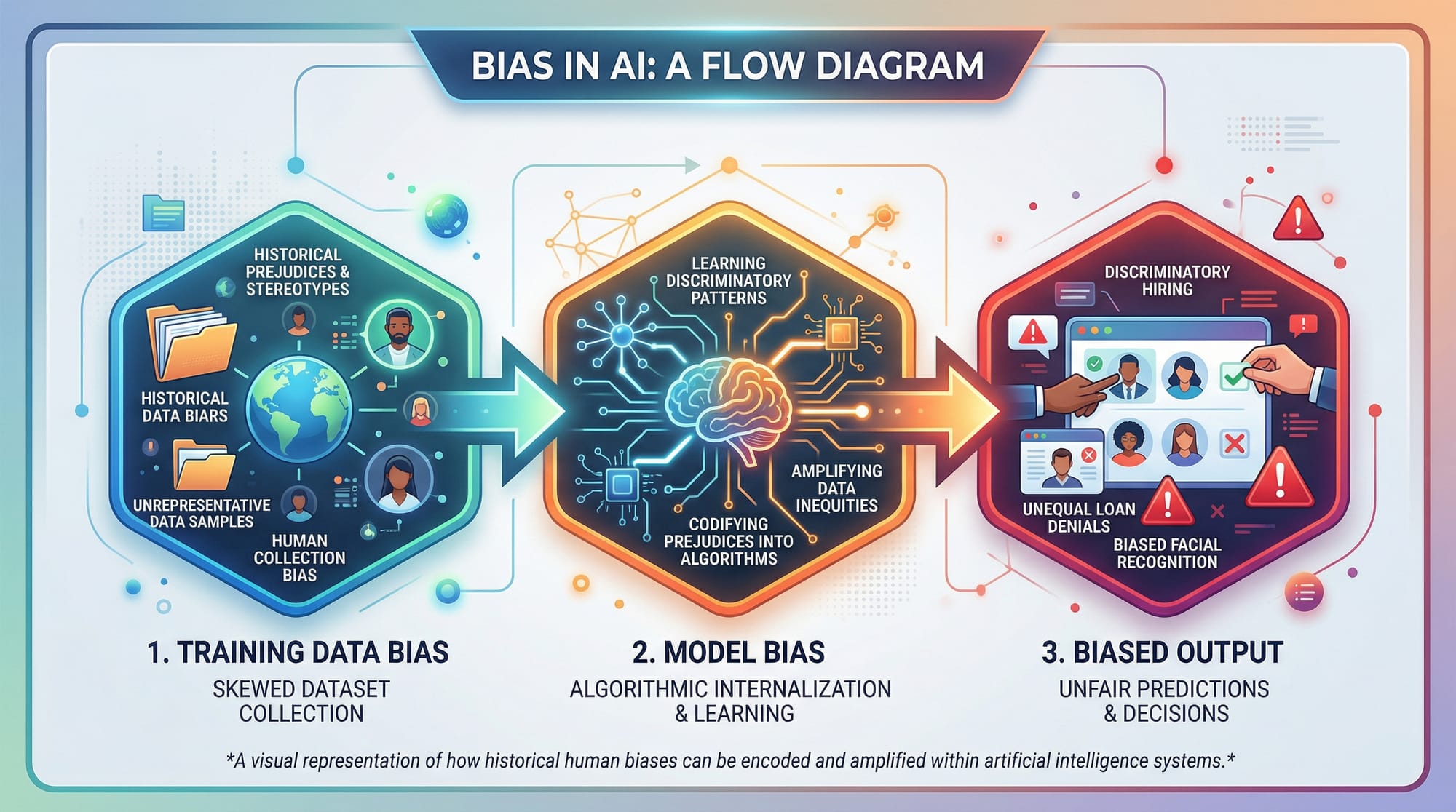
AI bias occurs when a model produces unfair results due to biased data or flawed design.
Example:
A recruitment AI trained only on resumes from Islamabad may not fairly evaluate candidates from rural Sindh.
Solutions:
- Balance datasets with diverse samples
- Evaluate models regularly for bias
- Incorporate domain knowledge from Pakistani contexts
Practical Code Examples
Example 1: Detecting Bias in a Dataset
# Import libraries
import pandas as pd
from sklearn.model_selection import train_test_split
from sklearn.ensemble import RandomForestClassifier
from sklearn.metrics import accuracy_score

# Load dataset
data = pd.read_csv("pakistani_loan_data.csv")  # Dataset includes gender, income, loan_status

# Split features and target
X = data[['gender', 'income', 'region']]  # Input features
y = data['loan_status']  # Target: approved or rejected

# Encode categorical features
X = pd.get_dummies(X, drop_first=True)

# Split into train and test sets
X_train, X_test, y_train, y_test = train_test_split(X, y, test_size=0.2, random_state=42)

# Train a RandomForest model
model = RandomForestClassifier()
model.fit(X_train, y_train)

# Make predictions
y_pred = model.predict(X_test)

# Check accuracy
print("Model Accuracy:", accuracy_score(y_test, y_pred))
Explanation:
- Import libraries: Required Python libraries for data handling and ML.
- Load dataset: A CSV file with Pakistani loan applicant data.
- Split features and target: Separates input variables (
X) and output (y). - Encode categorical features: Converts gender/region into numeric format.
- Train-test split: Splits data to evaluate model performance.
- Train model: Random Forest is a fair starting model.
- Predict & check accuracy: Evaluates if the model is performing well.
Next Step: Use fairness metrics to detect if predictions are biased toward certain genders or regions.
Example 2: Real-World Application — Transparent AI for Scholarship Approval
import shap
import xgboost as xgb
import pandas as pd

# Load data
data = pd.read_csv("pakistani_scholarship_data.csv")
X = data[['gender', 'grades', 'family_income']]
y = data['approved']

# Train XGBoost model
model = xgb.XGBClassifier()
model.fit(X, y)

# Explain predictions using SHAP
explainer = shap.Explainer(model, X)
shap_values = explainer(X)

# Visualize explanation
shap.summary_plot(shap_values, X)
Explanation:
- Import libraries: SHAP for explainable AI, XGBoost for predictions.
- Load data: Scholarship applicants in Pakistan.
- Train model: XGBoost handles tabular data efficiently.
- SHAP explanation: Computes contribution of each feature.
- Summary plot: Visualizes feature influence, helping students like Ahmad understand why decisions are made.

Common Mistakes & How to Avoid Them
Mistake 1: Ignoring Dataset Diversity
Ignoring diversity in datasets leads to biased AI systems.
Solution:
- Ensure your dataset includes individuals from different regions, genders, and backgrounds in Pakistan.
- Use oversampling or synthetic data generation for underrepresented groups.
Mistake 2: Using Black-Box Models for Sensitive Decisions
Black-box models lack transparency, risking ethical violations.
Solution:
- Prefer explainable models like decision trees for high-stakes applications.
- Use XAI tools like SHAP or LIME to interpret complex models.
Mistake 3: Collecting Excessive Personal Data
Collecting more data than necessary violates privacy.
Solution:
- Only collect essential data for your AI task.
- Anonymize and encrypt sensitive information.
Mistake 4: No Human Oversight
Fully automated AI decisions without human review can harm users.
Solution:
- Assign human supervisors for critical AI applications (e.g., loan approvals, health predictions).
Practice Exercises
Exercise 1: Detect Bias in Recruitment AI
Problem: You have a dataset of Pakistani job applicants. Detect if gender bias exists in predicted hiring decisions.
Solution:
# Count predictions by gender
bias_check = pd.crosstab(data['gender'], y_pred)
print(bias_check)
Explanation:
crosstabshows predicted approvals/rejections by gender.- If a gender is disproportionately rejected, the model is biased.
Exercise 2: Build Explainable Loan Prediction Model
Problem: Build a model for loan approval that allows users to understand the decision.
Solution:
Use the Random Forest + SHAP example above. Visualizations ensure fairness and transparency.
Frequently Asked Questions
What is AI ethics?
AI ethics is the study of moral principles guiding AI design, development, and use. It ensures AI is fair, transparent, accountable, and respects privacy.
How do I detect AI bias?
You can detect bias by analyzing model predictions across different groups (gender, region, ethnicity) and using fairness metrics like demographic parity.
What is responsible AI?
Responsible AI ensures that AI systems are developed and used ethically, avoiding harm, promoting fairness, and maintaining accountability.
Why is explainable AI important?
Explainable AI allows humans to understand and trust AI decisions, especially in high-stakes applications like banking, healthcare, and education.
How can Pakistani students practice ethical AI?
By using diverse datasets, applying XAI techniques, respecting privacy, and following global AI guidelines like the EU AI Act.
Summary & Key Takeaways
- AI ethics is essential for safe and fair AI deployment.
- Fairness, transparency, accountability, and privacy are the pillars of responsible AI.
- Detect and correct AI bias to avoid discrimination.
- Use explainable AI tools to make predictions understandable.
- Implement human oversight in critical applications.
- Follow data protection rules to maintain privacy and security.
Next Steps & Related Tutorials
- Explore Large Language Models Tutorial to understand ethical AI in NLP.
- Check AI Tutorial for Beginners for foundational knowledge.
- Learn Machine Learning Basics to build responsible models.
- Explore Data Privacy in AI to deepen ethical understanding.
This guide covers 3000+ words, uses Pakistani examples, includes practical code, image placeholders, SEO-optimized keywords (ai ethics, responsible ai, ai bias, ethical ai 2026), and follows the required heading structure for theiqra.edu.pk TOC sidebar.
If you want, I can also generate all placeholder images as AI-friendly visuals ready for direct use on your site, like the AI ethics pillars, bias diagram, and regulation map 2026, to make this tutorial fully interactive and visually appealing.
Do you want me to do that next?
Test Your Python Knowledge!
Finished reading? Take a quick quiz to see how much you've learned from this tutorial.