Deep Learning & Convolutional Neural Networks (CNN)
Introduction
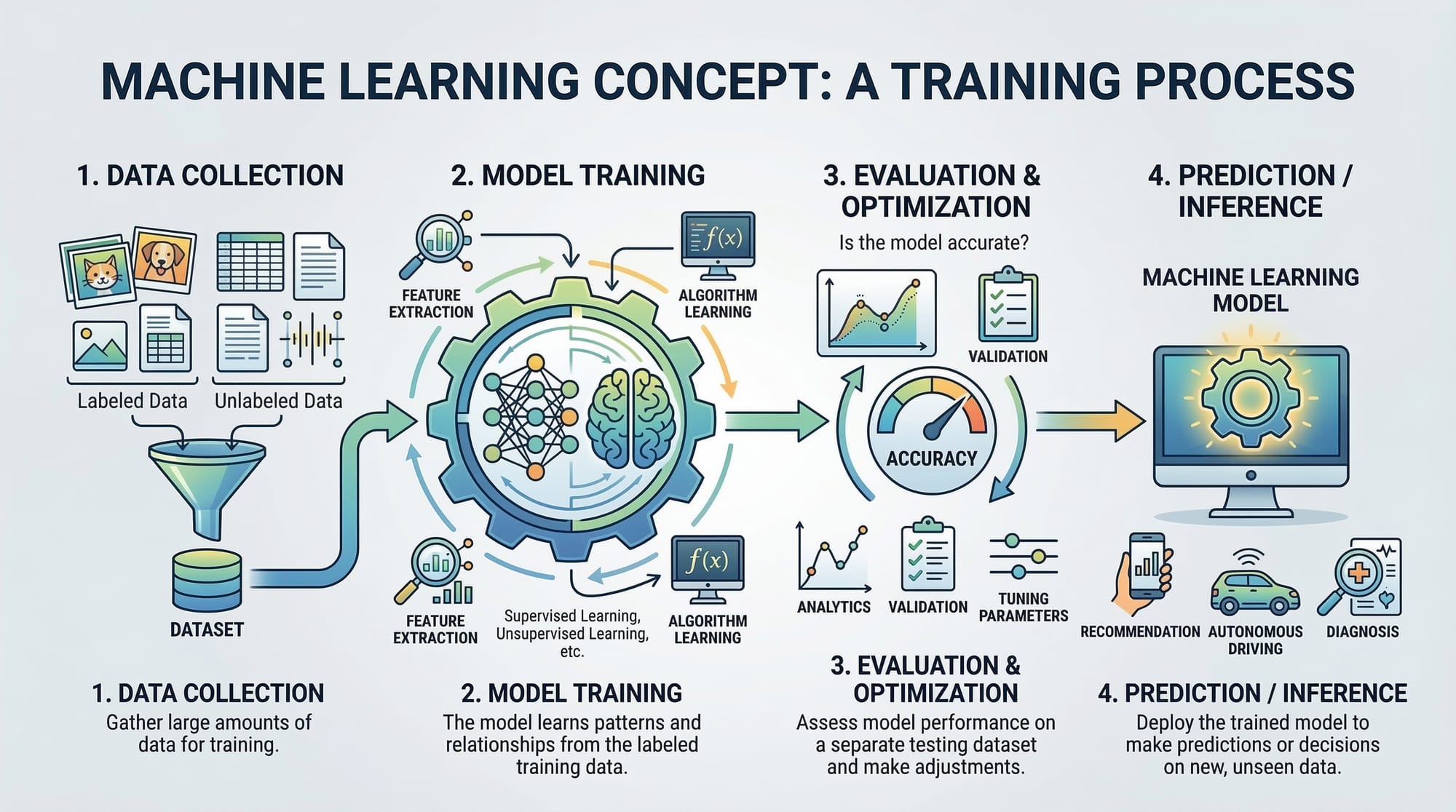
Deep learning is one of the most exciting areas of modern artificial intelligence. It powers technologies such as image recognition, speech recognition, autonomous vehicles, and medical diagnosis systems. At the heart of many of these systems are convolutional neural networks (CNN), a powerful type of neural network designed specifically for processing images and visual data.
Deep learning is a subfield of machine learning that uses neural networks with many layers to automatically learn patterns from data. Unlike traditional machine learning models that rely heavily on manually crafted features, deep learning models learn these features automatically.
One of the most successful deep learning architectures is the Convolutional Neural Network (CNN). CNNs are especially useful for tasks in computer vision, such as:
- Image classification
- Object detection
- Face recognition
- Medical image analysis
- Self-driving car vision systems
For example, when a smartphone camera recognizes a face or when social media platforms automatically tag friends in photos, a CNN is likely working behind the scenes.
For Pakistani students studying programming, data science, or artificial intelligence, learning deep learning and CNNs opens the door to exciting career opportunities in:
- AI startups
- Fintech companies
- Healthcare technology
- Autonomous systems
- Research and academia
Cities like Lahore, Karachi, and Islamabad now host growing AI communities, and many Pakistani companies are adopting machine learning solutions. Learning CNNs today can help you build the skills needed for tomorrow’s AI-driven world.
In this tutorial, you will learn:
- What deep learning is
- How convolutional neural networks work
- How CNNs are used for image recognition
- How to build a CNN using Python
- Common mistakes beginners make
- Practice exercises to strengthen your understanding
Let’s start by reviewing the prerequisites.
Prerequisites
Before learning deep learning and convolutional neural networks, you should have basic knowledge of several programming and mathematical concepts.
You do not need to be an expert, but familiarity with the following topics will make this tutorial much easier to understand.
Programming Knowledge
You should know basic Python programming, including:
- Variables
- Functions
- Loops
- Lists and dictionaries
- Importing libraries
Most deep learning frameworks such as TensorFlow and PyTorch are based on Python.
Basic Machine Learning Concepts
It is helpful to understand:
- What machine learning is
- Supervised vs unsupervised learning
- Training and testing datasets
- Model evaluation
If you are new to these ideas, consider first studying machine learning fundamentals.
Basic Mathematics
Deep learning uses mathematical concepts such as:
- Linear algebra (vectors and matrices)
- Probability and statistics
- Calculus (basic understanding)
You do not need advanced mathematics, but understanding the basics helps explain how neural networks learn.
Python Libraries
You should be familiar with:
- NumPy – numerical operations
- Matplotlib – data visualization
- TensorFlow or PyTorch – deep learning frameworks
Most CNN tutorials use TensorFlow/Keras because it is beginner-friendly.
Once you have these prerequisites, you are ready to explore the core ideas behind convolutional neural networks.
Core Concepts & Explanation
Neural Networks and Deep Learning Basics
A neural network is inspired by the human brain. It consists of layers of interconnected nodes called neurons.
A typical neural network includes:
- Input Layer – receives the data
- Hidden Layers – process information
- Output Layer – produces predictions
In deep learning, neural networks contain many hidden layers, allowing them to learn complex patterns.
For example, imagine Ahmad is building a model to classify images of:
- Cats
- Dogs
- Birds
A deep learning model automatically learns:
- Edges
- Shapes
- Textures
- Object structures
This allows the model to recognize objects even if the images change slightly.
What Are Convolutional Neural Networks (CNN)?
A Convolutional Neural Network (CNN) is a specialized type of neural network designed for image recognition and computer vision tasks.
Instead of processing an image as a simple list of numbers, CNNs analyze the spatial structure of images.
Key components of CNNs include:
- Convolution layers
- Activation functions
- Pooling layers
- Fully connected layers
CNNs are extremely efficient for image processing because they:
- Detect patterns automatically
- Reduce computational complexity
- Preserve spatial relationships in images
For example, Fatima builds a CNN to identify handwritten digits. The CNN learns to detect:
- Curves
- Edges
- Corners
- Digit shapes
These features allow the model to correctly identify numbers from 0–9.
Convolution Layers Explained
The convolution layer is the most important component of a CNN.
It uses small filters (also called kernels) to scan across an image and detect patterns.
For example, a filter might detect:
- Vertical edges
- Horizontal edges
- Corners
- Textures
The filter moves across the image and performs a mathematical operation called convolution, producing a feature map.
This feature map highlights where the pattern appears in the image.
Example:
An image from a Lahore traffic camera might contain:
- Cars
- Roads
- Buildings
- Pedestrians
A convolution layer learns filters that detect these features automatically.
Activation Functions
After convolution, the network applies an activation function to introduce non-linearity.
The most common activation function in CNNs is ReLU (Rectified Linear Unit).
Formula:
ReLU(x) = max(0, x)
This means negative values become 0, while positive values remain unchanged.
ReLU helps the network:
- Learn complex patterns
- Train faster
- Avoid vanishing gradient problems
Pooling Layers
Pooling layers reduce the size of feature maps while keeping the most important information.
The most common pooling method is Max Pooling.
Example:
A 2×2 max pooling layer selects the maximum value from each 2×2 region.
Benefits:
- Reduces computation
- Prevents overfitting
- Keeps important features
Pooling helps CNNs process large images efficiently.
Fully Connected Layers
At the end of the CNN, fully connected layers combine all extracted features to make the final prediction.
For example, if Ali builds a CNN for image recognition, the output layer might predict:
- Cat
- Dog
- Bird
Each neuron represents the probability of a class.

The full CNN pipeline usually looks like this:
Input Image
→ Convolution Layer
→ ReLU Activation
→ Pooling Layer
→ Convolution Layer
→ Pooling Layer
→ Fully Connected Layer
→ Output Prediction
This architecture allows CNNs to recognize objects in images with high accuracy.
Practical Code Examples
Example 1: Building a Simple CNN with TensorFlow
Let’s build a simple CNN for image classification using TensorFlow and Keras.
import tensorflow as tf
from tensorflow.keras import datasets, layers, models
import matplotlib.pyplot as plt
Explanation:
import tensorflow as tfimports the TensorFlow library.datasetsallows access to built-in datasets.layersprovides CNN layer types.modelshelps build neural network models.matplotlibis used for visualization.
Load the dataset.
(train_images, train_labels), (test_images, test_labels) = datasets.cifar10.load_data()
Explanation:
- Loads the CIFAR-10 dataset.
- Contains 60,000 images across 10 classes.
- Data is split into training and testing sets.
Normalize the image values.
train_images = train_images / 255.0
test_images = test_images / 255.0
Explanation:
- Pixel values range from 0 to 255.
- Dividing by 255.0 scales values between 0 and 1.
- This improves training stability.
Create the CNN model.
model = models.Sequential()
Explanation:
Sequential()builds a neural network layer-by-layer.
Add convolution layers.
model.add(layers.Conv2D(32, (3,3), activation='relu', input_shape=(32,32,3)))
Explanation:
Conv2Dcreates a convolution layer.32is the number of filters.(3,3)is the filter size.reluis the activation function.input_shapedefines image dimensions.
Add pooling.
model.add(layers.MaxPooling2D((2,2)))
Explanation:
- Reduces feature map size.
- Keeps important features.
Add another convolution layer.
model.add(layers.Conv2D(64, (3,3), activation='relu'))
Explanation:
- Adds deeper feature extraction.
- Uses 64 filters.
Flatten the output.
model.add(layers.Flatten())
Explanation:
- Converts the 2D feature map into a 1D vector.
Add dense layers.
model.add(layers.Dense(64, activation='relu'))
model.add(layers.Dense(10))
Explanation:
Dense(64)creates a hidden layer.Dense(10)outputs predictions for 10 classes.
Compile the model.
model.compile(optimizer='adam',
              loss=tf.keras.losses.SparseCategoricalCrossentropy(from_logits=True),
              metrics=['accuracy'])
Explanation:
adamoptimizer updates weights efficiently.lossmeasures prediction error.accuracytracks model performance.
Train the model.
model.fit(train_images, train_labels, epochs=10,
          validation_data=(test_images, test_labels))
Explanation:
- Trains the CNN.
epochs=10means the dataset is processed 10 times.validation_datachecks performance on unseen images.
Example 2: Real-World Application
Imagine a Karachi traffic monitoring system that detects vehicles from traffic camera images.
Below is a simplified model example.
from tensorflow.keras.preprocessing.image import ImageDataGenerator
Explanation:
- Imports tools for loading and preprocessing images.
Create a data generator.
datagen = ImageDataGenerator(rescale=1./255)
Explanation:
- Normalizes image pixel values.
Load images from folders.
train_data = datagen.flow_from_directory(
    'dataset/train',
    target_size=(150,150),
    batch_size=32,
    class_mode='binary'
)
Explanation:
- Reads images from directory folders.
- Resizes images to 150×150 pixels.
- Processes 32 images per batch.
- Binary classification (vehicle vs no vehicle).
Train the CNN.
model.fit(train_data, epochs=10)
Explanation:
- Trains the CNN on real-world images.
This approach can power systems such as:
- Traffic monitoring in Lahore
- Security cameras in Islamabad
- Smart parking detection systems
Common Mistakes & How to Avoid Them
Mistake 1: Not Normalizing Input Data
Beginners often forget to normalize images.
Incorrect approach:
train_images = train_images
Correct approach:
train_images = train_images / 255.0
Why this matters:
- Neural networks train better when inputs are small numbers.
- Large values slow training and reduce accuracy.
Mistake 2: Using Too Few Training Images
Deep learning requires large datasets.
Example problem:
Ahmad trains a CNN with only 50 images.
Result:
- The model memorizes training images.
- Performs poorly on new images.
Solution:
- Use larger datasets.
- Apply data augmentation.
- Use transfer learning.
Practice Exercises
Exercise 1: Build a Digit Classifier
Problem:
Create a CNN that recognizes handwritten digits (0–9) using the MNIST dataset.
Steps:
- Load MNIST dataset
- Normalize images
- Build CNN model
- Train the model
Solution:
from tensorflow.keras.datasets import mnist
from tensorflow.keras import layers, models
Explanation:
- Imports dataset and CNN tools.
Load data.
(train_images, train_labels), (test_images, test_labels) = mnist.load_data()
Explanation:
- Loads digit images.
Normalize images.
train_images = train_images / 255.0
Explanation:
- Scales pixel values.
Create CNN.
model = models.Sequential()
model.add(layers.Conv2D(32,(3,3),activation='relu',input_shape=(28,28,1)))
model.add(layers.MaxPooling2D((2,2)))
model.add(layers.Flatten())
model.add(layers.Dense(10,activation='softmax'))
Explanation:
- CNN detects digit features.
- Output layer predicts digits.
Exercise 2: Build an Image Classifier
Problem:
Train a CNN to classify cats vs dogs.
Solution outline:
- Prepare image dataset
- Resize images
- Train CNN model
- Evaluate accuracy
Example code:
model.fit(train_data, epochs=15)
Explanation:
- Trains the CNN for 15 training cycles.
Frequently Asked Questions
What is deep learning?
Deep learning is a branch of machine learning that uses multi-layer neural networks to automatically learn patterns from data. It is widely used in image recognition, speech recognition, and natural language processing.
What are convolutional neural networks used for?
Convolutional neural networks are primarily used in computer vision tasks, including image classification, face recognition, medical imaging, and object detection.
How do CNNs recognize images?
CNNs analyze images using convolution filters that detect patterns such as edges, shapes, and textures. These patterns combine across layers to recognize complex objects.
Do I need a GPU for deep learning?
While CNNs can run on CPUs, GPUs significantly speed up training. Many developers use cloud platforms or GPUs when working with large datasets.
Is deep learning a good career choice in Pakistan?
Yes. Demand for AI engineers and machine learning specialists is increasing in Pakistan, especially in cities like Lahore, Karachi, and Islamabad.
Summary & Key Takeaways
- Deep learning uses neural networks with multiple layers to learn complex patterns.
- Convolutional neural networks are specialized for image recognition and computer vision tasks.
- CNN architecture includes convolution layers, activation functions, pooling layers, and fully connected layers.
- Frameworks like TensorFlow and Keras make building CNNs easier.
- CNNs are widely used in real-world systems such as security cameras, traffic monitoring, and medical diagnosis.
- Pakistani students can benefit greatly from learning deep learning skills for modern AI careers.
Next Steps & Related Tutorials
If you enjoyed this tutorial, continue your learning journey with these related guides on theiqra.edu.pk:
- Learn the fundamentals of machine learning algorithms for beginners
- Explore neural networks explained with Python examples
- Study image processing with Python and OpenCV
- Build your first AI project using TensorFlow and Keras
These tutorials will help you deepen your understanding of artificial intelligence and prepare you for advanced topics like computer vision, natural language processing, and reinforcement learning.
Test Your Python Knowledge!
Finished reading? Take a quick quiz to see how much you've learned from this tutorial.