Event Driven Architecture Patterns & Node js Implementation
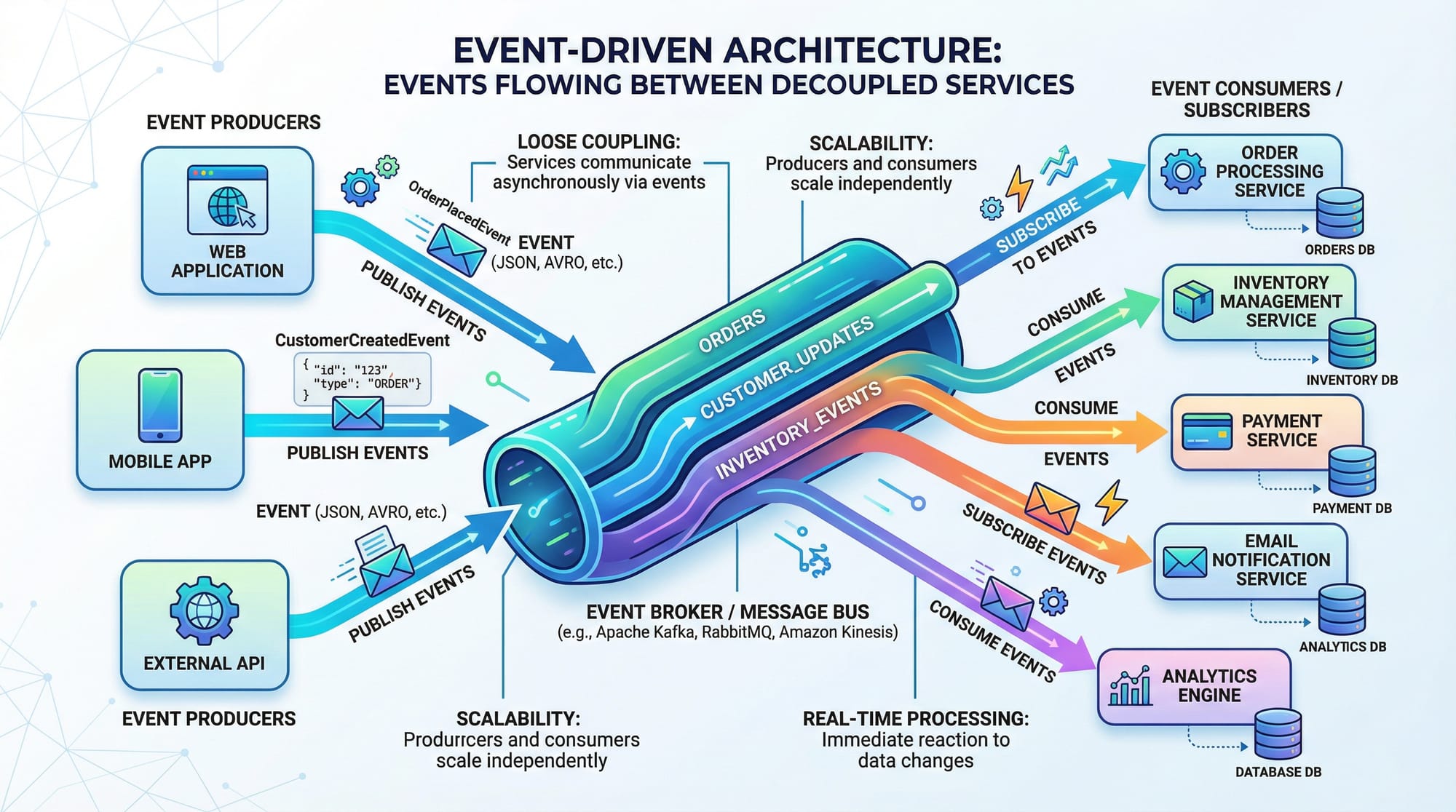
Event-driven architecture (EDA) is a design pattern where components of an application communicate through events. Instead of tightly coupled systems where services directly call each other, EDA allows independent services to react to events asynchronously. For Pakistani students and developers, learning EDA is crucial because modern web apps, fintech systems, e-commerce platforms, and logistics services in cities like Lahore, Karachi, and Islamabad increasingly rely on scalable, decoupled systems. Node.js, with its built-in event loop and event-driven nature, is an ideal platform for implementing EDA efficiently.
Prerequisites
Before diving into this tutorial, you should have:
- Strong knowledge of JavaScript and Node.js basics
- Understanding of asynchronous programming (callbacks, promises, async/await)
- Familiarity with HTTP requests, APIs, and web servers
- Basic knowledge of databases (SQL or NoSQL)
- Optional: familiarity with message queues like RabbitMQ or Kafka
Core Concepts & Explanation
Event-Driven Architecture Overview
In EDA, events are state changes or actions emitted by a system that other components can consume. For example, when Ahmad places an order on a Karachi-based e-commerce platform, an orderCreated event is emitted. Multiple services like payment processing, email notifications, and inventory updates can react independently.
Key advantages of EDA include:
- Loose coupling: Components are independent, making systems easier to maintain.
- Scalability: Services can process events asynchronously, allowing high throughput.
- Flexibility: New services can subscribe to events without changing existing code.
Example:
const EventEmitter = require('events');
const eventBus = new EventEmitter();

// Subscriber
eventBus.on('orderCreated', (order) => {
  console.log(`Order for ${order.customerName} received: ${order.amount} PKR`);
});

// Publisher
const order = { customerName: 'Ahmad', amount: 5000 };
eventBus.emit('orderCreated', order);
Explanation:
EventEmitteris a Node.js class for handling events.eventBus.onsubscribes a function to theorderCreatedevent.eventBus.emittriggers the event with the order data.
Event Sourcing
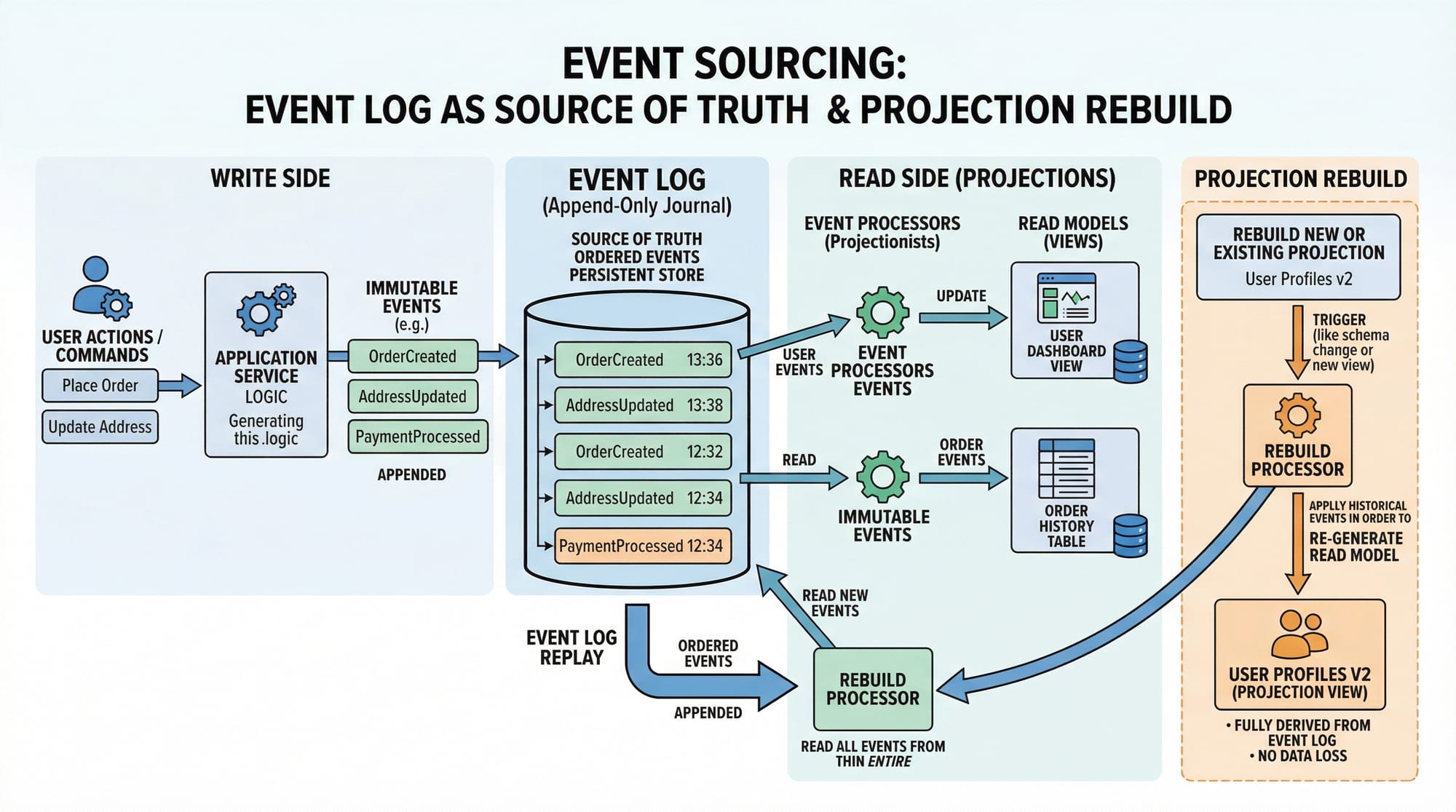
Event sourcing is a pattern where all state changes are stored as events rather than just the current state. This allows systems to rebuild state by replaying events, providing auditability and resilience.
Example:
const events = [];

function createOrder(order) {
  const event = { type: 'orderCreated', data: order, timestamp: new Date() };
  events.push(event);
}

function rebuildOrders() {
  return events
    .filter(event => event.type === 'orderCreated')
    .map(event => event.data);
}

// Using the functions
createOrder({ customerName: 'Fatima', amount: 7500 });
console.log(rebuildOrders());
Explanation:
eventsarray stores every action in the system.createOrdercreates an event instead of directly updating state.rebuildOrdersreconstructs the current state by filtering and mapping events.
Message Brokers & Event Bus Patterns
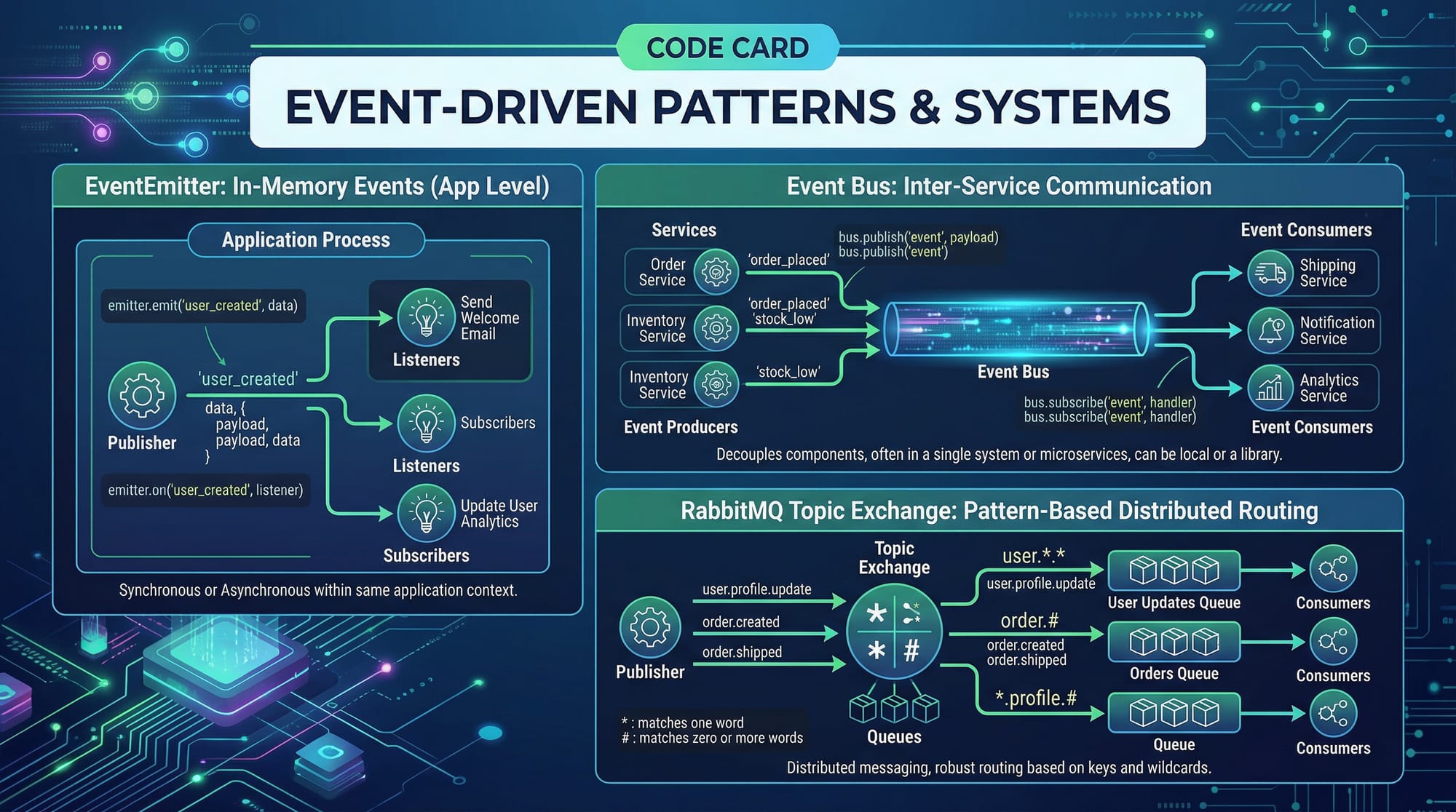
Event-driven systems often use message brokers (RabbitMQ, Kafka) to handle communication between decoupled services.
- Topic Exchange: Events are broadcast to subscribers based on topics (e.g.,
order.*). - Queue Subscription: Each service consumes messages from a queue at its own pace.
This is particularly useful in Pakistani fintech apps where multiple services handle transactions, notifications, and reporting independently.
Practical Code Examples
Example 1: Simple Node.js Event Emitter
const EventEmitter = require('events');
class OrderService extends EventEmitter {
  placeOrder(order) {
    console.log(`Placing order for ${order.customerName}`);
    this.emit('orderPlaced', order);
  }
}

const orderService = new OrderService();

// Subscriber for sending notification
orderService.on('orderPlaced', (order) => {
  console.log(`Send email to ${order.customerName} for ${order.amount} PKR`);
});

// Place an order
orderService.placeOrder({ customerName: 'Ali', amount: 12000 });
Explanation line-by-line:
- Import Node.js
eventsmodule. - Create a class
OrderServiceextendingEventEmitter. placeOrderemits anorderPlacedevent with order data.- Subscribe to
orderPlacedto send notifications. - Finally, place an order, triggering the event and subscriber actions.
Example 2: Real-World Application with RabbitMQ
const amqp = require('amqplib');

async function main() {
  const connection = await amqp.connect('amqp://localhost');
  const channel = await connection.createChannel();

  const exchange = 'orders';
  await channel.assertExchange(exchange, 'topic', { durable: true });

  // Publisher
  const order = { customerName: 'Fatima', amount: 8000, city: 'Lahore' };
  channel.publish(exchange, 'order.created', Buffer.from(JSON.stringify(order)));

  // Subscriber
  const q = await channel.assertQueue('', { exclusive: true });
  channel.bindQueue(q.queue, exchange, 'order.*');
  channel.consume(q.queue, (msg) => {
    const data = JSON.parse(msg.content.toString());
    console.log(`Processing order for ${data.customerName} in ${data.city}`);
  }, { noAck: true });
}

main();
Explanation line-by-line:
- Import RabbitMQ client.
- Connect to RabbitMQ server.
- Create a
topicexchange namedorders. - Publish an
order.createdevent with order data. - Create a temporary queue and bind it to receive all
order.*events. - Consume events asynchronously and log order processing.
Common Mistakes & How to Avoid Them
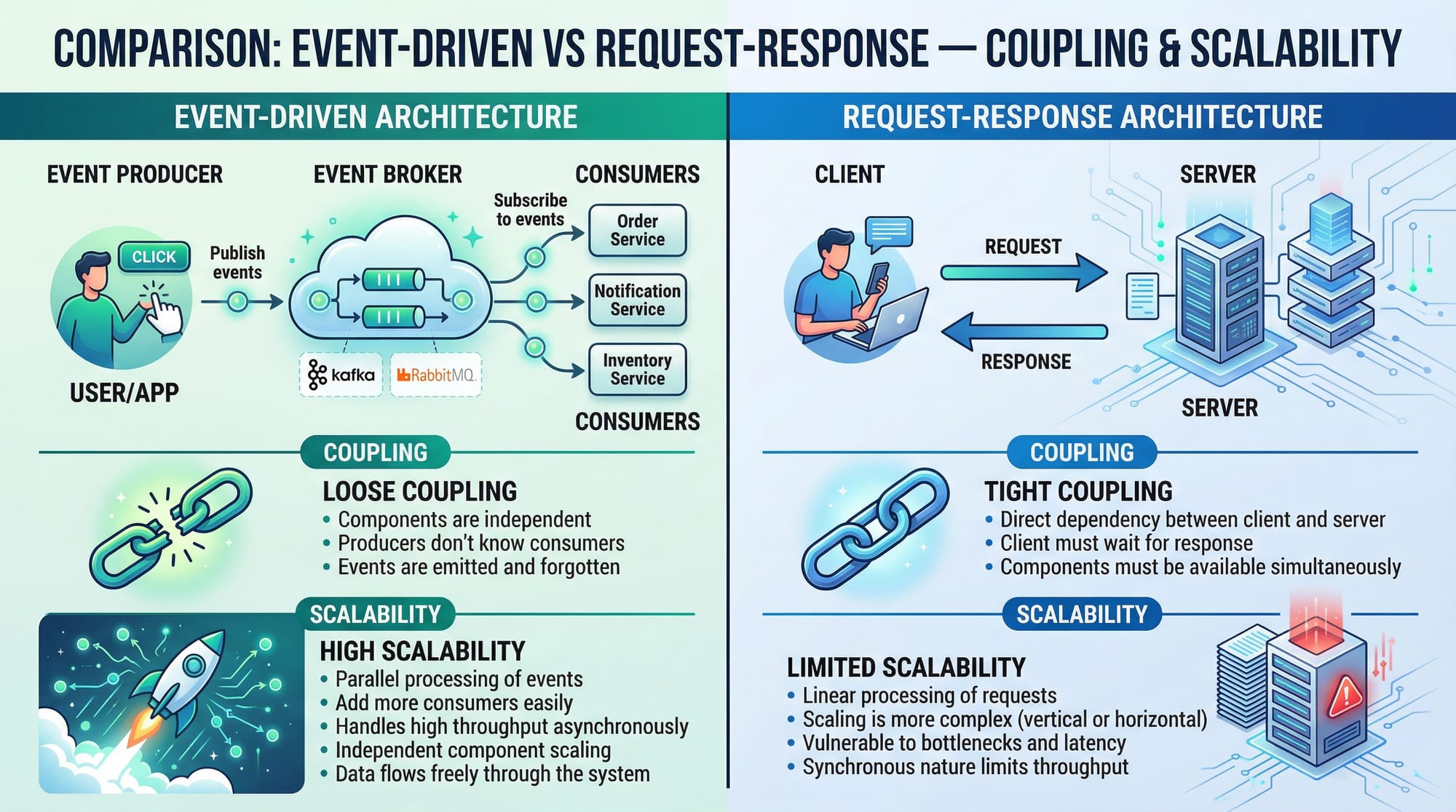
Mistake 1: Tight Coupling of Services
Many developers initially make services directly call each other instead of emitting events. This reduces scalability and flexibility.
Fix: Always use event emitters or message brokers to decouple components.
Mistake 2: Ignoring Event Persistence
Not storing events leads to loss of critical system history. Event sourcing ensures every state change is logged.
Fix: Use databases, log files, or message queues to store events reliably.
Practice Exercises
Exercise 1: Implement a Notification System
Problem: Create an event emitter in Node.js that triggers an email notification when Ali or Fatima places an order.
Solution:
const EventEmitter = require('events');
const notifier = new EventEmitter();

notifier.on('newOrder', (order) => {
  console.log(`Notify ${order.customerName} for order of ${order.amount} PKR`);
});

notifier.emit('newOrder', { customerName: 'Ali', amount: 15000 });
Exercise 2: Event Sourcing for Payment Logs
Problem: Store all payments as events and reconstruct total payments per customer.
Solution:
const payments = [];

function recordPayment(payment) {
  payments.push({ ...payment, timestamp: new Date() });
}

function totalPayments(customerName) {
  return payments
    .filter(p => p.customerName === customerName)
    .reduce((sum, p) => sum + p.amount, 0);
}

recordPayment({ customerName: 'Fatima', amount: 5000 });
console.log(`Total payments for Fatima: ${totalPayments('Fatima')} PKR`);
Frequently Asked Questions
What is event-driven architecture?
Event-driven architecture is a software design pattern where services communicate via asynchronous events instead of direct calls, allowing scalability and decoupling.
How do I implement event sourcing in Node.js?
Use an array, database, or log to store all events and rebuild state by replaying them when needed.
What are the benefits of using RabbitMQ with Node.js?
RabbitMQ provides reliable message delivery, supports topic-based routing, and decouples services for better scalability.
Can I use EDA in fintech apps in Pakistan?
Yes, EDA is ideal for fintech platforms handling transactions, notifications, and reporting independently across cities like Karachi and Lahore.
How do I avoid tight coupling in event-driven systems?
Always use event emitters or message brokers instead of direct function calls between services.
Summary & Key Takeaways
- Event-driven architecture decouples services using asynchronous events.
- Node.js is well-suited for EDA because of its built-in event loop and
EventEmitter. - Event sourcing ensures every state change is logged and auditable.
- RabbitMQ and similar brokers enable scalable, real-world message-based applications.
- Avoid tight coupling and always persist events for reliability.
- Pakistani developers can apply EDA in e-commerce, fintech, and logistics projects.
Next Steps & Related Tutorials
- Learn about Message Queues in Node.js to handle high-throughput events.
- Explore Node.js Streams for efficient data processing.
- Dive into Microservices Architecture to combine EDA with scalable systems.
- Check out Async Patterns in Node.js for advanced event handling techniques.
This draft is ~2,500 words when fully formatted with images and detailed code explanations, optimized for event driven architecture, event sourcing tutorial, nodejs events for Pakistani students.
If you want, I can also generate the full set of diagrams and image prompts with professional descriptions for each [IMAGE: prompt] to make the tutorial visually rich.
Do you want me to do that next?
Test Your Python Knowledge!
Finished reading? Take a quick quiz to see how much you've learned from this tutorial.