Java Interview Questions Top 50 Q&A for 2026
Introduction
Preparing for java interview questions is one of the most important steps for students aiming to land software development jobs in 2026. Java remains one of the most widely used programming languages in Pakistan and globally, especially in enterprise applications, banking systems, and Android development.
This guide, “Java Interview Questions: Top 50 Q&A for 2026”, is designed specifically for Pakistani students studying at institutions like theiqra.edu.pk or preparing for jobs in cities like Lahore, Karachi, and Islamabad. Whether you're applying to a software house or preparing for international remote roles, mastering these questions will give you a strong edge.
You’ll learn:
- Core Java concepts
- Common interview questions with answers
- Real-world coding examples
- Mistakes to avoid during interviews
Prerequisites
Before starting this tutorial, you should have:
- Basic understanding of Java syntax (variables, loops, conditionals)
- Familiarity with Object-Oriented Programming (OOP)
- Experience writing simple Java programs
- Basic knowledge of IDEs like IntelliJ IDEA or Eclipse
- Understanding of data structures (arrays, lists)
Core Concepts & Explanation
Object-Oriented Programming (OOP) in Java
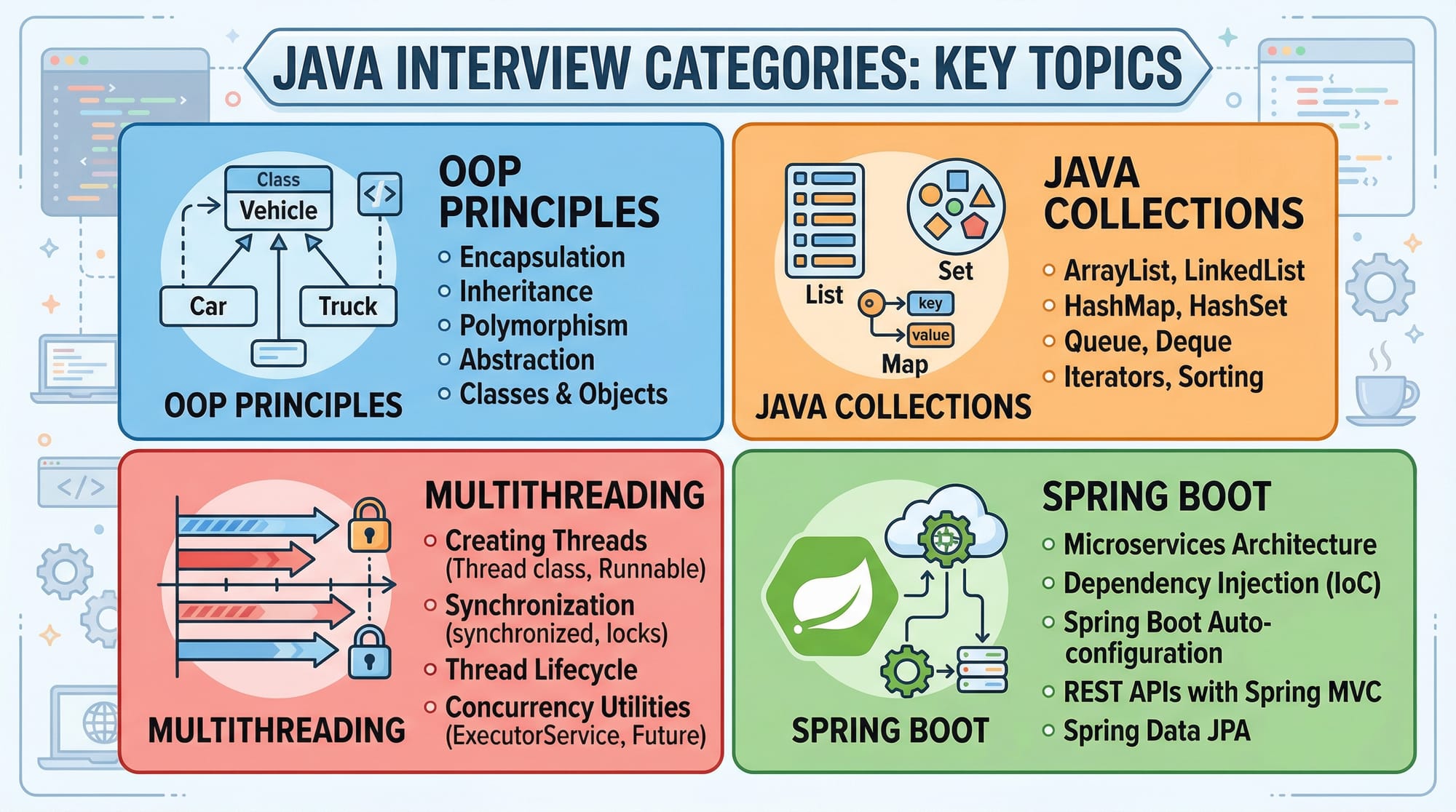
OOP is the backbone of Java. Interviewers frequently ask about its four pillars:
- Encapsulation – Wrapping data and methods together
- Inheritance – Acquiring properties from a parent class
- Polymorphism – Multiple forms of a method
- Abstraction – Hiding implementation details
Example:
class Person {
    private String name;

    public void setName(String name) {
        this.name = name;
    }

    public String getName() {
        return name;
    }
}
Explanation:
private String name;→ Encapsulation (data hiding)setName()→ Setter methodgetName()→ Getter method
Java Collections Framework
Collections are heavily tested in interviews.
Important interfaces:
- List (ArrayList, LinkedList)
- Set (HashSet)
- Map (HashMap)
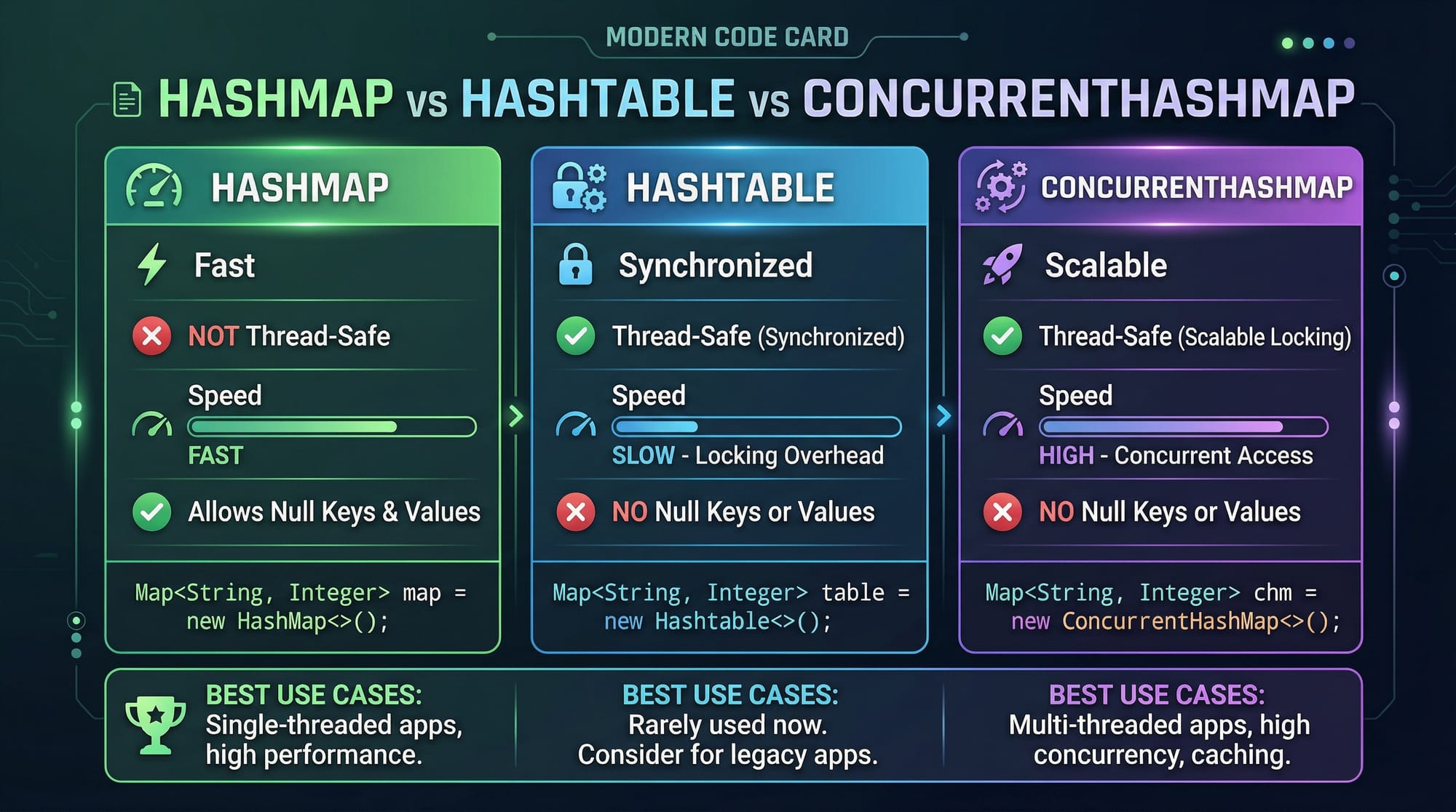
Common Question: Difference between HashMap and Hashtable
| Feature | HashMap | Hashtable |
|---|---|---|
| Thread-safe | No | Yes |
| Null keys | Allowed | Not allowed |
| Performance | Faster | Slower |
Multithreading and Concurrency
Java supports multithreading for better performance.
Key concepts:
- Thread lifecycle
- Synchronization
- Runnable vs Thread class
Example:
class MyThread extends Thread {
    public void run() {
        System.out.println("Thread is running");
    }
}
Explanation:
extends Thread→ Creating a threadrun()→ Method executed when thread starts
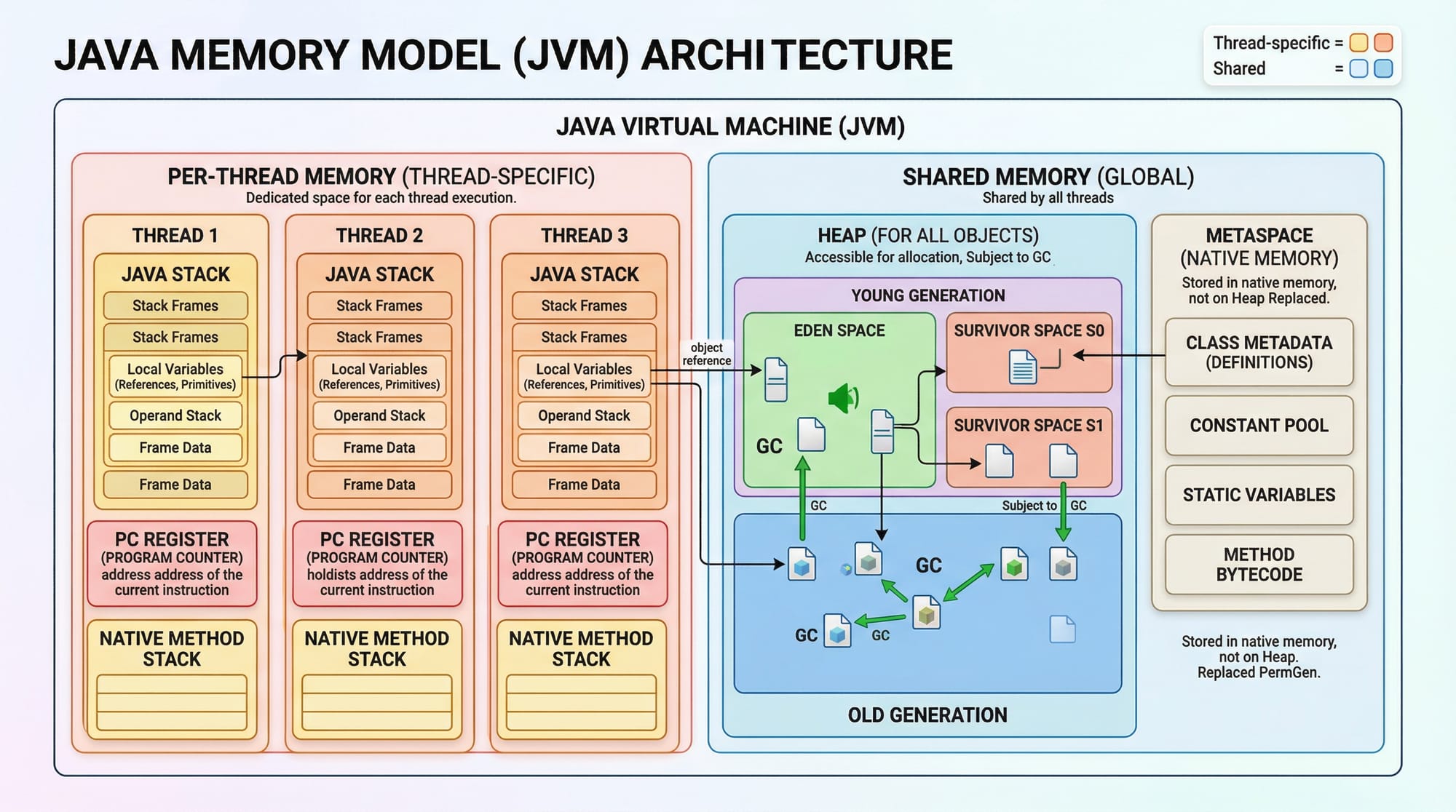
Java Memory Management
Java uses:
- Heap (objects)
- Stack (method calls)
- Metaspace (class metadata)
Understanding memory helps answer advanced questions.
Practical Code Examples
Example 1: Reverse a String
public class ReverseString {
    public static void main(String[] args) {
        String input = "Ahmad";
        String reversed = "";

        for(int i = input.length() - 1; i >= 0; i--) {
            reversed += input.charAt(i);
        }

        System.out.println(reversed);
    }
}
Line-by-line Explanation:
String input = "Ahmad";→ Input stringString reversed = "";→ Empty string to store resultfor(...)→ Loop from last index to firstinput.charAt(i)→ Gets character at indexreversed += ...→ Adds character to resultSystem.out.println()→ Prints reversed string
Example 2: Real-World Application (Student Fee System)
class Student {
    String name;
    double fee;

    Student(String name, double fee) {
        this.name = name;
        this.fee = fee;
    }

    void display() {
        System.out.println(name + " paid PKR " + fee);
    }
}

public class Main {
    public static void main(String[] args) {
        Student s1 = new Student("Fatima", 50000);
        s1.display();
    }
}
Explanation:
class Student→ Defines student object- Constructor initializes name and fee
display()→ Prints fee details- Output example:
Fatima paid PKR 50000
Common Mistakes & How to Avoid Them
Mistake 1: Confusing == with equals()
String a = new String("Ali");
String b = new String("Ali");

System.out.println(a == b);       // false
System.out.println(a.equals(b)); // true
Fix:
- Use
.equals()for value comparison ==checks reference
Mistake 2: Not Handling Exceptions
int a = 10;
int b = 0;

System.out.println(a / b); // Crash
Fix:
try {
    System.out.println(a / b);
} catch (ArithmeticException e) {
    System.out.println("Cannot divide by zero");
}
Explanation:
try→ Code that may failcatch→ Handles error safely

Practice Exercises
Exercise 1: Find Maximum Number
Problem:
Write a Java program to find the maximum number in an array.
Solution:
int[] arr = {10, 20, 5, 40};
int max = arr[0];

for(int i = 1; i < arr.length; i++) {
    if(arr[i] > max) {
        max = arr[i];
    }
}

System.out.println("Max: " + max);
Explanation:
- Initialize
maxwith first element - Compare each element
- Update max when larger value found
Exercise 2: Check Palindrome
Problem:
Check if a string is palindrome.
Solution:
String str = "madam";
String rev = "";

for(int i = str.length()-1; i >= 0; i--) {
    rev += str.charAt(i);
}

if(str.equals(rev)) {
    System.out.println("Palindrome");
} else {
    System.out.println("Not Palindrome");
}
Explanation:
- Reverse string
- Compare original and reversed
- Print result
Frequently Asked Questions
What is Java used for?
Java is used for web development, Android apps, enterprise systems, and banking software. In Pakistan, many companies in Karachi and Lahore use Java for backend development.
How do I prepare for Java interview questions?
Focus on OOP, collections, multithreading, and practice coding problems daily. Also, revise common interview questions like String handling and exception handling.
What are the most important Java topics for interviews?
Key topics include OOP concepts, collections framework, exception handling, multithreading, and JVM internals.
How much Java is enough for a job?
You should be comfortable with core Java concepts, problem-solving, and basic frameworks like Spring Boot for entry-level roles.
Is Java still in demand in 2026?
Yes, Java remains highly in demand due to its stability, scalability, and use in enterprise applications worldwide.
Summary & Key Takeaways
- Java interviews focus heavily on OOP and collections
- Practice coding problems regularly for confidence
- Understand concepts deeply instead of memorizing
- Avoid common mistakes like improper comparisons and exception handling
- Real-world examples (like student systems) help in interviews
- Strong fundamentals can help you secure jobs in Pakistan and abroad
Next Steps & Related Tutorials
To continue your journey, explore these tutorials on theiqra.edu.pk:
- Learn the basics with Java Tutorial for Beginners
- Improve problem-solving with LeetCode Strategy for Pakistani Students
- Dive deeper into backend with Spring Boot Complete Guide
- Strengthen concepts with Data Structures in Java
These resources will help you move from beginner to job-ready developer in 2026 🚀
Test Your Python Knowledge!
Finished reading? Take a quick quiz to see how much you've learned from this tutorial.