JavaScript Interview Questions Top 50 Q&A for 2026
Introduction
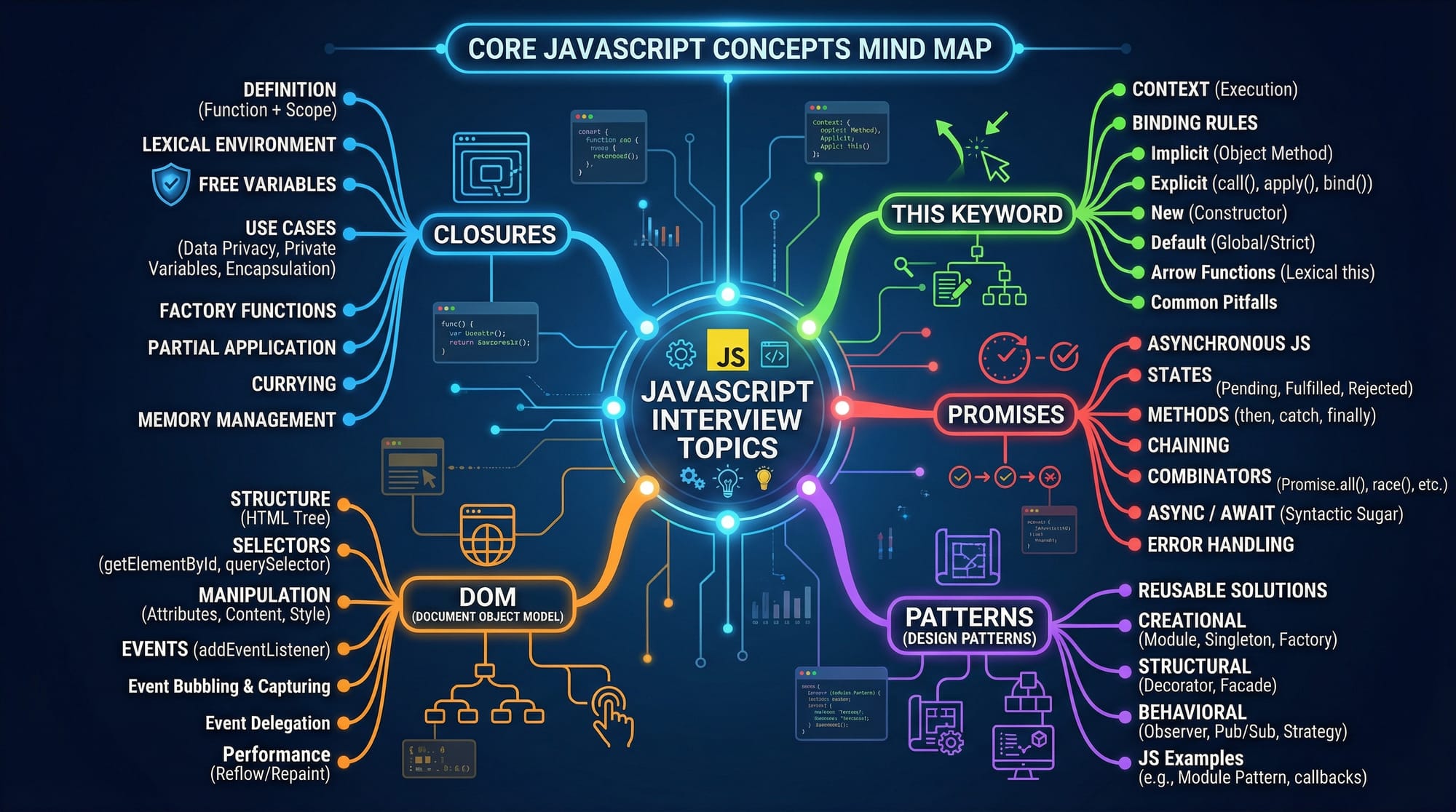
Preparing for javascript interview questions is one of the most important steps for Pakistani students aiming to land internships or software engineering roles in 2026. Whether you're applying in Lahore, Karachi, or Islamabad, companies increasingly expect strong JavaScript fundamentals along with modern concepts like async programming and design patterns.
This guide, “JavaScript Interview Questions: Top 50 Q&A for 2026”, is designed to help you master the most commonly asked questions in technical interviews. It covers core concepts, real-world coding examples, and practical explanations tailored for js interview prep 2026.
If you're a student like Ahmad preparing for a frontend role, or Fatima aiming for a full-stack position, this tutorial will give you the confidence to answer questions clearly and effectively.
Prerequisites
Before diving into this tutorial, you should have:
- Basic understanding of JavaScript syntax (variables, loops, functions)
- Familiarity with HTML and the DOM
- Knowledge of ES6 features (let/const, arrow functions, destructuring)
- Basic problem-solving skills
- A browser or Node.js environment for practice
Core Concepts & Explanation
JavaScript Closures Explained
A closure is one of the most commonly asked concepts in interviews.
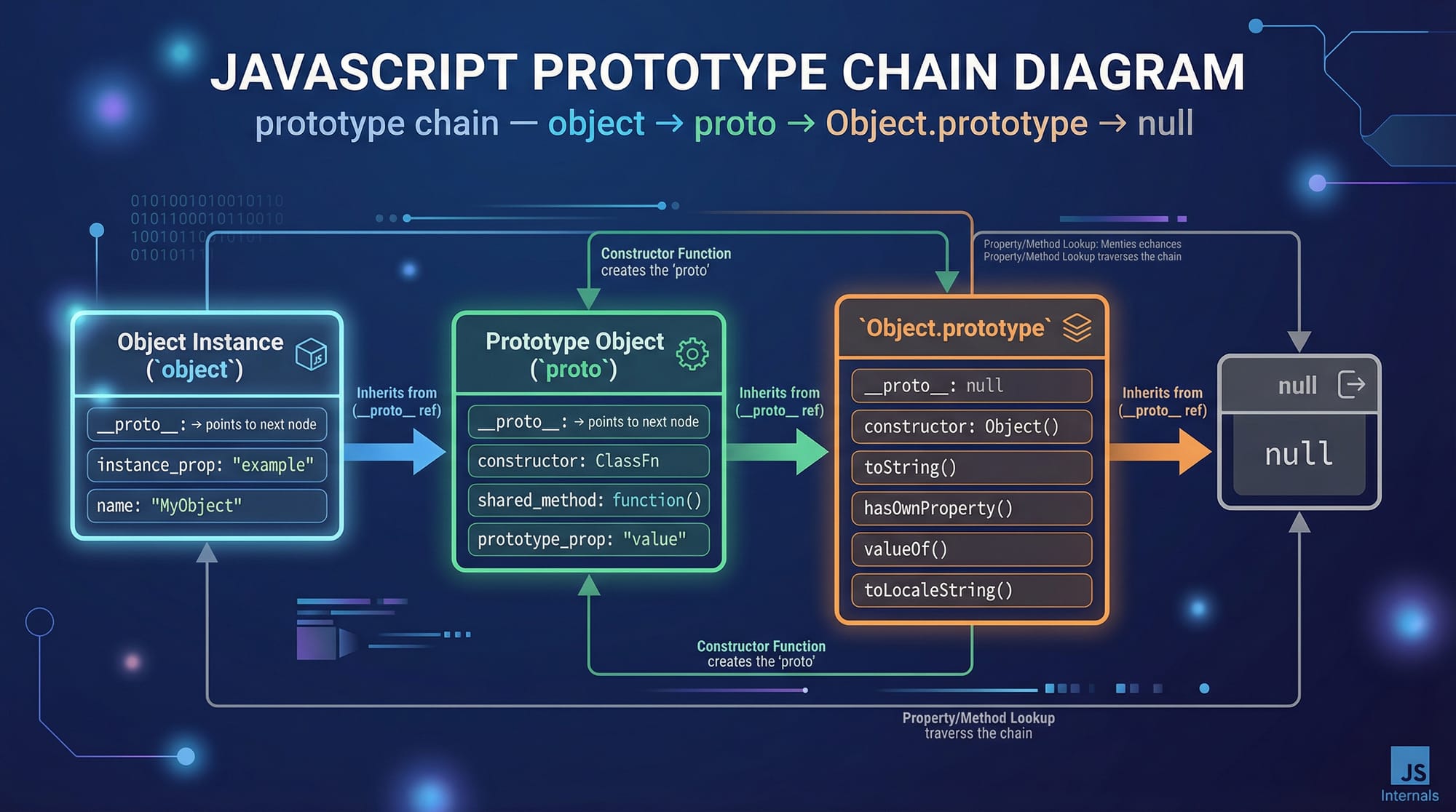
A closure happens when a function remembers variables from its outer scope even after the outer function has finished executing.
function createCounter() {
  let count = 0;

  return function() {
    count++;
    return count;
  };
}

const counter = createCounter();
console.log(counter()); // 1
console.log(counter()); // 2
Explanation:
createCounterdefines a variablecount- It returns an inner function
- That inner function "remembers"
count - Even after
createCounterhas finished execution
👉 Interview Tip: If you can explain closures clearly, you already stand out.
Understanding "this" Keyword
The this keyword refers to the object that is executing the current function.
const student = {
  name: "Ali",
  greet: function() {
    console.log(this.name);
  }
};

student.greet();
Explanation:
thisrefers to thestudentobject- So
this.namebecomes "Ali"
⚠️ Trick Question:
const greet = student.greet;
greet(); // undefined
Here, this is lost because the function is called independently.
Promises & Async/Await
Modern JavaScript relies heavily on asynchronous programming.
const fetchData = () => {
  return new Promise((resolve) => {
    setTimeout(() => {
      resolve("Data received");
    }, 2000);
  });
};

fetchData().then(data => console.log(data));
Explanation:
Promisehandles async operationsresolvereturns the result.then()handles the output
Using async/await:
async function getData() {
  const result = await fetchData();
  console.log(result);
}
👉 Cleaner and easier to read — interviewers prefer this.
Event Loop & Execution Context
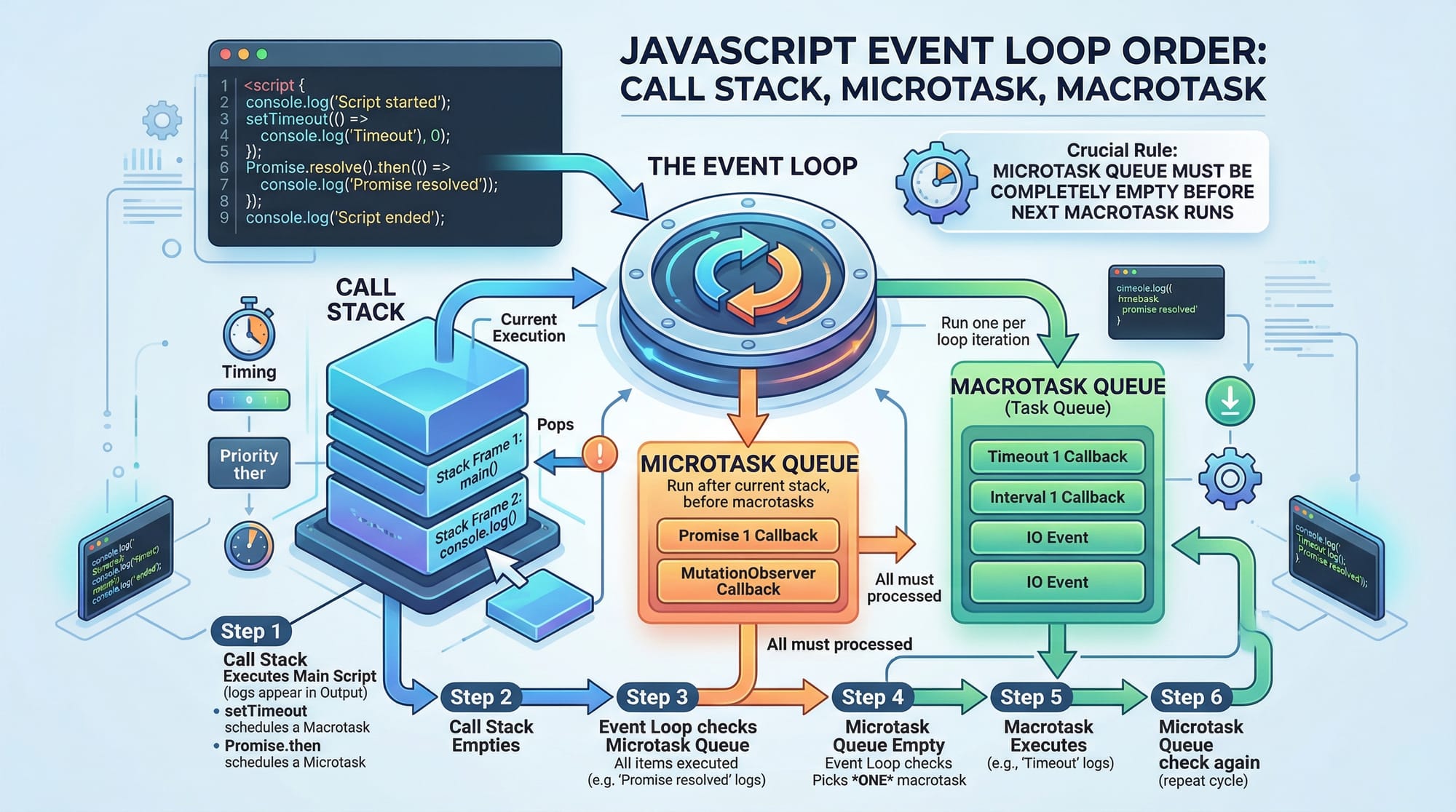
JavaScript is single-threaded but uses the event loop for async tasks.
Example:
console.log("Start");

setTimeout(() => {
  console.log("Timeout");
}, 0);

Promise.resolve().then(() => {
  console.log("Promise");
});

console.log("End");
Output:
Start
End
Promise
Timeout
Explanation:
- Call stack executes sync code first
- Microtasks (Promises) run before macrotasks (setTimeout)
Prototypes & Inheritance
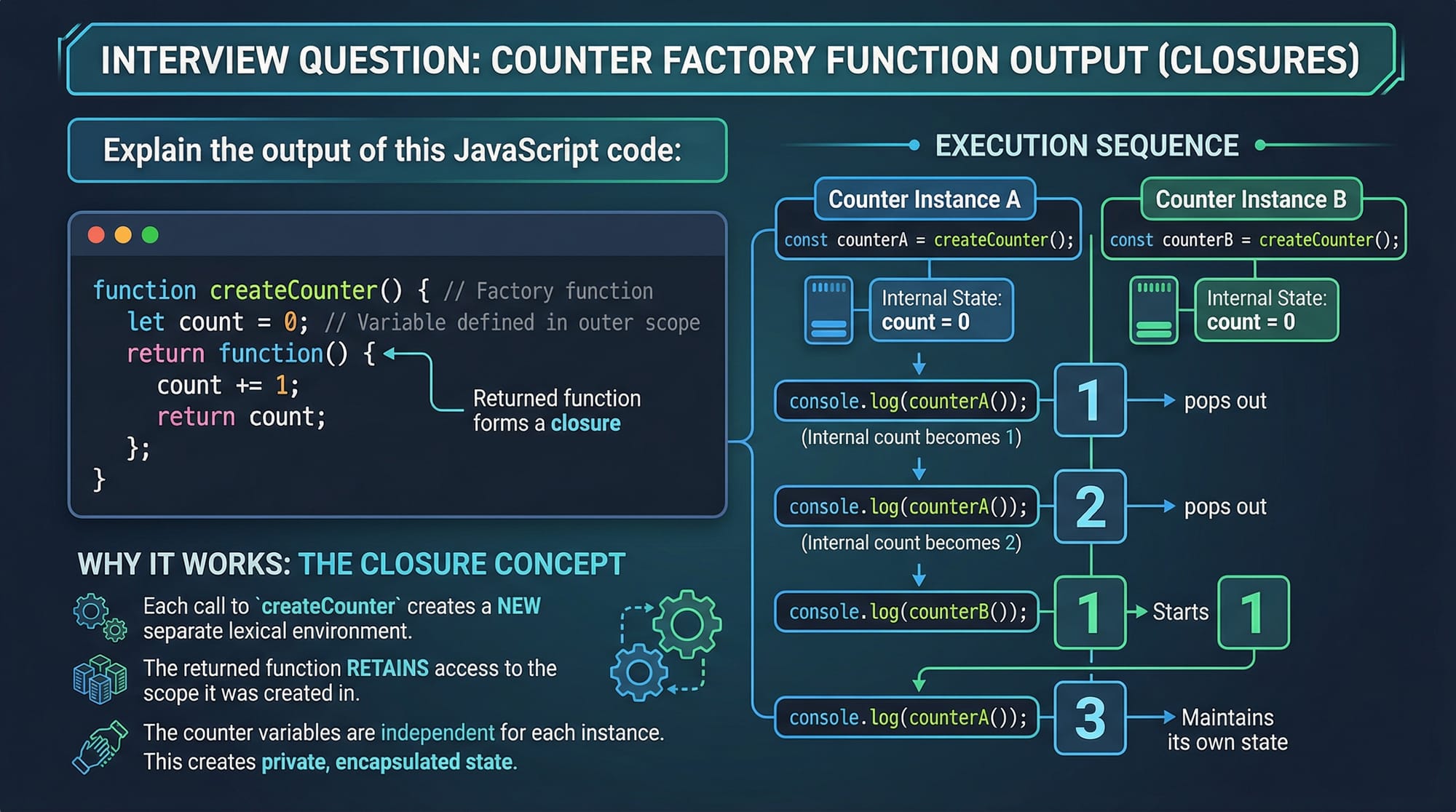
JavaScript uses prototype-based inheritance.
function Person(name) {
  this.name = name;
}

Person.prototype.sayHello = function() {
  return "Hello " + this.name;
};

const user = new Person("Ahmad");
console.log(user.sayHello());
Explanation:
- Functions have a
prototype - Objects inherit from it
- Efficient memory usage
Practical Code Examples
Example 1: Debouncing Input (Search Box)
Used in real-world apps like Daraz or Foodpanda.
function debounce(func, delay) {
  let timer;

  return function(...args) {
    clearTimeout(timer);

    timer = setTimeout(() => {
      func.apply(this, args);
    }, delay);
  };
}

const search = (query) => {
  console.log("Searching:", query);
};

const debouncedSearch = debounce(search, 300);
Explanation line-by-line:
debouncetakes a function and delaytimerstores timeout IDclearTimeoutcancels previous callsetTimeoutdelays execution- Only latest input is processed
Example 2: Real-World Application (Cart Total in PKR)
const cart = [
  { name: "Shoes", price: 3000 },
  { name: "Shirt", price: 1500 }
];

const total = cart.reduce((sum, item) => {
  return sum + item.price;
}, 0);

console.log("Total PKR:", total);
Explanation:
reduceloops through arraysumaccumulates values- Starts from 0
- Adds each
price
👉 Output: Total PKR: 4500
Common Mistakes & How to Avoid Them
Mistake 1: Confusing == and ===
console.log(5 == "5");  // true
console.log(5 === "5"); // false
Fix:
- Always use
===(strict equality) - Avoid type coercion bugs
Mistake 2: Not Understanding Hoisting
console.log(a);
var a = 10;
Explanation:
- JS hoists
var ato top - But not its value
Correct approach:
let a = 10;
console.log(a);
Practice Exercises
Exercise 1: Closure Counter
Problem:
Create a function that counts how many times it is called.
Solution:
function counter() {
  let count = 0;

  return function() {
    count++;
    return count;
  };
}

const c = counter();
console.log(c());
console.log(c());
Explanation:
- Inner function remembers
count - Each call increments value
Exercise 2: Filter Even Numbers
Problem:
Return only even numbers from an array.
Solution:
const numbers = [1, 2, 3, 4, 5, 6];

const evens = numbers.filter(num => num % 2 === 0);

console.log(evens);
Explanation:
filterchecks each element- Keeps only even numbers
Frequently Asked Questions
What is closure in JavaScript?
A closure is a function that retains access to variables from its outer scope even after the outer function has executed. It is widely used in callbacks and data privacy.
How do I prepare for JavaScript interviews in 2026?
Focus on core concepts like closures, promises, event loop, and practice coding problems daily. Build small projects to strengthen real-world understanding.
What is the difference between var, let, and const?
var is function-scoped, while let and const are block-scoped. const cannot be reassigned, making it safer for constants.
What are promises in JavaScript?
Promises are used to handle asynchronous operations. They have three states: pending, fulfilled, and rejected.
How does the event loop work?
The event loop manages execution of async code by processing tasks from queues (microtasks and macrotasks) after the call stack is empty.
Summary & Key Takeaways
- Closures and
thisare critical interview topics - Always understand async behavior (Promises & Event Loop)
- Practice real-world coding problems regularly
- Avoid common mistakes like
==vs=== - Learn prototypes and object inheritance deeply
- Use modern JavaScript (ES6+) features confidently
Next Steps & Related Tutorials
To continue your learning journey on theiqra.edu.pk, explore:
- JavaScript Tutorial for Beginners – Build strong fundamentals step-by-step
- Advanced JavaScript Concepts Guide – Master closures, prototypes, and async patterns
- LeetCode Strategy for Pakistani Students – Crack coding interviews with smart practice
- Frontend Developer Roadmap 2026 – Plan your career path effectively
👉 Consistent practice + concept clarity = interview success. Keep going!
Test Your Python Knowledge!
Finished reading? Take a quick quiz to see how much you've learned from this tutorial.