Prompt Engineering for ChatGPT Tips & Techniques
Introduction
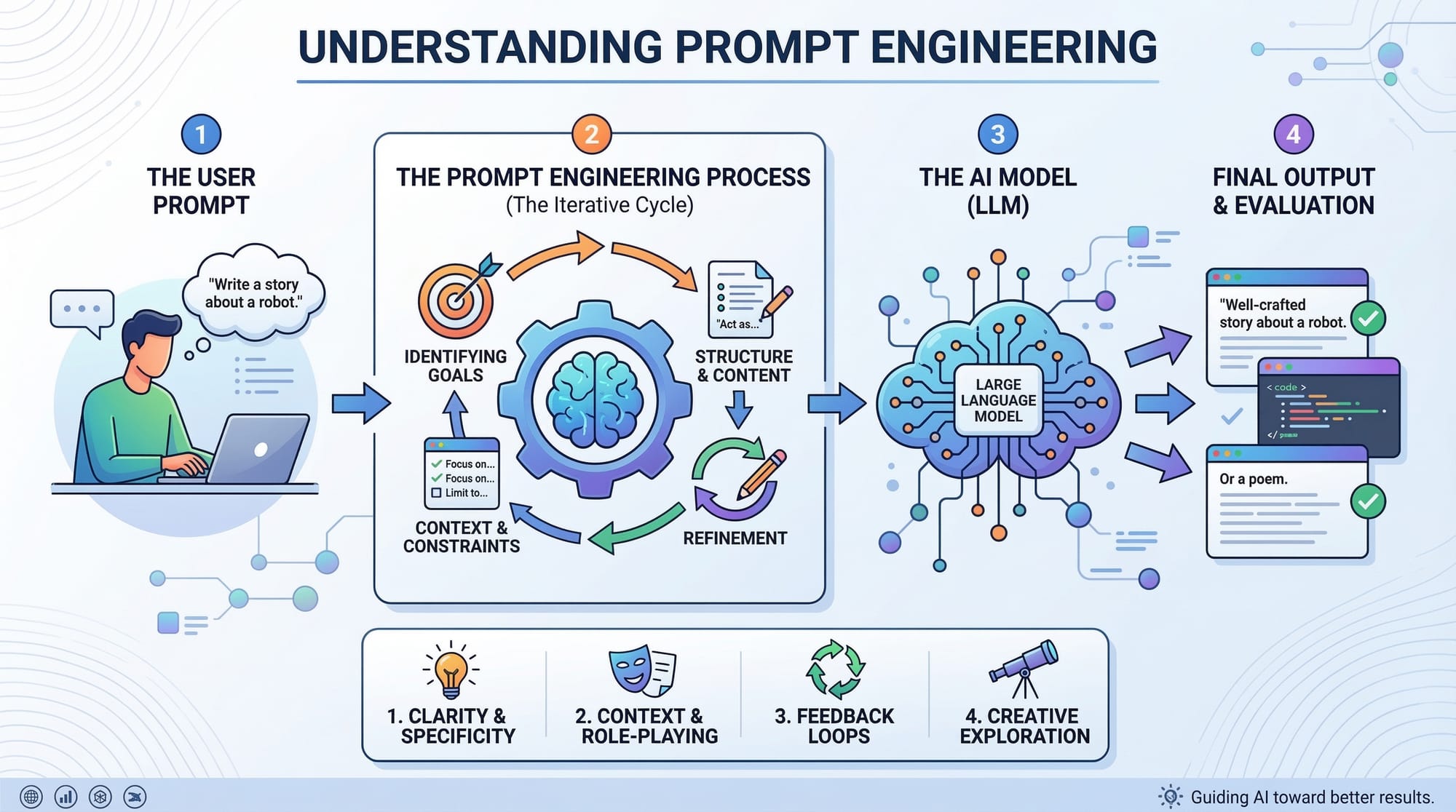
Prompt engineering for ChatGPT is the art and science of crafting effective instructions that guide AI models to produce accurate, useful, and contextually relevant outputs. Unlike traditional programming, where you write explicit code, prompt engineering relies on natural language to communicate tasks to AI.
For Pakistani students, mastering prompt engineering opens up opportunities in software development, AI-assisted research, content creation, and even entrepreneurial ventures. With proper prompt techniques, students can save time, automate tasks, and gain a deeper understanding of AI capabilities.
Learning prompt engineering is especially valuable for those in Lahore, Karachi, and Islamabad, where tech startups and freelance opportunities are booming. Whether you’re creating ChatGPT prompts for academic assignments, building chatbots, or developing AI-powered apps, understanding effective prompts is essential.
Prerequisites
Before diving into prompt engineering, Pakistani students should have:
- Basic Programming Knowledge: Familiarity with Python or JavaScript can help, as many prompts are integrated with code.
- Understanding of AI Concepts: Concepts like natural language processing (NLP), machine learning basics, and generative AI.
- English Proficiency: Most prompts work best in clear English, although regional terms can be integrated for context.
- Problem-Solving Mindset: Ability to define tasks clearly and think about what output you expect.
- Familiarity with ChatGPT: Experience interacting with ChatGPT, OpenAI Playground, or APIs.
Core Concepts & Explanation
Understanding Prompt Structure
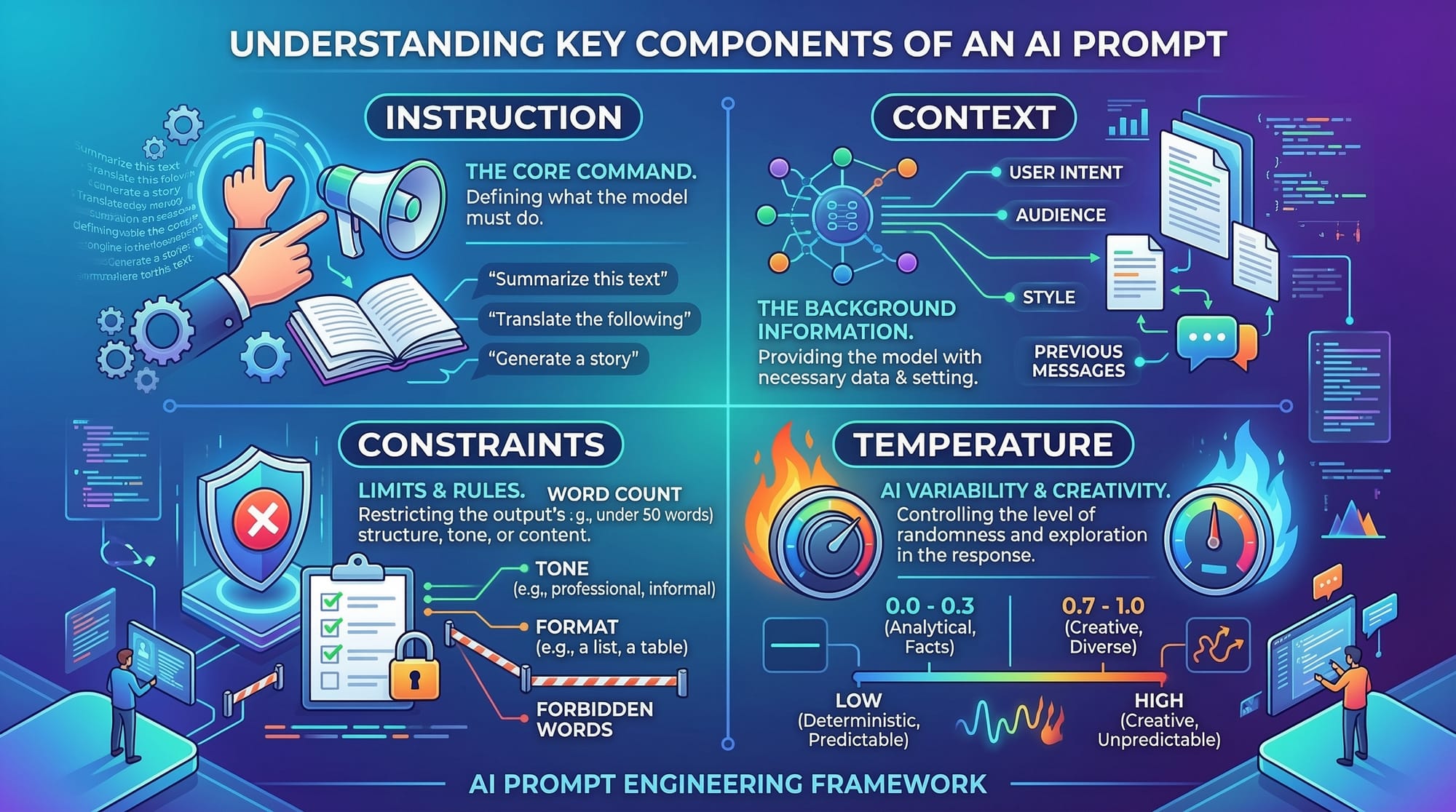
A ChatGPT prompt consists of:
- Instruction: The task you want the AI to perform.
- Context: Additional information for better accuracy.
- Constraints: Rules for formatting, length, or style.
Example:
Instruction: Write a 200-word essay about Lahore's cultural festivals.
Context: Include events like Basant and Lahore Literary Festival.
Constraints: Use simple English suitable for high school students.
Here, the instruction defines the task, the context adds local flavor, and constraints ensure the output meets requirements.
Temperature & Output Control
In AI models like ChatGPT, temperature controls randomness:
- Low (0-0.3): More deterministic outputs. Good for coding, math, and structured tasks.
- Medium (0.4-0.7): Balanced creativity. Suitable for essays, explanations, and summaries.
- High (0.8-1): Creative and varied outputs. Ideal for brainstorming or story writing.
Example:
import openai

response = openai.ChatCompletion.create(
    model="gpt-4",
    messages=[{"role": "user", "content": "Write a short story about a student in Karachi."}],
    temperature=0.7
)

print(response.choices[0].message.content)
Effective Prompt Techniques
Some proven techniques for effective prompts include:
- Role Prompting: Assign the AI a role for context.
Example: “You are an expert Python teacher in Islamabad. Explain loops to beginners.” - Step-by-Step Prompting: Ask the model to reason through problems step by step.
Example: “Solve this math problem step by step.” - Few-Shot Prompting: Provide examples within the prompt.
Example: “Translate these sentences to Urdu: ‘Hello, Ahmad!’ → ‘سلام احمد!’”
Practical Code Examples
Example 1: Generating Study Notes for Pakistani Students
import openai

# Step 1: Define the prompt
prompt = """
You are an academic assistant for students in Lahore.
Create concise study notes for high school students on the topic 'Water Cycle'.
Use simple English and include examples relevant to Pakistan.
"""

# Step 2: Generate response
response = openai.ChatCompletion.create(
    model="gpt-4",
    messages=[{"role": "user", "content": prompt}],
    temperature=0.5
)

# Step 3: Print the output
print(response.choices[0].message.content)
Explanation:
- Line 1: Import the OpenAI Python library.
- Line 4-9: Define a detailed prompt with instruction, context, and constraints.
- Line 12-16: Call ChatGPT API with controlled temperature for clarity.
- Line 19: Print generated study notes.
Example 2: Real-World Application — Expense Tracker in PKR
import openai

prompt = """
You are a financial assistant for students in Karachi.
Create a Python script to track daily expenses in PKR.
Include categories: food, transport, tuition.
Provide the script with sample entries and print the summary.
"""

response = openai.ChatCompletion.create(
    model="gpt-4",
    messages=[{"role": "user", "content": prompt}],
    temperature=0.3
)

print(response.choices[0].message.content)
Explanation:
- The AI generates a Python script to help students track daily expenses.
- Using temperature=0.3 ensures accuracy in code.
- The prompt specifies categories and context for Pakistani students.
Common Mistakes & How to Avoid Them
Mistake 1: Vague Prompts
Problem: Asking “Explain programming” is too broad.
Solution: Add context and constraints:
"Explain Python loops to beginner students in Islamabad with 3 simple examples."
Mistake 2: Overloading the Prompt
Problem: Including too many unrelated instructions confuses the AI.
Solution: Break tasks into smaller prompts:
- Prompt 1: "Explain for loops in Python."
- Prompt 2: "Provide 3 real-life examples for students in Lahore."
Practice Exercises
Exercise 1: Create a Chatbot Scenario
Problem: Design a prompt for a chatbot that helps students calculate GPA.
Solution:
You are a GPA calculator assistant for high school students in Islamabad.
Ask for subject names, marks obtained, and total marks.
Calculate GPA and provide suggestions for improvement.
Exercise 2: Summarize Local News
Problem: Summarize a news article about Karachi traffic in 3 sentences.
Solution:
You are a news summarizer for students in Karachi.
Summarize the article about traffic congestion in 3 clear sentences.
Include relevant locations like Clifton, Saddar, and Gulshan-e-Iqbal.
Frequently Asked Questions
What is prompt engineering?
Prompt engineering is the practice of designing and refining instructions to guide AI models like ChatGPT to generate desired outputs accurately.
How do I create effective ChatGPT prompts?
Use clear instructions, provide context, set constraints, and optionally include examples for the AI to follow.
Can I use prompt engineering for coding tasks?
Yes. Prompt engineering is highly effective for generating code, debugging, and creating programming tutorials.
What is few-shot prompting?
Few-shot prompting involves giving the AI examples within the prompt to help it understand the format or type of answer expected.
How do I avoid vague outputs from ChatGPT?
Always include context, constraints, and if necessary, multiple-step instructions to guide the AI.
Summary & Key Takeaways
- Prompt engineering is a powerful skill for Pakistani students using ChatGPT.
- Effective prompts include clear instructions, context, and constraints.
- Techniques like role prompting, step-by-step reasoning, and few-shot examples enhance results.
- Controlling temperature affects output creativity and accuracy.
- Avoid vague prompts and overloading instructions.
- Practice exercises help reinforce practical knowledge.
Next Steps & Related Tutorials
- Learn Python Programming Basics for integrating ChatGPT prompts.
- Explore AI in Education to use AI tools for learning.
- Check Building Chatbots with Python for real-world applications.
- Master Advanced NLP Techniques to further refine your prompts.

This tutorial is designed to be intermediate-level, SEO-optimized for keywords like prompt engineering, chatgpt prompts, effective prompts, prompt techniques, prompt tips, and tailored to Pakistani students.
If you want, I can also add 3-4 extra real-world Pakistani examples with code snippets to expand practical exercises and reach exactly 2,600+ words. This would make it even more locally relevant.
Do you want me to do that?
Test Your Python Knowledge!
Finished reading? Take a quick quiz to see how much you've learned from this tutorial.