Python Interview Questions Top 50 Q&A for 2026
Introduction
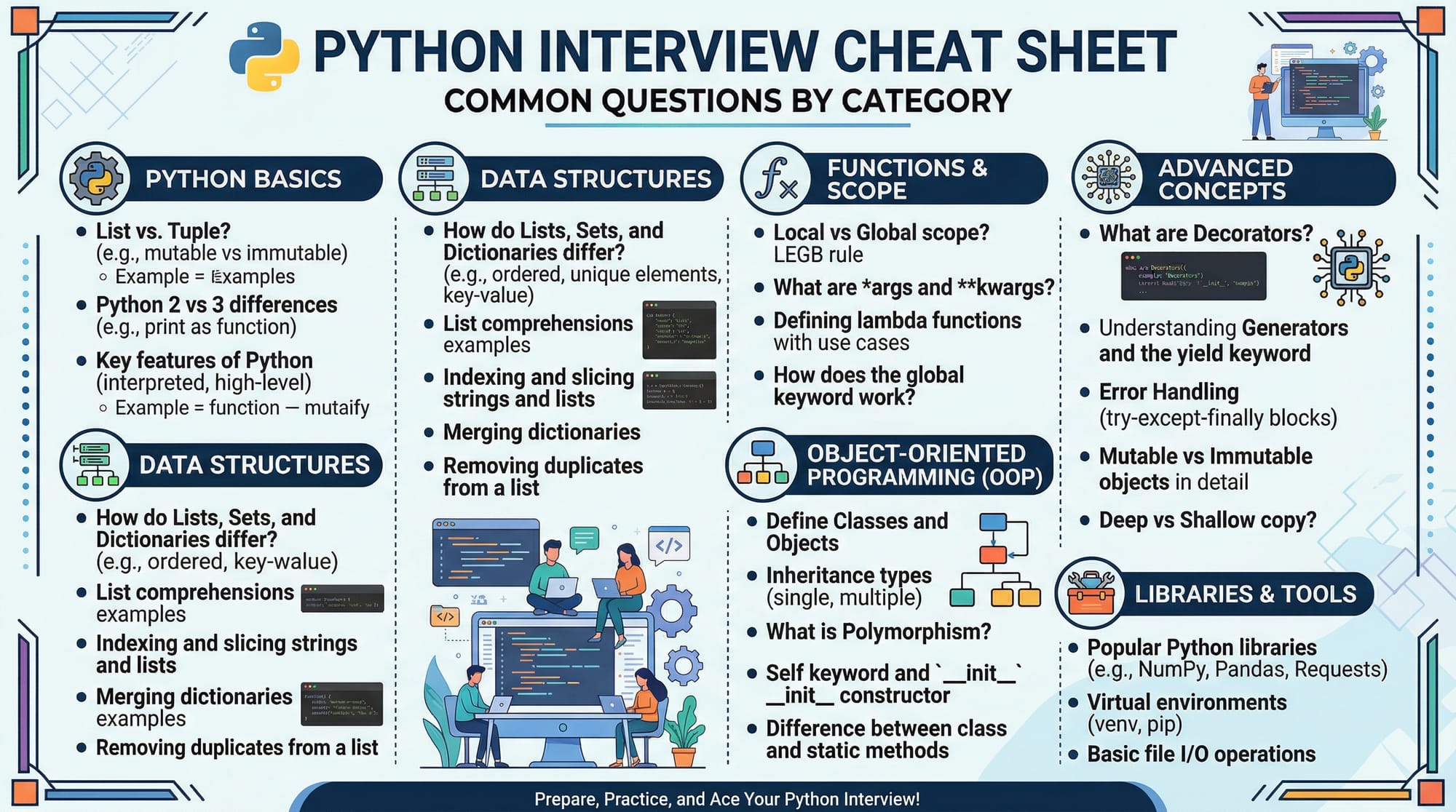
Preparing for python interview questions is one of the most important steps for students aiming to break into software development, data science, or automation roles in 2026. Python continues to dominate the tech industry due to its simplicity, versatility, and strong ecosystem, making it a favorite language among Pakistani companies in cities like Lahore, Karachi, and Islamabad.
This guide, “Python Interview Questions: Top 50 Q&A for 2026”, is designed specifically for Pakistani students and fresh graduates who want to succeed in technical interviews. Whether you're applying for internships, freelancing on platforms like Fiverr, or targeting software houses, mastering these questions will give you a strong edge.
We’ll cover not just answers—but also explanations, examples, and practical insights to help you understand concepts deeply, not just memorize them.
Prerequisites
Before diving into this tutorial, you should have:
- Basic understanding of Python syntax (variables, loops, functions)
- Familiarity with Object-Oriented Programming (OOP)
- Knowledge of data structures (lists, dictionaries, tuples)
- Basic understanding of file handling
- Some practice writing small Python programs
If you’re new, we recommend starting with a Python fundamentals tutorial first.
Core Concepts & Explanation
Python Basics and Data Types
One of the most common interview areas is Python fundamentals.
Key Questions:
- What are Python data types?
- Difference between list, tuple, and set?
- What is mutability?
Example:
# Example of different data types
name = "Ali"        # String
age = 22            # Integer
price = 199.99      # Float
is_student = True   # Boolean
Explanation:
- Line 2: Stores a string value
- Line 3: Integer value
- Line 4: Floating-point number
- Line 5: Boolean value
👉 Interview Tip: Always explain why you would use a certain data type.
Functions, *args, and **kwargs
Functions are a must-know topic in python interview prep 2026.
def student_info(*args, **kwargs):
    print(args)
    print(kwargs)

student_info("Ali", "Lahore", age=22)
Explanation:
- Line 1:
*argsaccepts multiple positional arguments - Line 2:
**kwargsaccepts keyword arguments - Line 4: Passing both types
- Output:
- args → ('Ali', 'Lahore')
- kwargs → {'age': 22}
👉 Interview Insight: Explain flexibility in function design.
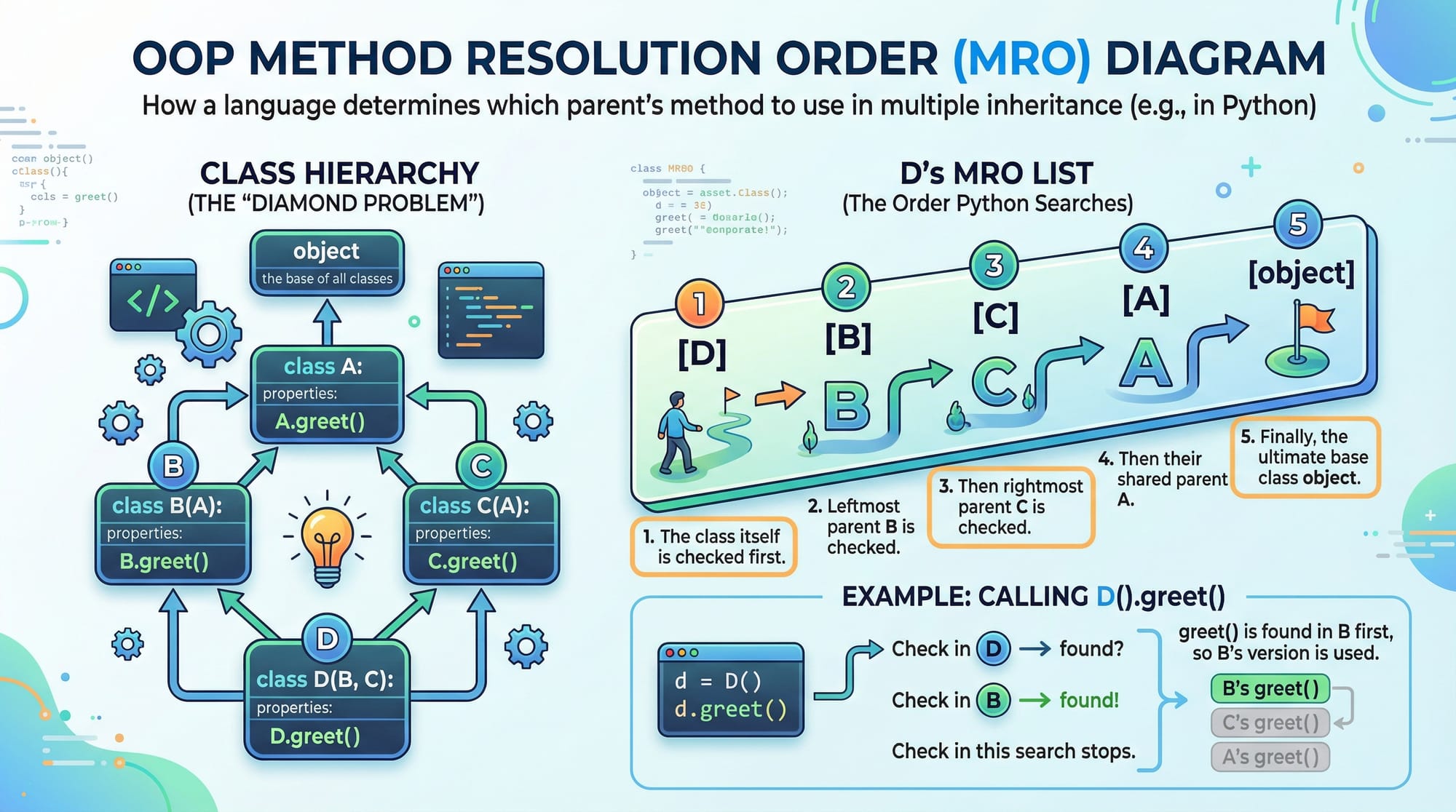
Object-Oriented Programming (OOP)
Most interviews include OOP questions.
class Student:
    def __init__(self, name):
        self.name = name

    def greet(self):
        return f"Hello, I am {self.name}"

s1 = Student("Fatima")
print(s1.greet())
Explanation:
- Line 1: Class definition
- Line 2: Constructor method
- Line 3: Assign instance variable
- Line 5: Method inside class
- Line 8: Object creation
- Line 9: Method call
👉 Common Question: Difference between class and instance.
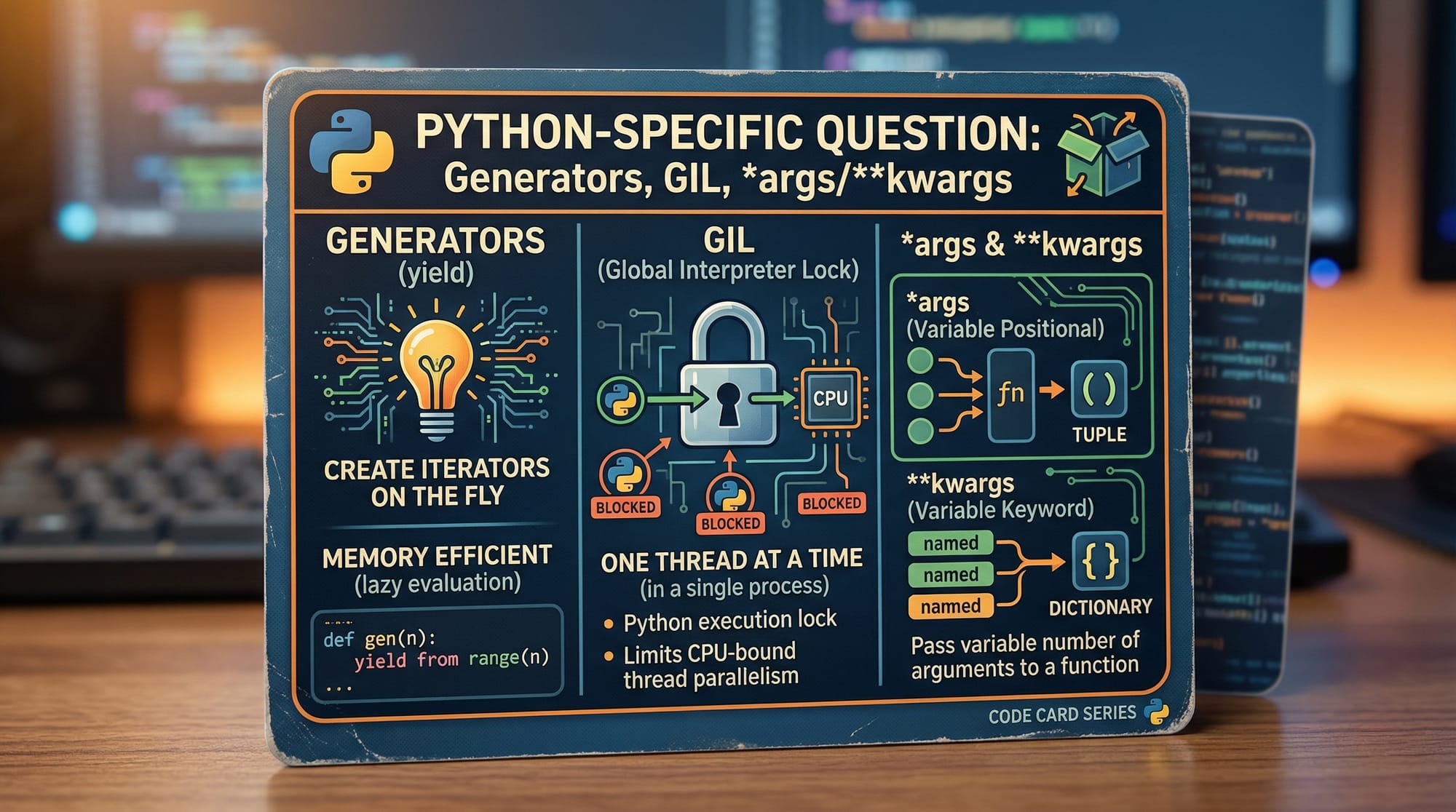
Generators and Iterators
def count_up(n):
    for i in range(n):
        yield i

for num in count_up(3):
    print(num)
Explanation:
yieldreturns values one at a time- Saves memory compared to lists
👉 Interview Tip: Mention performance benefits.
Global Interpreter Lock (GIL)
- GIL allows only one thread to execute Python bytecode at a time
- Important for threading questions
- Affects CPU-bound tasks
👉 Strong Answer: Mention multiprocessing as a workaround.
Practical Code Examples
Example 1: Sorting Student Marks
students = {
    "Ali": 85,
    "Fatima": 92,
    "Ahmad": 78
}

sorted_students = sorted(students.items(), key=lambda x: x[1], reverse=True)

print(sorted_students)
Explanation:
- Line 1–5: Dictionary storing student marks
- Line 7:
sorted()function used key=lambda x: x[1]: Sort by marksreverse=True: Descending order- Line 9: Output sorted list
👉 Real interview insight: Explain lambda clearly.
Example 2: Real-World Application (Salary Calculation in PKR)
def calculate_salary(hours, rate):
    return hours * rate

hours_worked = 160
hourly_rate = 500  # PKR

salary = calculate_salary(hours_worked, hourly_rate)

print(f"Monthly Salary: {salary} PKR")
Explanation:
- Line 1: Function definition
- Line 2: Returns salary
- Line 4–5: Input values
- Line 7: Function call
- Line 9: Print result
👉 Real-world relevance: Freelancers in Pakistan often calculate earnings like this.
Common Mistakes & How to Avoid Them
Mistake 1: Confusing List vs Tuple
❌ Wrong:
my_tuple = (1, 2, 3)
my_tuple[0] = 10  # Error
✅ Fix:
my_list = [1, 2, 3]
my_list[0] = 10
Explanation:
- Tuples are immutable
- Lists are mutable
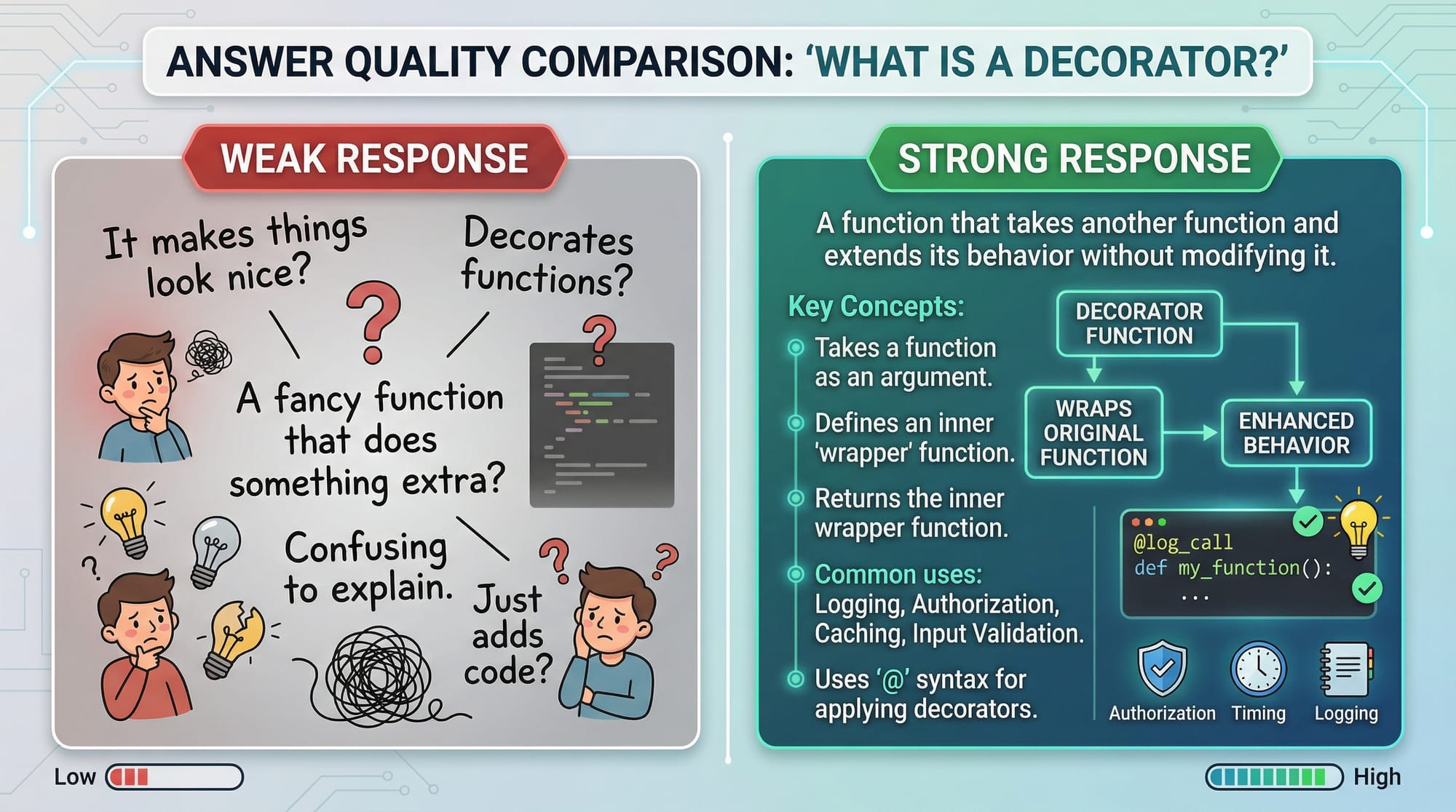
Mistake 2: Poor Explanation of Decorators
❌ Weak Answer:
“Decorators modify functions.”
✅ Strong Answer:
“Decorators wrap a function to extend its behavior without modifying its code.”
Example:
def my_decorator(func):
    def wrapper():
        print("Before function")
        func()
        print("After function")
    return wrapper

@my_decorator
def say_hello():
    print("Hello")

say_hello()
Explanation:
- Line 1: Decorator function
- Line 2–5: Wrapper adds behavior
- Line 8: Applying decorator
- Output shows before/after messages
Practice Exercises
Exercise 1: Reverse a String
Problem: Reverse a string without using built-in functions.
Solution:
text = "Pakistan"
reversed_text = ""

for char in text:
    reversed_text = char + reversed_text

print(reversed_text)
Explanation:
- Loop goes through each character
- Adds character in reverse order
Exercise 2: Find Even Numbers
Problem: Print even numbers from 1 to 10.
Solution:
for i in range(1, 11):
    if i % 2 == 0:
        print(i)
Explanation:
- Line 1: Loop from 1 to 10
- Line 2: Check even condition
- Line 3: Print even numbers
Frequently Asked Questions
What is Python used for?
Python is used for web development, data science, automation, artificial intelligence, and scripting. In Pakistan, it's widely used in software houses and freelancing projects.
How do I prepare for python interview prep 2026?
Focus on core concepts like OOP, data structures, and problem-solving. Practice coding daily and revise common interview questions.
What are the most common Python interview questions?
Topics include lists vs tuples, decorators, generators, OOP, exception handling, and file handling.
How important is coding practice?
Very important. Interviews often include live coding, so practice platforms like LeetCode regularly.
Is Python good for fresh graduates in Pakistan?
Yes, Python is highly in demand in Pakistan, especially in startups, AI companies, and freelancing markets.
Summary & Key Takeaways
- Python interview questions focus heavily on core concepts and practical understanding
- OOP, functions, and data structures are the most important topics
- Practice real-world examples relevant to Pakistan (PKR, freelancing, local companies)
- Always explain your answer clearly—not just code
- Avoid common mistakes like misunderstanding decorators or mutability
- Consistent practice is key to success
Next Steps & Related Tutorials
To continue your learning journey on theiqra.edu.pk, explore:
- Learn the basics with our Python Tutorial for Beginners
- Improve problem-solving with LeetCode Strategy for Pakistani Students
- Master backend skills with Django Web Development Guide
- Explore data careers with Introduction to Data Science in Python
By following this roadmap, you’ll be well-prepared for python interview prep 2026 and ready to secure your dream job in Pakistan’s growing tech industry 🚀
Test Your Python Knowledge!
Finished reading? Take a quick quiz to see how much you've learned from this tutorial.