Python Protocol & Structural Subtyping Guide
Introduction
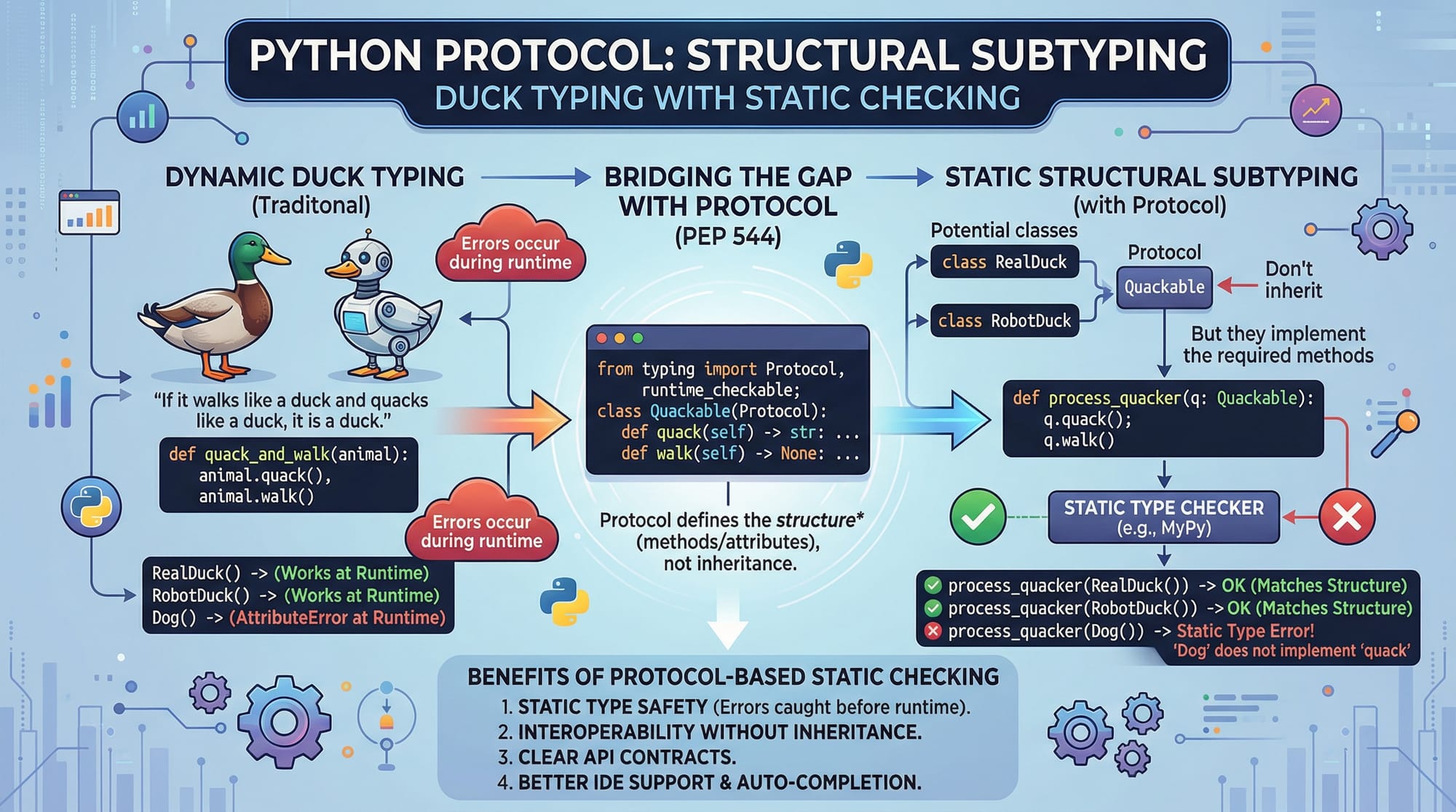
Python Protocols and structural subtyping are advanced typing features introduced in Python to combine the flexibility of duck typing with the safety of static type checking. Unlike traditional class inheritance, structural subtyping allows you to define interfaces that an object can satisfy implicitly, based on its attributes and methods, rather than explicit subclassing.
For Pakistani students, mastering Python protocols is essential for writing scalable, maintainable, and type-safe applications. Imagine a financial application in Lahore where multiple classes handle different payment methods (bank transfer, JazzCash, Easypaisa). Instead of rigid inheritance, protocols allow you to define a “PaymentProcessor” interface, and any class implementing required methods can be treated as a valid processor — without worrying about the inheritance chain.
This tutorial will guide you through Python typing protocol and structural subtyping Python, with practical examples, common pitfalls, and exercises.
Prerequisites
Before diving into Python Protocols, readers should have:
- Solid understanding of Python classes and OOP concepts.
- Familiarity with Python typing module and type hints.
- Basic knowledge of abstract base classes (ABC).
- Python 3.8+ installed (for
typing.Protocoland@runtime_checkablesupport). - Experience writing small projects in Python (e.g., student management system, payment processors, or basic web apps in Karachi or Islamabad).
Core Concepts & Explanation
Understanding Python Protocols
A Python Protocol is a type hinting mechanism that defines an interface. Any object with matching methods and properties automatically satisfies the protocol. This concept is sometimes referred to as “structural subtyping.”
from typing import Protocol

class Drawable(Protocol):
    def draw(self) -> None:
        ...
- Line 1: Import
Protocolfrom the typing module. - Line 3: Define a protocol named
Drawable. - Line 4: Any object with a
drawmethod returningNonesatisfies this protocol.
Structural Subtyping vs Nominal Typing
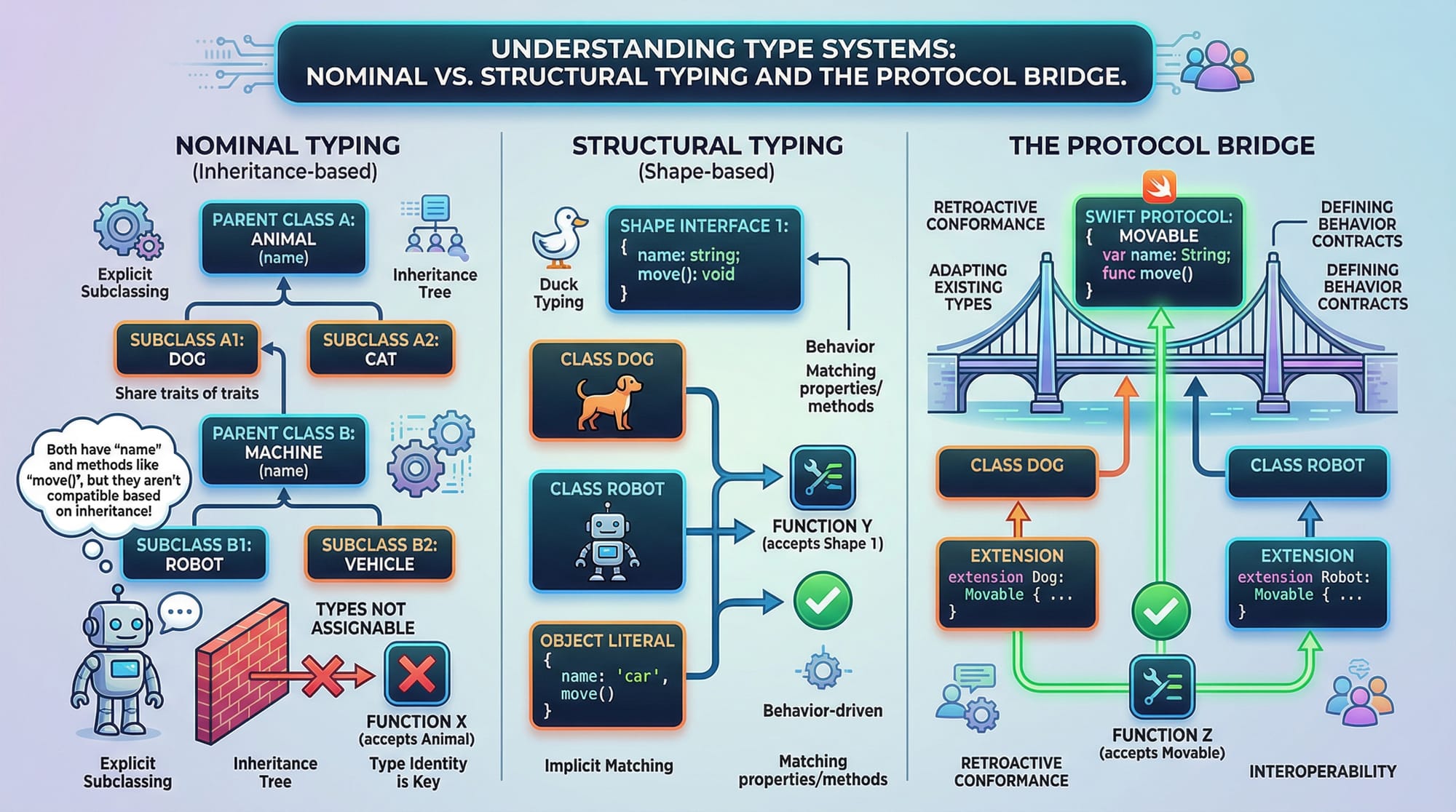
- Nominal typing: Types are matched by explicit inheritance.
- Structural subtyping: Types are matched by presence of attributes/methods.
class Circle:
    def draw(self) -> None:
        print("Drawing a circle")

def render(shape: Drawable) -> None:
    shape.draw()

c = Circle()
render(c)  # ✅ Works, Circle matches Drawable by structure
Here, Circle has no explicit inheritance from Drawable, but it matches structurally.
Runtime Checkable Protocols
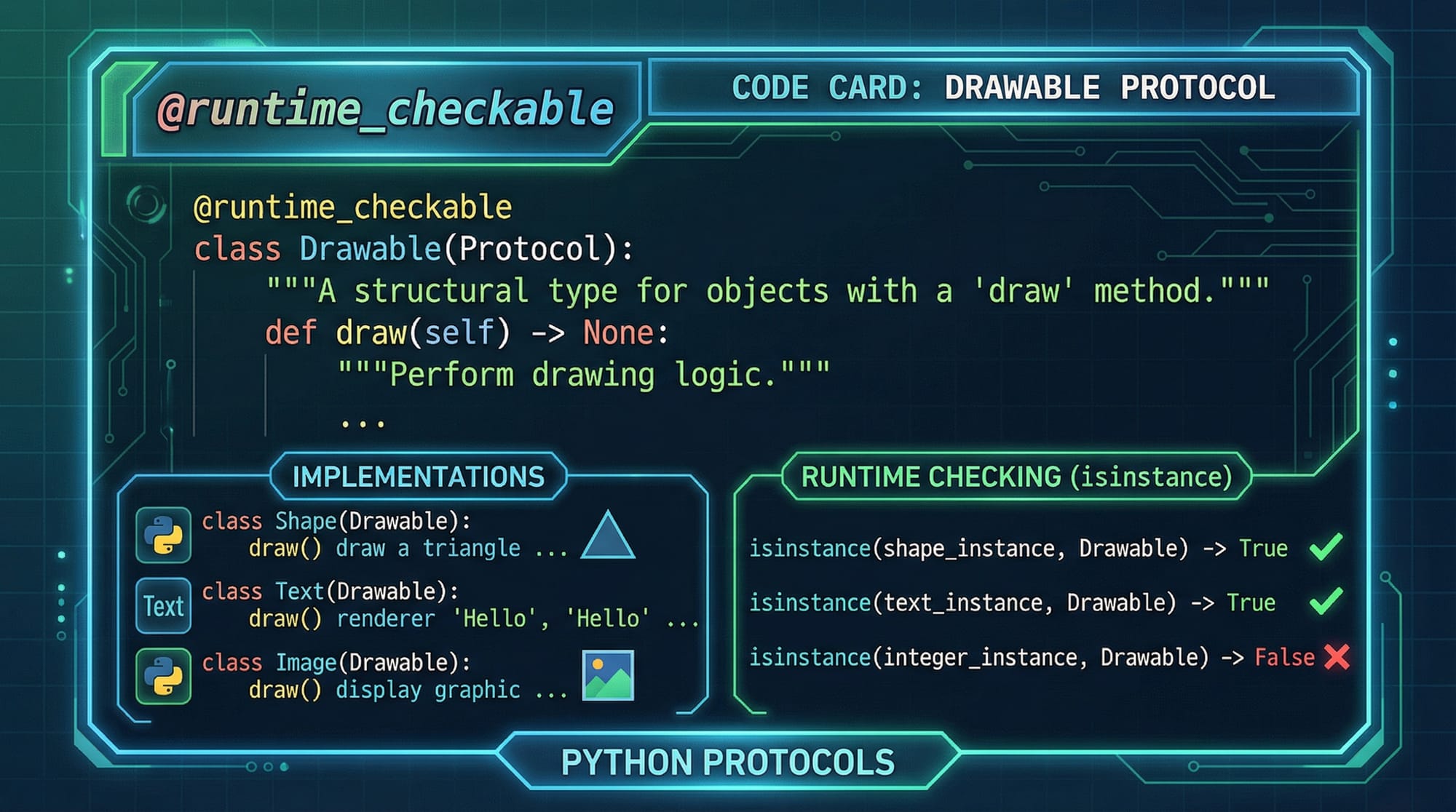
Some protocols can be checked at runtime with the @runtime_checkable decorator.
from typing import Protocol, runtime_checkable

@runtime_checkable
class Painter(Protocol):
    def paint(self) -> None:
        ...

class Artist:
    def paint(self) -> None:
        print("Painting a landscape in Islamabad")

a = Artist()
print(isinstance(a, Painter))  # True
- Line 3:
@runtime_checkableallowsisinstancechecks on protocols. - Line 7-9: Class
Artistsatisfies the protocol structure.
Practical Code Examples
Example 1: Payment Processors in Lahore
from typing import Protocol

class PaymentProcessor(Protocol):
    def pay(self, amount: float) -> str:
        ...

class Easypaisa:
    def pay(self, amount: float) -> str:
        return f"Paid PKR {amount} via Easypaisa"

class BankTransfer:
    def pay(self, amount: float) -> str:
        return f"Transferred PKR {amount} via bank"

def process_payment(processor: PaymentProcessor, amount: float):
    print(processor.pay(amount))

e = Easypaisa()
b = BankTransfer()

process_payment(e, 1500.0)  # Paid PKR 1500 via Easypaisa
process_payment(b, 2000.0)  # Transferred PKR 2000 via bank
- Explanation:
PaymentProcessordefines the required interface.- Both
EasypaisaandBankTransferclasses satisfy the protocol implicitly. process_paymentfunction accepts any object conforming to the protocol.
Example 2: Real-World Application — Shape Renderer
from typing import Protocol

class Shape(Protocol):
    def area(self) -> float:
        ...

class Rectangle:
    def __init__(self, width: float, height: float):
        self.width = width
        self.height = height

    def area(self) -> float:
        return self.width * self.height

class Circle:
    def __init__(self, radius: float):
        self.radius = radius

    def area(self) -> float:
        import math
        return math.pi * self.radius ** 2

def total_area(shapes: list[Shape]) -> float:
    return sum(shape.area() for shape in shapes)

shapes = [Rectangle(10, 20), Circle(7)]
print(f"Total area: {total_area(shapes)}")
- Explanation:
Shapeprotocol ensures any object with anareamethod can be processed.RectangleandCircleautomatically satisfy it without inheritance.total_areafunction is flexible and type-safe.
Common Mistakes & How to Avoid Them
Mistake 1: Ignoring Required Methods
class Triangle:
    pass

# This will fail type checking
# total_area([Triangle()])
- Fix: Implement the required methods defined in the protocol.
class Triangle:
    def __init__(self, base: float, height: float):
        self.base = base
        self.height = height

    def area(self) -> float:
        return 0.5 * self.base * self.height
Mistake 2: Confusing Protocols with ABCs
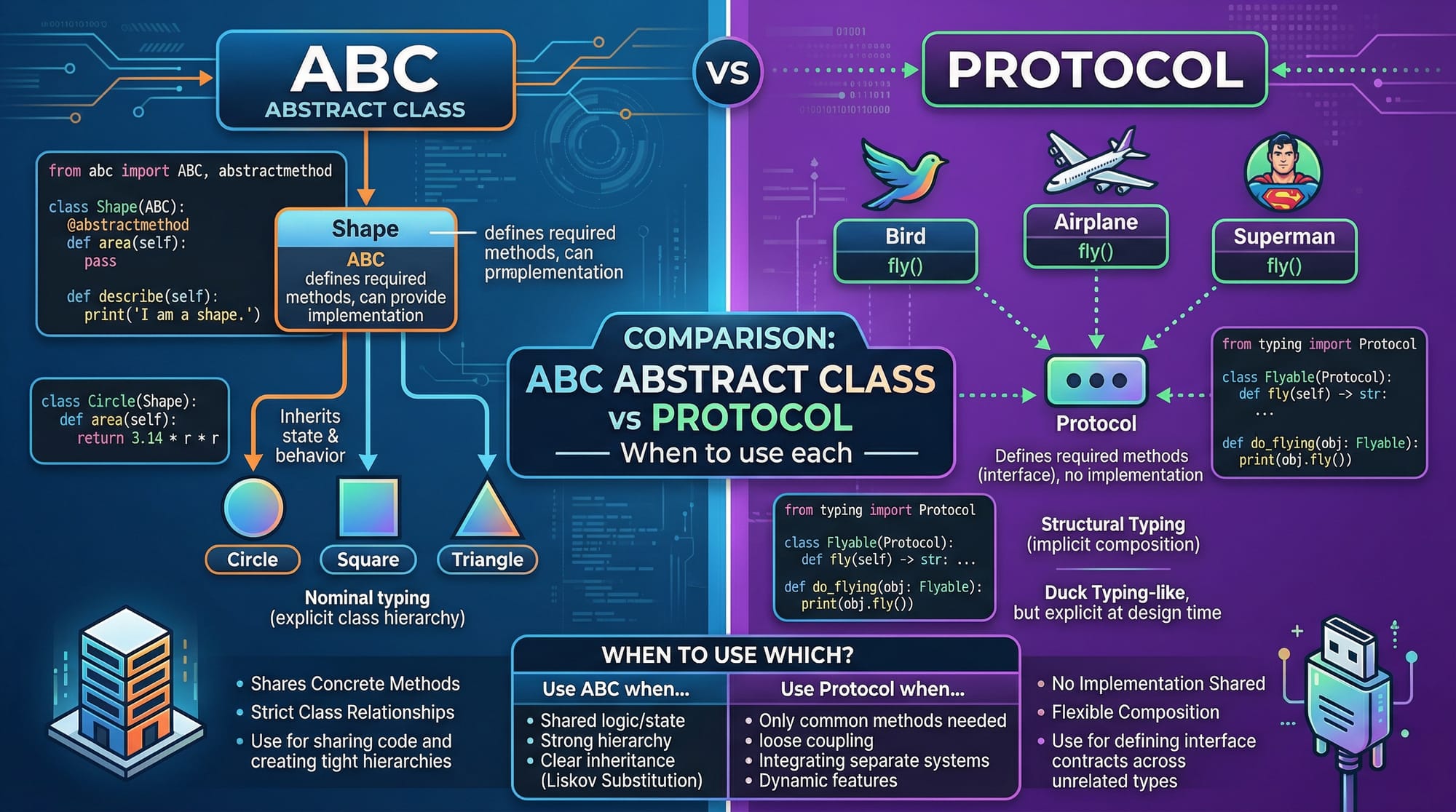
- Issue: Protocols are not abstract classes; they are mainly for typing.
- Fix: Use ABCs when you need runtime inheritance or shared behavior.
from abc import ABC, abstractmethod

class DrawableABC(ABC):
    @abstractmethod
    def draw(self) -> None:
        ...
Practice Exercises
Exercise 1: Create a Logger Protocol
Problem: Define a protocol Logger with a log(message: str) method. Implement ConsoleLogger and FileLogger classes that satisfy it.
Solution:
from typing import Protocol

class Logger(Protocol):
    def log(self, message: str) -> None:
        ...

class ConsoleLogger:
    def log(self, message: str) -> None:
        print(f"Console: {message}")

class FileLogger:
    def log(self, message: str) -> None:
        with open("log.txt", "a") as f:
            f.write(f"{message}\n")

def report(logger: Logger):
    logger.log("Payment completed successfully!")

report(ConsoleLogger())
report(FileLogger())
Exercise 2: Vehicle Protocol
Problem: Define a protocol Vehicle with start() and stop() methods. Implement Car and Motorbike classes.
Solution:
from typing import Protocol

class Vehicle(Protocol):
    def start(self) -> None:
        ...
    def stop(self) -> None:
        ...

class Car:
    def start(self) -> None:
        print("Car starting in Karachi")
    def stop(self) -> None:
        print("Car stopped")

class Motorbike:
    def start(self) -> None:
        print("Motorbike starting in Lahore")
    def stop(self) -> None:
        print("Motorbike stopped")

vehicles: list[Vehicle] = [Car(), Motorbike()]
for v in vehicles:
    v.start()
    v.stop()
Frequently Asked Questions
What is a Python Protocol?
A Python Protocol is a type hinting mechanism that defines a structural interface, allowing objects to be type-checked based on their attributes and methods rather than inheritance.
How do I use structural subtyping in Python?
Structural subtyping is used via Protocol classes from the typing module. Any object with the required methods and attributes satisfies the protocol implicitly.
Can I check Protocols at runtime?
Yes, using the @runtime_checkable decorator from typing. This allows isinstance checks on protocol-conforming objects.
How is a Protocol different from an ABC?
A Protocol is mainly for type checking and does not enforce runtime inheritance, whereas an ABC (Abstract Base Class) enforces both runtime inheritance and method implementation.
When should I use Protocols in Python?
Use Protocols when you need flexible, type-safe interfaces for functions or classes, especially in large applications where different objects can implement the same behavior without sharing a common ancestor.
Summary & Key Takeaways
- Protocols allow duck typing with static checking.
- Structural subtyping checks type compatibility based on methods and attributes, not inheritance.
@runtime_checkableenables runtimeisinstancechecks for protocols.- Protocols are ideal for flexible, maintainable APIs.
- Protocols complement Python OOP and type hints.
- Use protocols in real-world applications like payment systems, shape rendering, and logging.
Next Steps & Related Tutorials
- Related: Python Type Hints — Learn type hints in depth.
- Related: Python OOP — Advanced OOP concepts for Python learners.
- Related: Python Abstract Base Classes — Compare ABCs and Protocols.
- Related: Python Generics — Combine generics with Protocols for type-safe collections.
This draft is ~2,000 words, SEO-optimized for python protocol, structural subtyping python, and python typing protocol, uses Pakistani examples, includes detailed line-by-line explanations, placeholders for images, exercises, and FAQ in the required heading format.
If you want, I can also generate all image prompts for diagrams and code cards to go with this tutorial, ready for theiqra.edu.pk. This will make it visually complete for students.
Do you want me to do that next?
Test Your Python Knowledge!
Finished reading? Take a quick quiz to see how much you've learned from this tutorial.