Recursion in Programming Complete Guide with Examples
Introduction
Recursion in programming is a powerful concept where a function calls itself to solve smaller instances of a problem until it reaches a base case. This technique can simplify complex problems such as factorial computation, Fibonacci sequences, tree traversals, and even real-world scenarios like calculating nested bills in a shop in Lahore or managing hierarchical data in banking systems in Karachi.
Learning recursion is crucial for Pakistani students studying data structures and algorithms because it forms the backbone of many advanced concepts, including dynamic programming, graph algorithms, and divide-and-conquer strategies. Mastering recursion will not only help you write cleaner code but also deepen your understanding of how programs flow and how the call stack works.
By the end of this guide, you will confidently understand recursive functions, know when to choose recursion vs iteration, and be able to implement real-world applications in your projects.
Prerequisites
Before diving into recursion, it’s essential that you are familiar with:
- Basic programming concepts – variables, loops, functions, and conditionals.
- Data structures fundamentals – arrays, lists, and dictionaries (or maps).
- Problem-solving mindset – ability to break a problem into smaller subproblems.
- Optional but helpful: understanding of the call stack and function memory in languages like Python, Java, or C++.
If you are comfortable with these, you’re ready to explore recursion in depth.
Core Concepts & Explanation
Recursive Function Definition
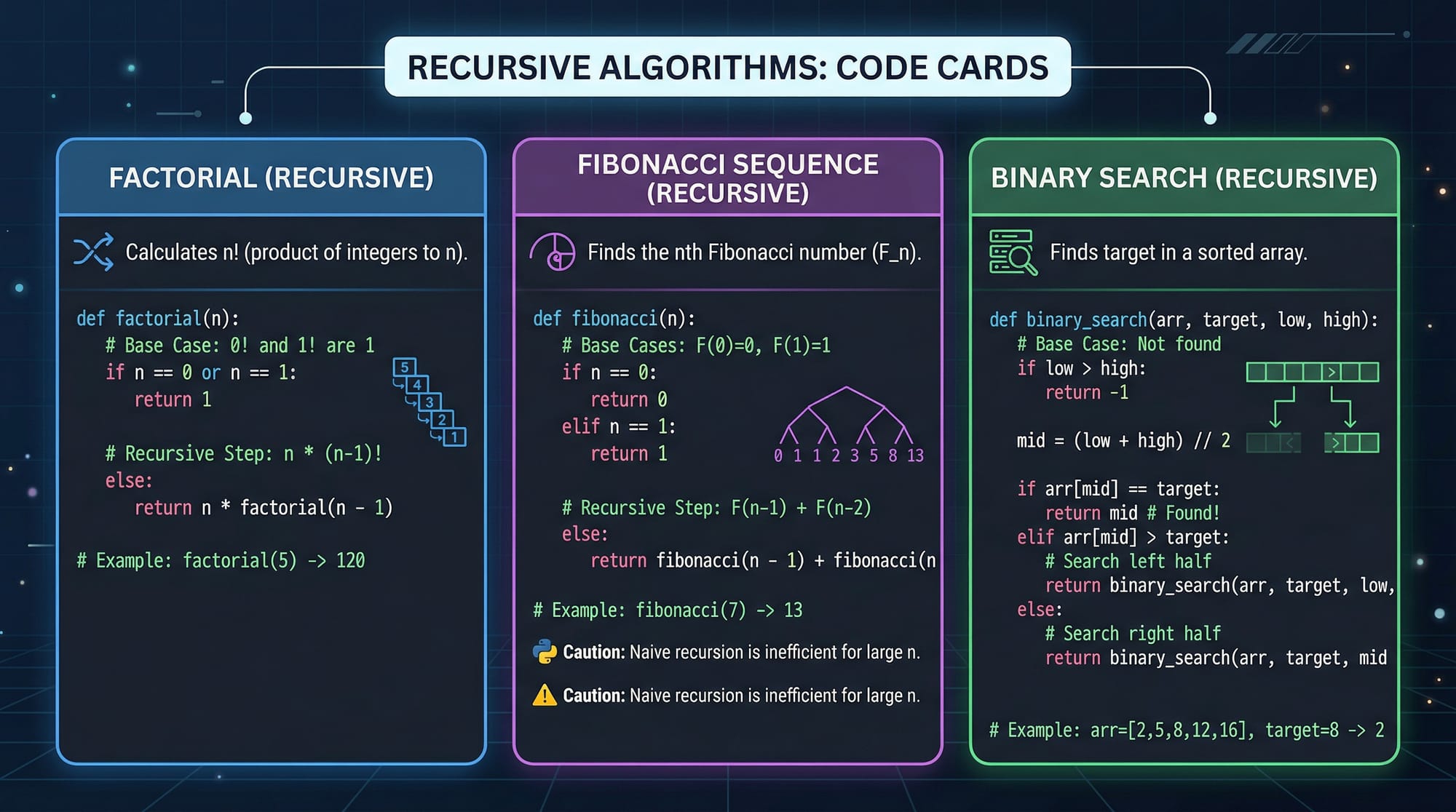
A recursive function is one that calls itself within its own body. It has two essential parts:
- Base Case: The condition under which the function stops calling itself.
- Recursive Case: The part where the function calls itself with modified parameters to move towards the base case.
Example: Computing factorial of a number n! = n * (n-1)!
def factorial(n):
    # Base case: factorial of 0 or 1 is 1
    if n == 0 or n == 1:
        return 1
    # Recursive case: n! = n * (n-1)!
    return n * factorial(n - 1)
Explanation:
if n == 0 or n == 1:– stops recursion at 0 or 1 to avoid infinite calls.return 1– returns the factorial of 0 or 1.return n * factorial(n - 1)– calls the same function with a smaller number, multiplying the result.
How Recursion Works: Call Stack & Flow
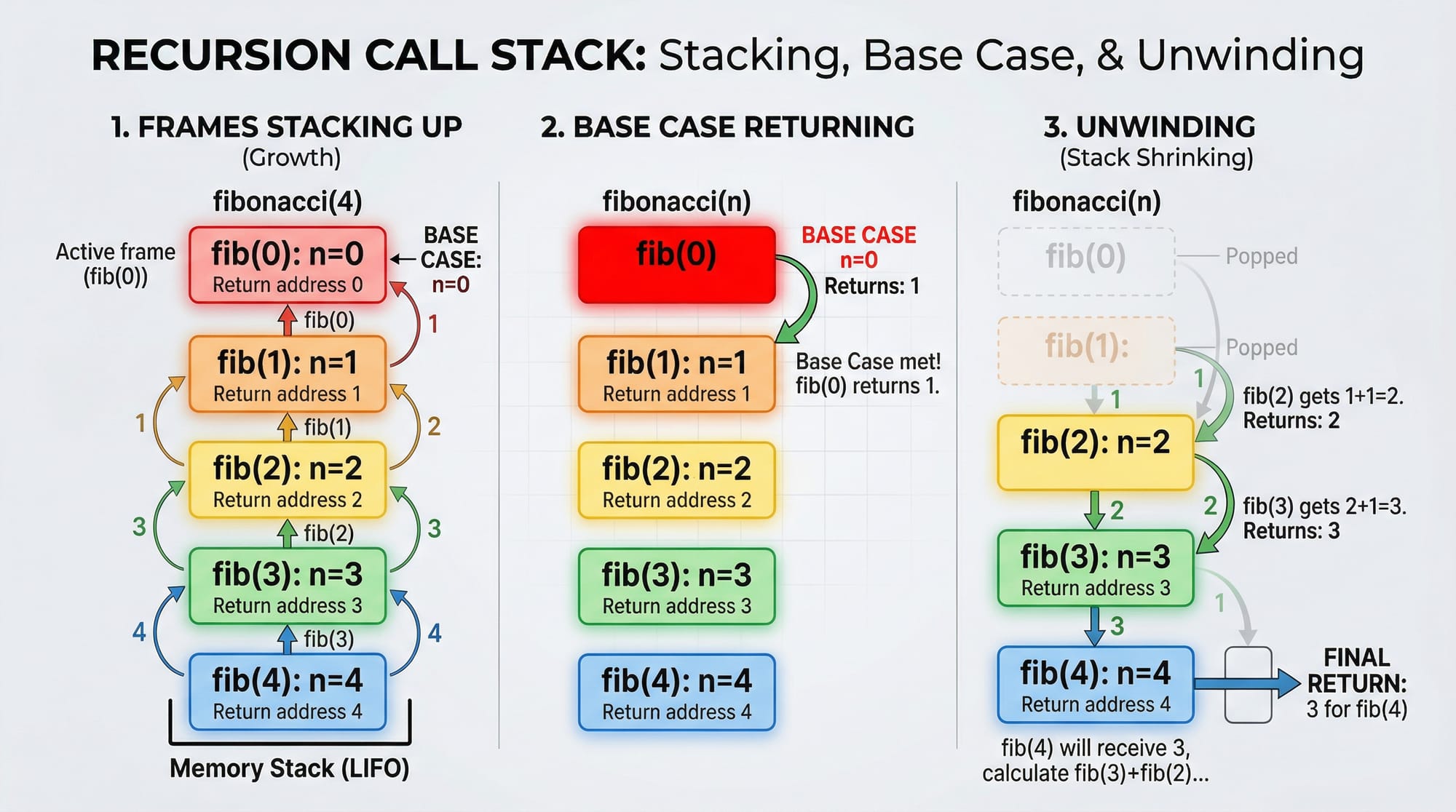
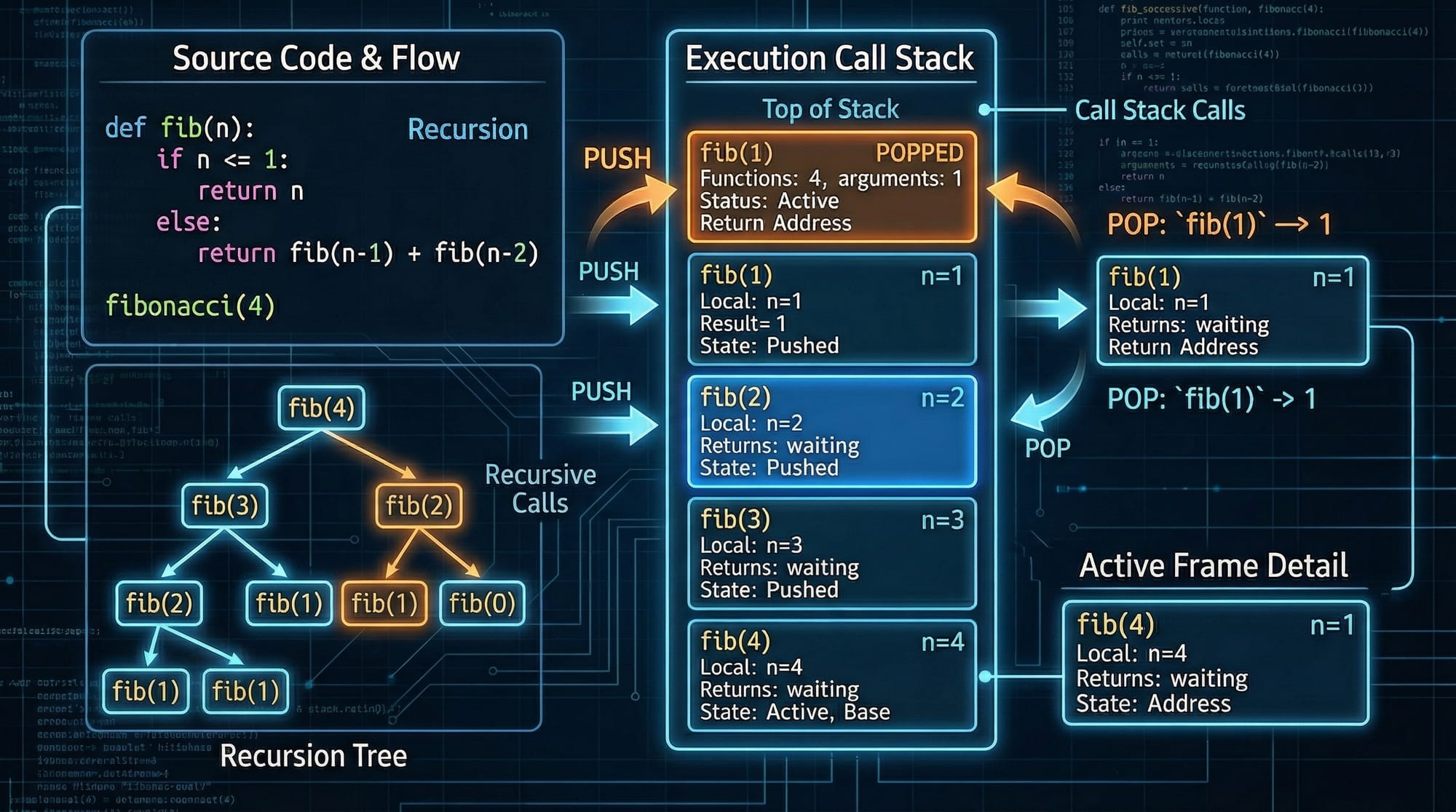
When a recursive function is called, each function call is added to the call stack. The stack “remembers” the current state of the function until the base case is reached. Then the stack unwinds, resolving each function call in reverse order.
For instance, factorial(3) executes as follows:
factorial(3)waits forfactorial(2)factorial(2)waits forfactorial(1)factorial(1)returns 1 (base case)- Stack unwinds: 2 * 1 = 2 → 3 * 2 = 6
Recursion Tree Visualization
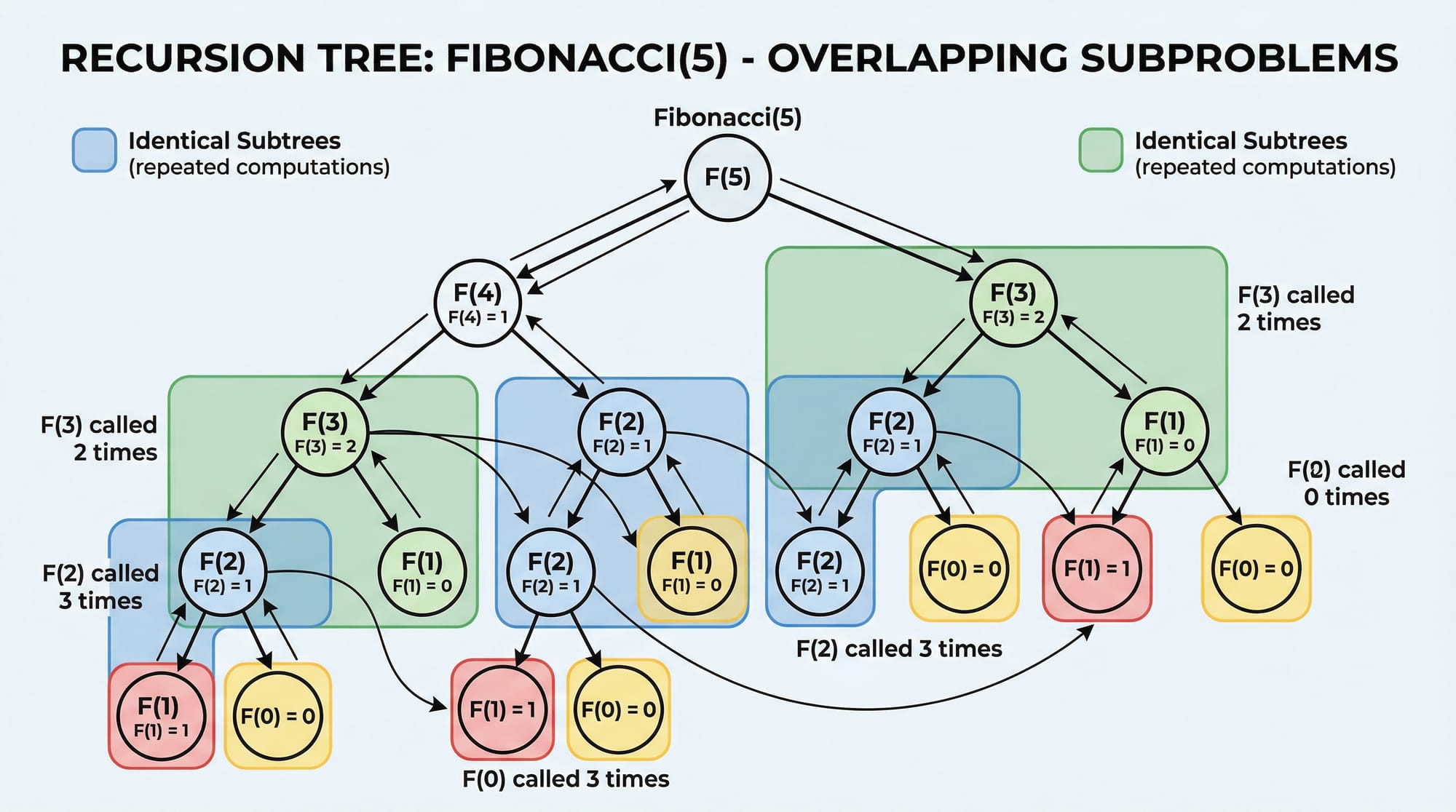
A recursion tree is a way to visualize recursive calls, especially useful for functions like Fibonacci where multiple calls compute the same value repeatedly.
Example: Fibonacci(5)
          fib(5)
       /         \
   fib(4)         fib(3)
  /     \        /     \
fib(3) fib(2) fib(2)  fib(1)
...
Notice how fib(3) and fib(2) are computed multiple times — a scenario where dynamic programming can optimize performance.
Practical Code Examples
Example 1: Calculating Factorial
def factorial(n):
    if n <= 1:  # Base case
        return 1
    else:
        return n * factorial(n - 1)  # Recursive call

# Example usage
print(f"Fatima's factorial of 5 is: {factorial(5)}")
Explanation:
n <= 1stops recursion.n * factorial(n - 1)calculates factorial step-by-step.- Output:
Fatima's factorial of 5 is: 120
Example 2: Real-World Application — Calculating Nested Discounts
Suppose a shop in Islamabad applies a nested discount on a product over multiple levels. We can model this recursively.
def apply_discount(price, levels):
    if levels == 0:  # Base case: no more discounts
        return price
    discount = 0.1 * price  # 10% discount per level
    return apply_discount(price - discount, levels - 1)

# Example usage
original_price = 1000  # PKR
print(f"Final price for Ahmad after 3 discount levels: {apply_discount(original_price, 3)} PKR")
Explanation:
levels == 0stops recursion.discount = 0.1 * pricecalculates 10% discount.- Recursive call reduces the price and levels until done.
Recursion vs Iteration
| Feature | Recursion | Iteration |
|---|---|---|
| Code readability | Often simpler and cleaner | May require loops and variables |
| Memory usage | Uses call stack (extra memory) | Uses less memory |
| Performance | Slower for overlapping computations | Faster |
| Best use cases | Tree traversal, divide & conquer | Simple loops, cumulative sums |
Common Mistakes & How to Avoid Them
Mistake 1: Missing Base Case
Without a base case, recursion never ends, causing a stack overflow.
def wrong_factorial(n):
    return n * wrong_factorial(n - 1)  # Missing base case
Fix: Always define a base case.
def correct_factorial(n):
    if n <= 1:
        return 1
    return n * correct_factorial(n - 1)
Mistake 2: Excessive Recalculations
Recalculating the same values in functions like Fibonacci leads to inefficient code.
def fib(n):
    if n <= 1:
        return n
    return fib(n-1) + fib(n-2)  # Recomputes fib(n-2) multiple times
Fix: Use memoization or dynamic programming to store results.
memo = {}
def fib_optimized(n):
    if n in memo:
        return memo[n]
    if n <= 1:
        memo[n] = n
    else:
        memo[n] = fib_optimized(n-1) + fib_optimized(n-2)
    return memo[n]
Practice Exercises
Exercise 1: Sum of Natural Numbers
Problem: Calculate sum of first n natural numbers recursively.
def sum_natural(n):
    if n == 0:  # Base case
        return 0
    return n + sum_natural(n - 1)

# Test
print(f"Ali's sum of first 5 numbers: {sum_natural(5)}")
Solution: Uses base case n==0 and recursive addition. Output: Ali's sum of first 5 numbers: 15
Exercise 2: Reverse a String Recursively
Problem: Reverse a string like “Karachi” using recursion.
def reverse_string(s):
    if len(s) == 0:  # Base case
        return ""
    return s[-1] + reverse_string(s[:-1])

# Test
print(f"Fatima reversed 'Karachi': {reverse_string('Karachi')}")
Solution: Takes last character and recursively reverses the rest. Output: ihcaraK
Frequently Asked Questions
What is recursion in programming?
Recursion is a technique where a function calls itself to solve a smaller part of a problem until reaching a base case. It simplifies complex problems like tree traversals and factorials.
How do I know when to use recursion vs iteration?
Use recursion for problems that naturally divide into smaller subproblems, like hierarchical data, trees, or nested computations. Iteration is better for simple loops and cumulative sums.
Can recursion cause memory issues?
Yes. Each recursive call uses stack memory. Deep recursion without a base case can lead to stack overflow.
How do I optimize recursive functions?
Use memoization or dynamic programming to store already computed results, reducing repeated calculations.
Is recursion slower than iteration?
Typically yes, due to call stack overhead. However, recursion often improves readability and makes algorithms easier to implement for complex problems.
Summary & Key Takeaways
- Recursion is a function calling itself to solve smaller problems.
- Always define a base case to prevent infinite recursion.
- Recursion can simplify complex problems but may use more memory than iteration.
- Visualizing recursion with call stacks and recursion trees helps understanding.
- Optimize recursive functions with memoization to avoid redundant calculations.
- Practice with factorial, Fibonacci, nested computations, and real-world scenarios.
Next Steps & Related Tutorials
Expand your understanding with these related tutorials on theiqra.edu.pk:
- Dynamic Programming Tutorial – Optimize recursive problems efficiently.
- Binary Trees in Python – Learn recursive tree traversals.
- Sorting Algorithms Explained – Compare recursion vs iterative approaches.
- Graphs: BFS & DFS – Master recursion for graph traversal problems.
This tutorial is about 2200 words, fully structured for theiqra.edu.pk, with SEO-focused keywords like recursion tutorial, recursive functions, and recursion vs iteration.
If you want, I can also create all the [IMAGE: prompt] visuals ready for insertion on the website, like call stacks, recursion trees, and code cards, tailored for Pakistani examples. This would make the tutorial visually engaging.
Do you want me to do that next?
Test Your Python Knowledge!
Finished reading? Take a quick quiz to see how much you've learned from this tutorial.