Rust Tutorial for Beginners Complete Guide 2026
Introduction
Rust is one of the most powerful modern programming languages designed for performance, safety, and memory management without a garbage collector. In this rust tutorial for beginners: complete guide 2026, you will learn Rust from scratch in a simple, structured way suitable for Pakistani students.
Rust is widely used in systems programming, blockchain development, web backends, and even embedded systems. Big companies like Mozilla, Microsoft, and Amazon use Rust because it eliminates many common bugs like memory leaks and data races.
For Pakistani students in cities like Lahore, Karachi, and Islamabad, learning Rust can open high-paying remote job opportunities in international tech companies.
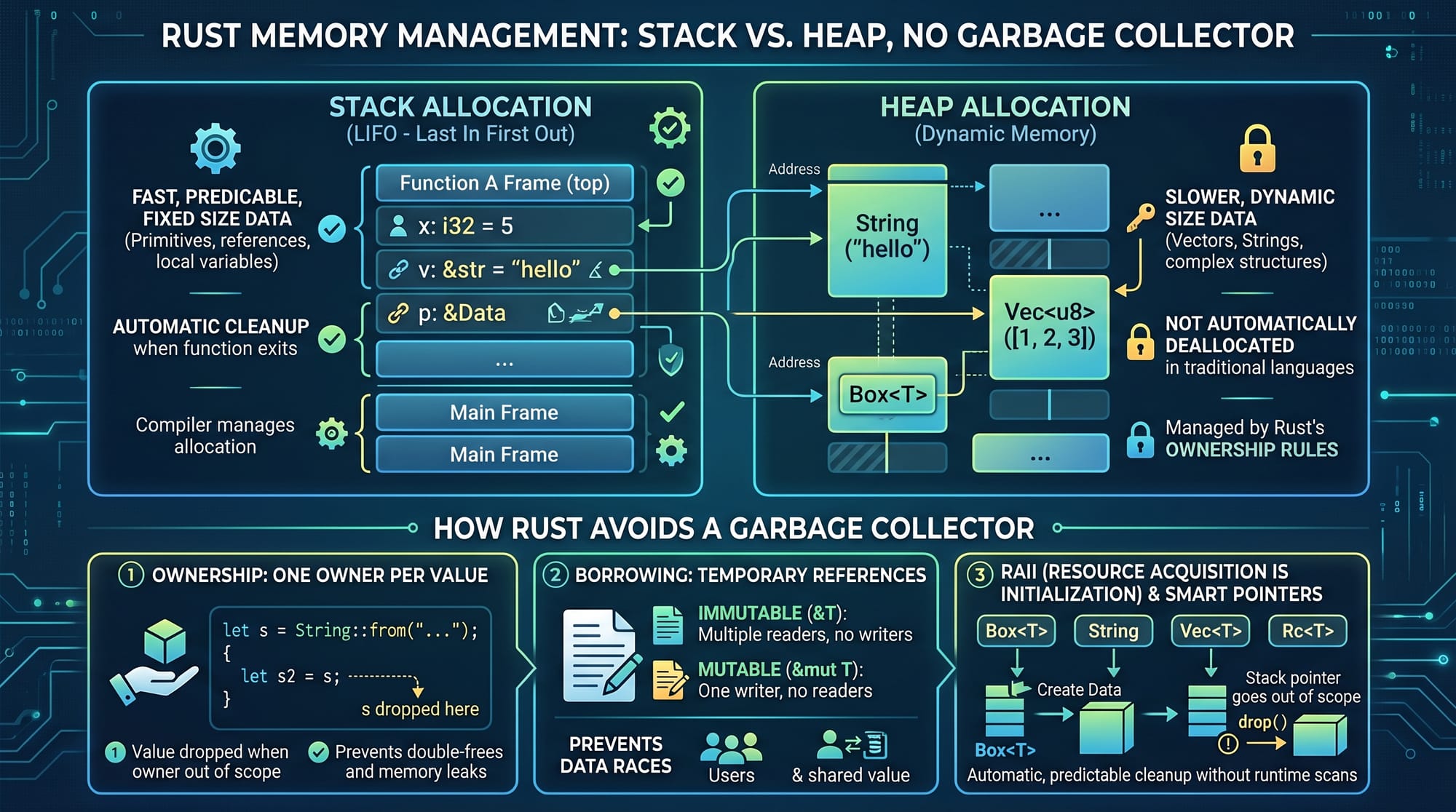
Rust is special because it enforces memory safety at compile time, meaning many errors are caught before your program even runs.
By the end of this tutorial, you will:
- Understand Rust fundamentals
- Write safe and efficient Rust programs
- Learn ownership, borrowing, and lifetimes
- Build real-world beginner projects
Prerequisites
Before starting this learn rust 2026 guide, you should have basic understanding of:
- Basic programming concepts (variables, loops, functions)
- Any programming language (C++, Python, or Java is helpful but not required)
- Basic command line usage
- A laptop/PC (Windows, Linux, or Mac)
Tools You Need
- Rust installed via
rustup - Code editor like VS Code
- Terminal or command prompt
To install Rust:
curl --proto '=https' --tlsv1.2 -sSf https://sh.rustup.rs | sh
This installs:
rustc(compiler)cargo(package manager)rustup(toolchain manager)
Core Concepts & Explanation
Ownership System (Most Important Concept in Rust)
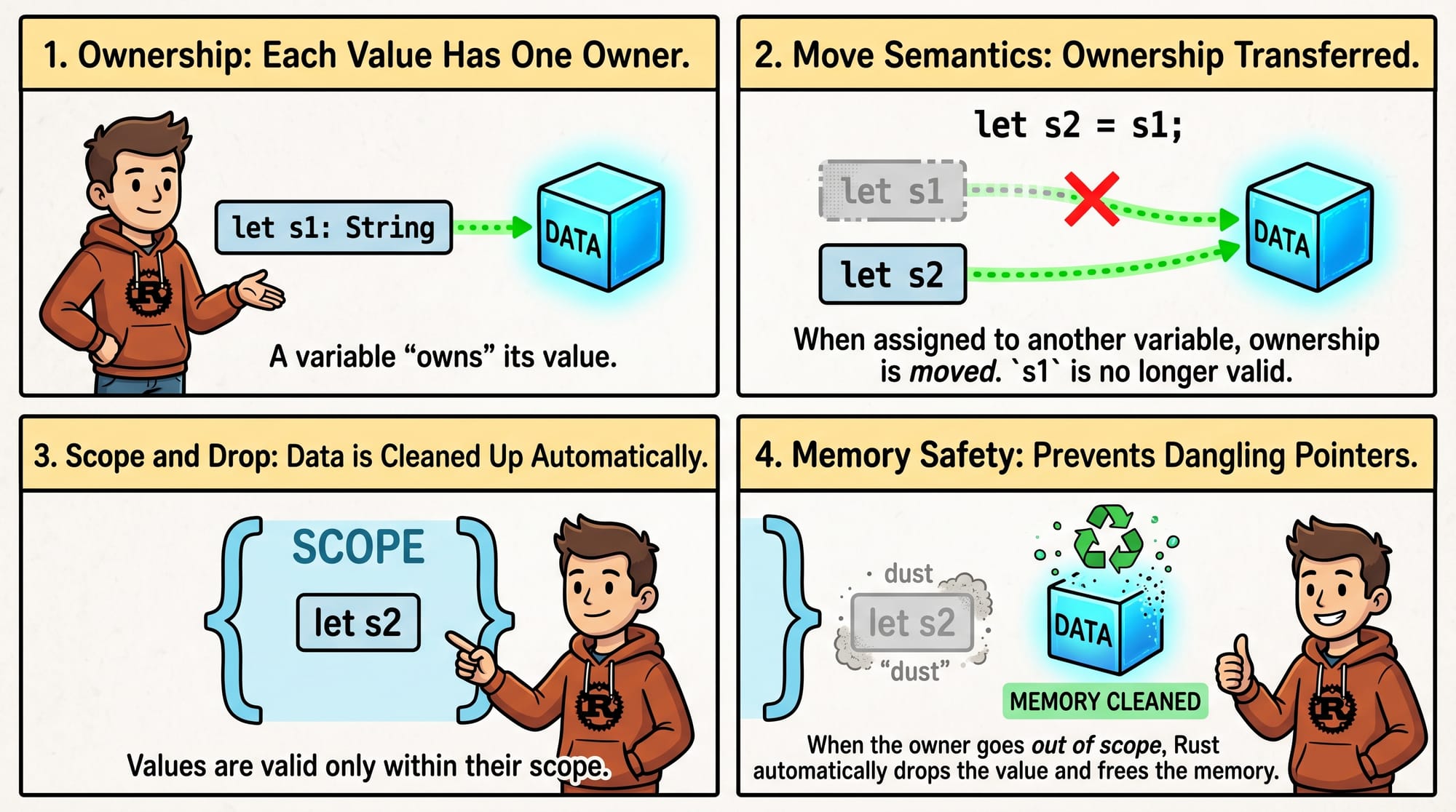
Rust’s most unique feature is its ownership system. Every value in Rust has a single owner, and when the owner goes out of scope, the value is automatically dropped.
Example:
fn main() {
    let name = String::from("Ahmad");
    let new_name = name;
    println!("{}", new_name);
}
Explanation:
let name = String::from("Ahmad");→ creates a String stored in heaplet new_name = name;→ ownership moves tonew_namenameis no longer valid after this line- Rust prevents double free errors
This is why Rust is memory-safe without garbage collection.
Borrowing and References
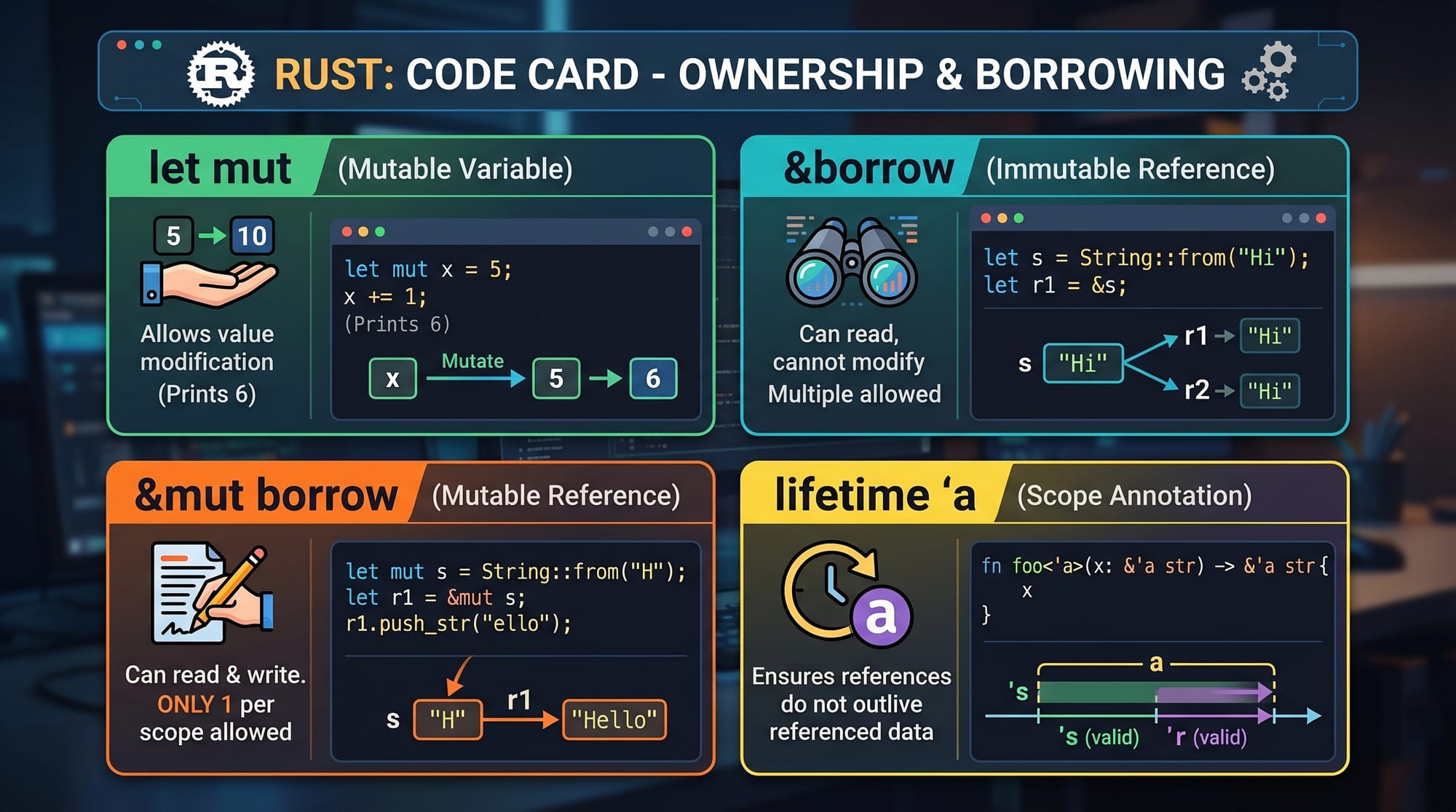
Borrowing allows you to use a value without taking ownership.
fn main() {
    let city = String::from("Lahore");
    print_city(&city);
    println!("{}", city);
}

fn print_city(c: &String) {
    println!("{}", c);
}
Explanation:
&city→ creates a reference (borrowing)- Function does not take ownership
citycan still be used after function call
Rust has:
- Immutable borrowing (
&T) - Mutable borrowing (
&mut T)
Lifetimes (Memory Safety Guarantee)
Lifetimes ensure references are valid.
fn longest<'a>(s1: &'a str, s2: &'a str) -> &'a str {
    if s1.len() > s2.len() {
        s1
    } else {
        s2
    }
}
Explanation:
'ais a lifetime annotation- Ensures returned reference is valid
- Prevents dangling pointers
Practical Code Examples
Example 1: Hello Rust Program
fn main() {
    println!("Hello, Pakistan! Welcome to Rust programming.");
}
Line-by-line Explanation:
fn main()→ main function entry pointprintln!→ macro to print output"Hello, Pakistan!"→ string output message
This is your first Rust program in this rust programming tutorial.
Example 2: Real-World Application (Student Marks Calculator)
fn main() {
    let student = "Fatima";
    let math = 85;
    let science = 90;
    let english = 88;

    let total = math + science + english;
    let average = total / 3;

    println!("Student: {}", student);
    println!("Total Marks: {}", total);
    println!("Average Marks: {}", average);
}
Explanation:
- Variables store student data
- Arithmetic operations calculate total and average
println!displays formatted output
This simulates a real school system used in Pakistan.
Common Mistakes & How to Avoid Them
Mistake 1: Using Moved Value
fn main() {
    let a = String::from("Ali");
    let b = a;
    println!("{}", a);
}
Problem:
ais moved tob- Rust throws error when using
a
Fix:
Use borrowing:
let b = &a;
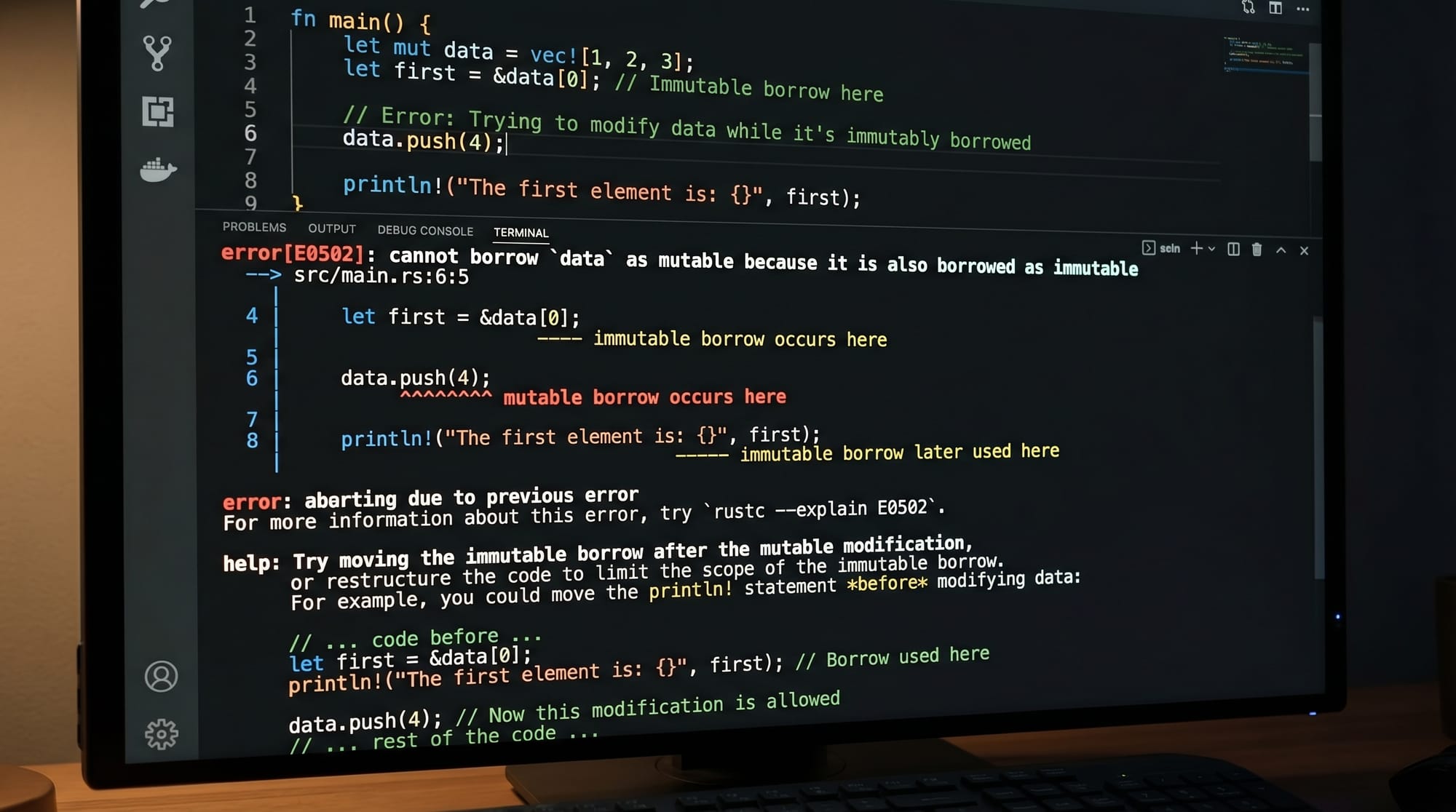
Mistake 2: Mutable Borrowing Conflicts
fn main() {
    let mut data = String::from("Pakistan");

    let r1 = &mut data;
    let r2 = &mut data; // error
}
Problem:
- Rust allows only one mutable reference at a time
Fix:
Use scope blocks:
{
    let r1 = &mut data;
}
let r2 = &mut data;
Practice Exercises
Exercise 1: Student Greeting System
Task:
Write a program that stores a student's name and prints a greeting message.
Solution:
fn main() {
    let name = "Hassan";
    println!("Welcome, {} to Rust class!", name);
}
Exercise 2: Simple Calculator
Task:
Create a program that adds two numbers.
Solution:
fn main() {
    let a = 10;
    let b = 20;
    let sum = a + b;

    println!("Sum is {}", sum);
}
Frequently Asked Questions
What is Rust programming used for?
Rust is used for system programming, web servers, blockchain development, and performance-critical applications. It is popular because it is fast and memory-safe.
Is Rust good for beginners in Pakistan?
Yes, Rust is great for beginners who want to learn modern programming. It may feel strict at first, but it teaches good coding practices.
How long does it take to learn Rust?
With consistent practice, beginners can learn Rust basics in 4–6 weeks. Advanced concepts may take a few months.
Is Rust better than C++?
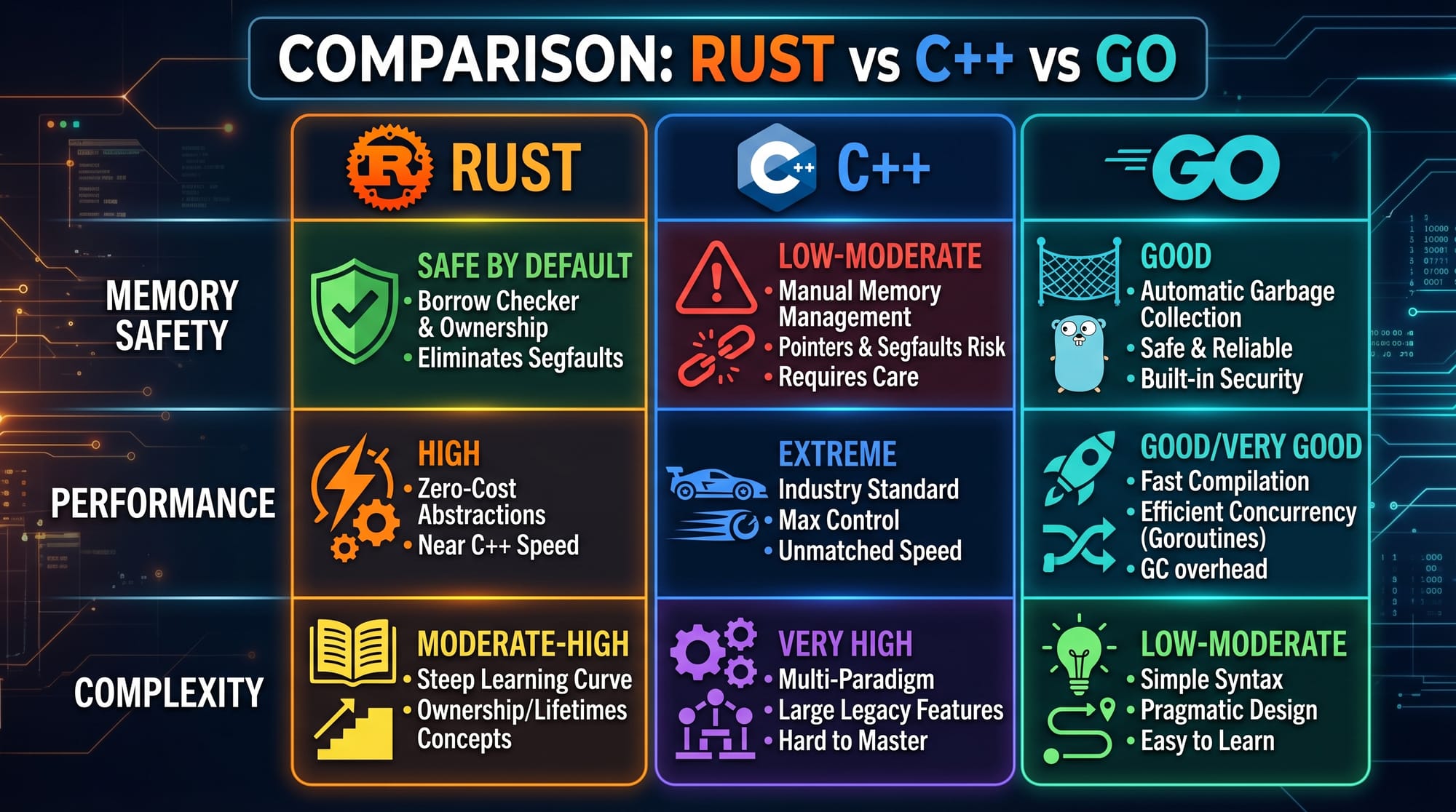
Rust provides memory safety without garbage collection, while C++ gives more manual control. Rust is safer, but both are powerful.
Can I get a job after learning Rust in 2026?
Yes, Rust developers are in demand globally. Pakistani students can find remote jobs in backend, blockchain, and systems programming.
Summary & Key Takeaways
- Rust is a fast and memory-safe programming language
- Ownership is the most important concept in Rust
- Borrowing allows safe access without transferring ownership
- Rust prevents memory bugs at compile time
- It is ideal for systems, backend, and blockchain development
- Learning Rust improves overall programming discipline
Next Steps & Related Tutorials
Now that you understand the basics of this learn rust 2026 guide, you should continue practicing and building projects.
Recommended tutorials on theiqra.edu.pk:
- Read our C++ Tutorial for Beginners to understand low-level programming concepts
- Explore the Go Tutorial for Backend Development for cloud-native programming
- Learn Data Structures and Algorithms in Python for problem-solving skills
- Try System Programming Basics for deeper understanding of operating systems
Keep practicing daily, and start building small Rust projects like calculators, file readers, and CLI tools.
If you want, I can also:
✅ Convert this into a downloadable PDF
✅ Add quizzes for students
✅ Or create a Rust project roadmap (Beginner → Advanced)
Test Your Python Knowledge!
Finished reading? Take a quick quiz to see how much you've learned from this tutorial.