Sorting Algorithms Bubble Merge Quick & Heap Sort Guide
Introduction
Sorting algorithms are fundamental techniques in computer science used to arrange data in a specific order—typically ascending or descending. Whether you are organizing exam scores, managing customer data, or preparing datasets for analysis, sorting plays a crucial role in making information easier to process and understand.
This tutorial, “Sorting Algorithms: Bubble, Merge, Quick & Heap Sort Guide”, is designed specifically for Pakistani students learning Data Structures and Algorithms (DSA). If you're studying in universities like Iqra University, FAST, or NUST, or preparing for coding interviews, mastering these algorithms is essential.
Why should Pakistani students learn sorting algorithms?
- 📊 They are frequently asked in job interviews (local and international companies)
- 💻 They build strong problem-solving skills for programming contests
- 🚀 They are used in real-world applications like e-commerce, banking, and data analytics
- 📈 They help you understand performance optimization using Big-O notation
By the end of this guide, you’ll clearly understand how bubble sort, merge sort, quicksort, and heap sort work—along with when to use each.
Prerequisites
Before starting this tutorial, you should have:
- Basic knowledge of arrays and lists
- Understanding of loops (for, while)
- Familiarity with functions
- Basic idea of recursion (important for merge sort and quicksort)
- Introductory understanding of Big-O notation
If you're new, consider reading a beginner-friendly DSA tutorial first.
Core Concepts & Explanation
Understanding Sorting Algorithms and Their Importance
Sorting algorithms arrange elements in a list or array. For example:
Unsorted: [5, 2, 9, 1]
Sorted:   [1, 2, 5, 9]
Real-life example in Pakistan:
Imagine a shopkeeper in Lahore sorting customer bills in ascending order of price (PKR). This makes it easier to identify highest and lowest sales quickly.
There are two major categories:
- Comparison-based sorting (Bubble, Merge, Quick, Heap)
- Non-comparison sorting (Counting sort, Radix sort)
We will focus on comparison-based sorting.
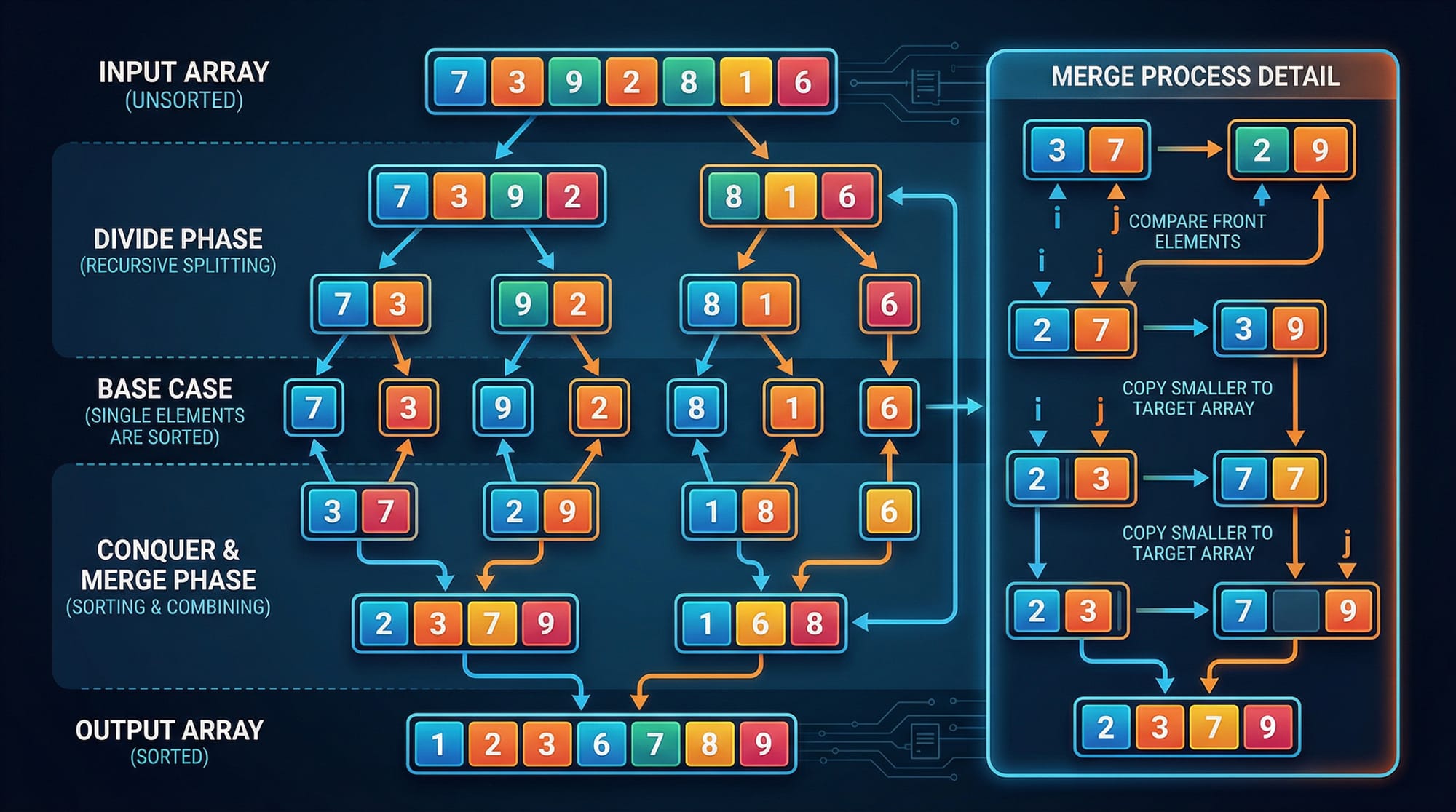
Divide and Conquer Strategy (Merge & Quick Sort)
Divide and Conquer is a powerful approach used in advanced sorting algorithms:
- Divide the problem into smaller sub-problems
- Solve each sub-problem recursively
- Combine the results
For example, in merge sort:
- Divide array into halves
- Sort each half
- Merge sorted halves
Understanding Time Complexity
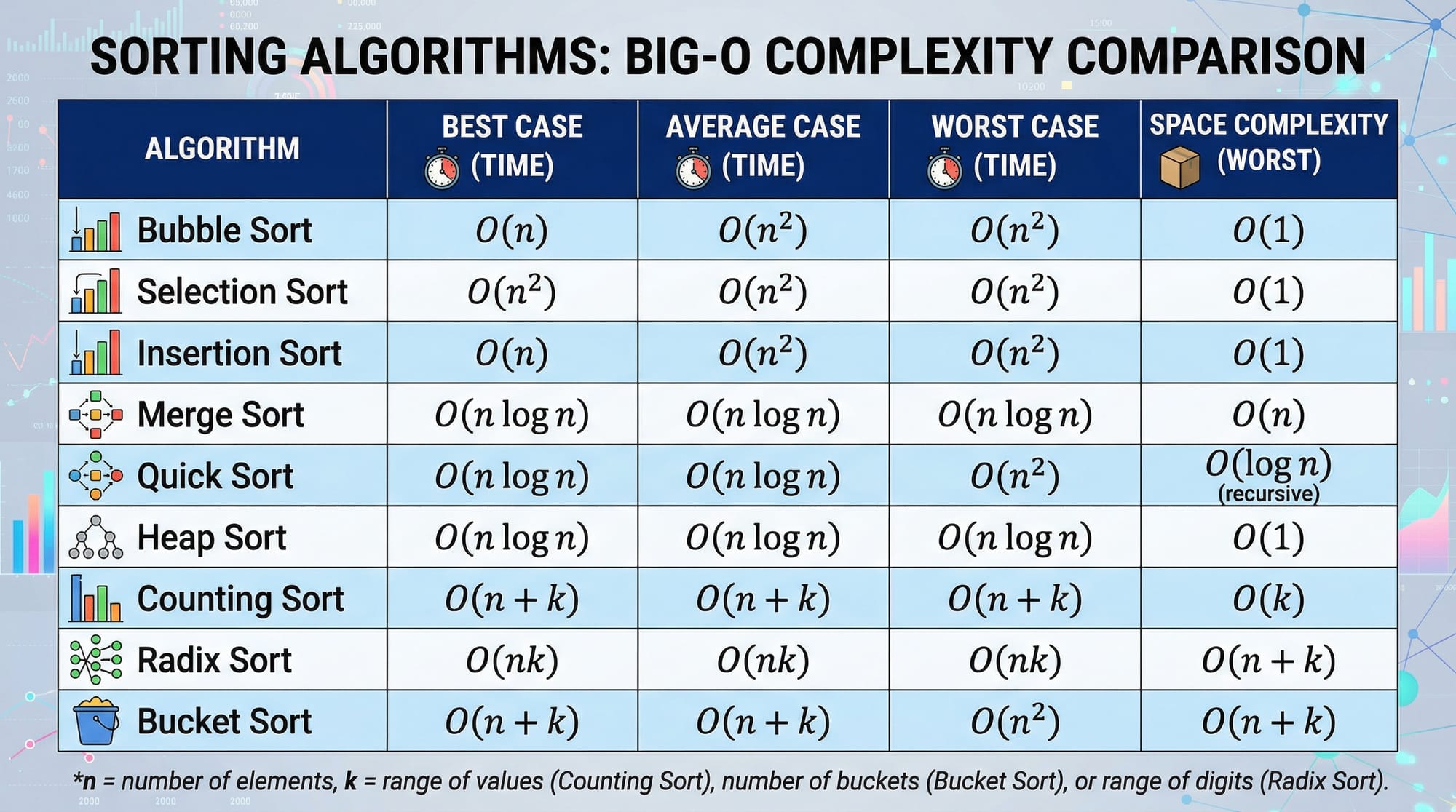
Time complexity measures how fast an algorithm runs.
| Algorithm | Best Case | Average Case | Worst Case |
|---|---|---|---|
| Bubble Sort | O(n) | O(n²) | O(n²) |
| Merge Sort | O(n log n) | O(n log n) | O(n log n) |
| Quick Sort | O(n log n) | O(n log n) | O(n²) |
| Heap Sort | O(n log n) | O(n log n) | O(n log n) |
Key takeaway:
- Bubble sort is simple but slow
- Merge, Quick, Heap are efficient for large datasets
Practical Code Examples
Example 1: Bubble Sort Implementation
def bubble_sort(arr):
    n = len(arr)  # Step 1: Get the length of the array

    for i in range(n):  # Step 2: Loop through the array
        for j in range(0, n - i - 1):  # Step 3: Compare adjacent elements

            if arr[j] > arr[j + 1]:  # Step 4: Swap if needed
                arr[j], arr[j + 1] = arr[j + 1], arr[j]

    return arr
Line-by-line Explanation:
n = len(arr)→ stores number of elements- Outer loop → runs multiple passes
- Inner loop → compares adjacent elements
- Swap → moves larger elements to the end
- After each pass → largest element is placed correctly
Example:
print(bubble_sort([5, 3, 8, 4]))
Output:
[3, 4, 5, 8]
Example 2: Real-World Application (Sorting Student Marks in Pakistan)
Let’s say Ahmad is sorting student marks in Islamabad:
def sort_marks(marks):
    return sorted(marks)
Explanation:
sorted()is Python’s built-in function- Internally uses Timsort (optimized merge sort + insertion sort)
- Efficient for real-world datasets
Example:
marks = [450, 380, 500, 420]
print(sort_marks(marks))
Output:
[380, 420, 450, 500]
Example 3: Merge Sort
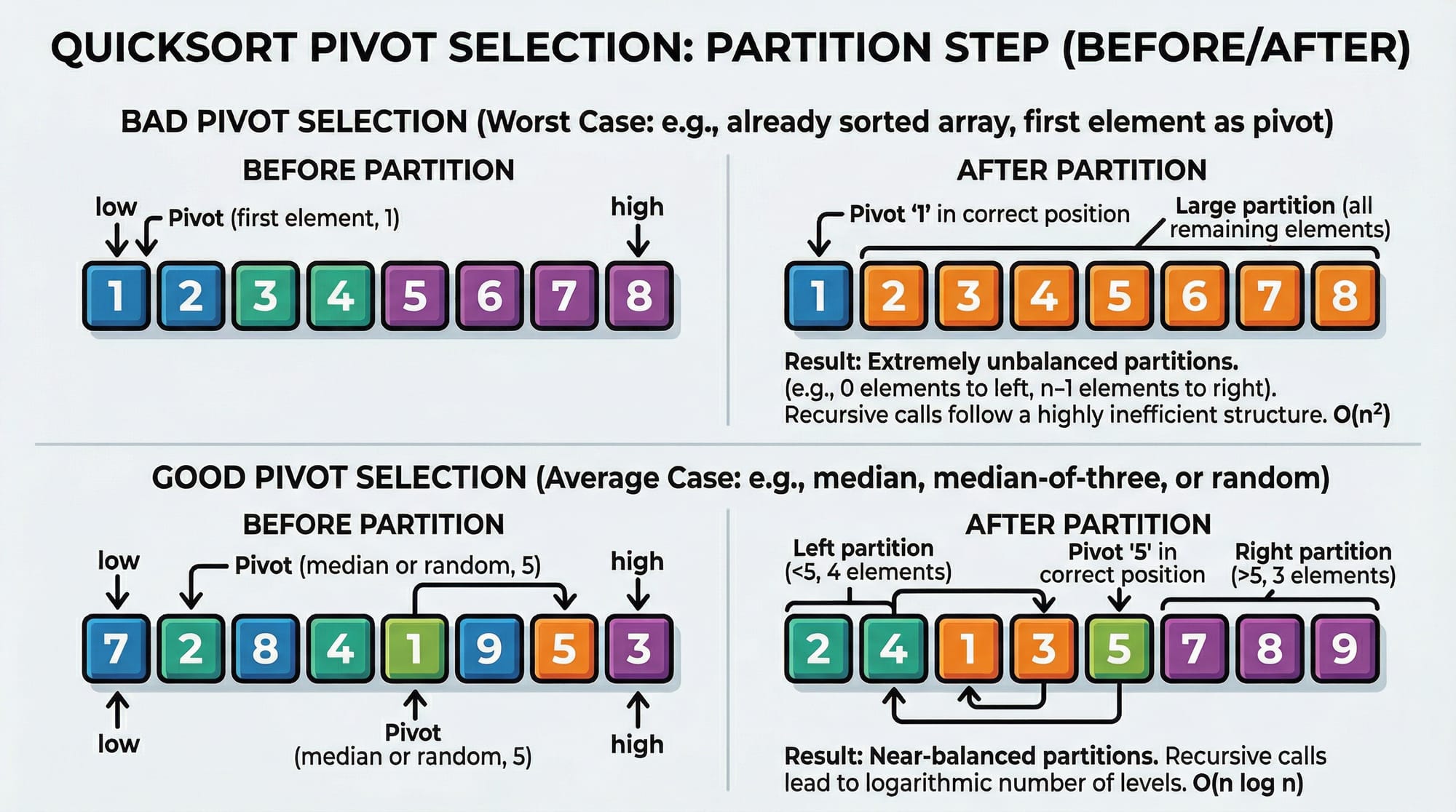
def merge_sort(arr):
    if len(arr) <= 1:
        return arr  # Base case

    mid = len(arr) // 2  # Step 1: Find middle
    left = merge_sort(arr[:mid])  # Step 2: Sort left
    right = merge_sort(arr[mid:])  # Step 3: Sort right

    return merge(left, right)  # Step 4: Merge

def merge(left, right):
    result = []
    i = j = 0

    while i < len(left) and j < len(right):
        if left[i] < right[j]:
            result.append(left[i])
            i += 1
        else:
            result.append(right[j])
            j += 1

    result.extend(left[i:])
    result.extend(right[j:])

    return result
Explanation:
- Recursively splits array
- Merges sorted halves
- Efficient for large data
Example 4: Quick Sort
def quick_sort(arr):
    if len(arr) <= 1:
        return arr

    pivot = arr[0]  # Step 1: Choose pivot
    left = [x for x in arr[1:] if x <= pivot]
    right = [x for x in arr[1:] if x > pivot]

    return quick_sort(left) + [pivot] + quick_sort(right)
Explanation:
- Pivot divides array
- Smaller elements → left
- Larger → right
- Recursively sorts
Example 5: Heap Sort
import heapq

def heap_sort(arr):
    heapq.heapify(arr)  # Convert to heap
    sorted_arr = []

    while arr:
        sorted_arr.append(heapq.heappop(arr))  # Extract smallest

    return sorted_arr
Explanation:
- Heap is a binary tree structure
- Always extracts smallest element
- Efficient and consistent performance
Common Mistakes & How to Avoid Them
Mistake 1: Ignoring Time Complexity
Many beginners use bubble sort for large datasets.
❌ Problem:
- Slow performance for large input
✅ Solution:
- Use merge sort or quicksort for large data
Mistake 2: Incorrect Recursive Base Case
In merge/quick sort:
❌ Missing base case:
if len(arr) == 1:
This may fail for empty arrays.
✅ Correct:
if len(arr) <= 1:
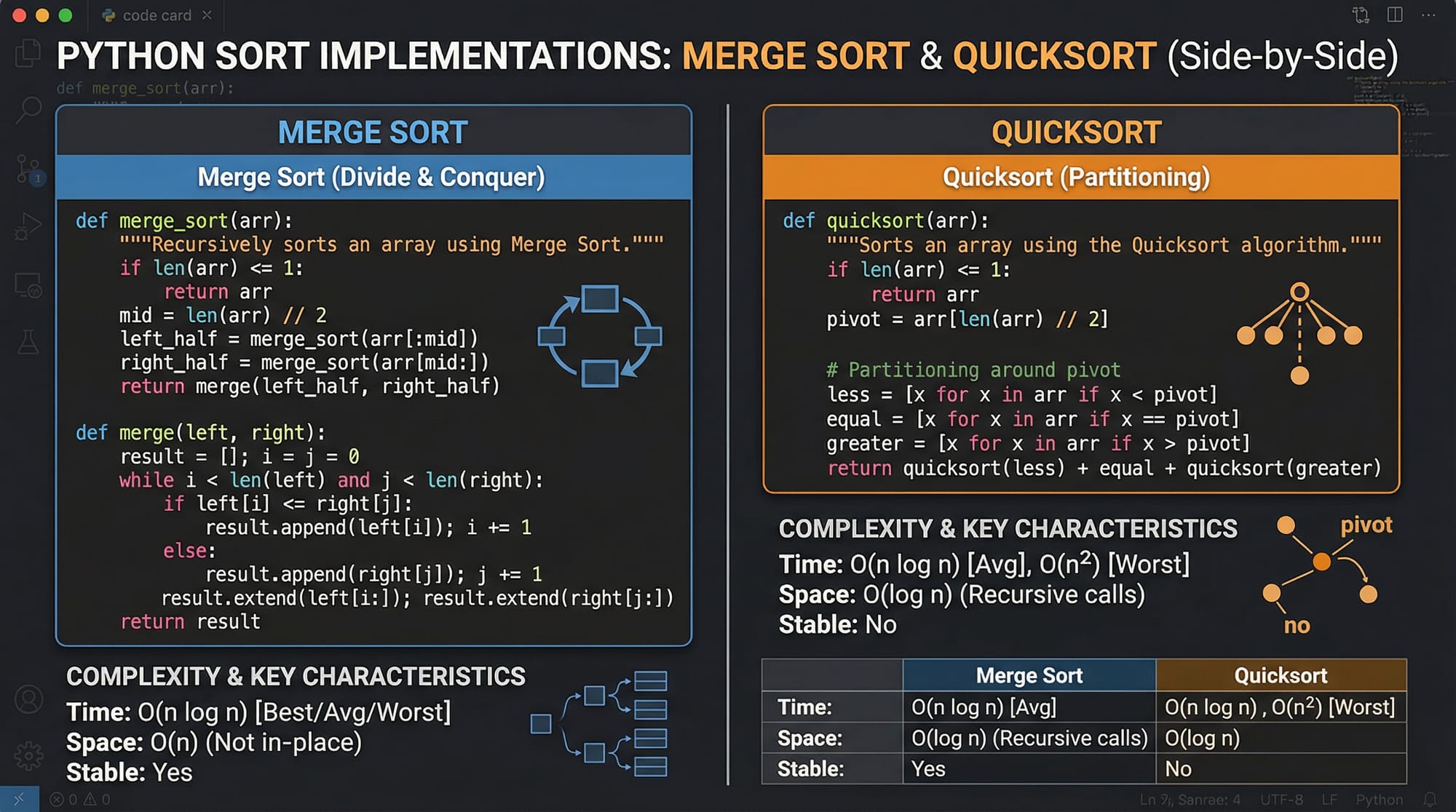
Mistake 3: Wrong Pivot Selection (Quick Sort)
Bad pivot → worst-case O(n²)
✅ Fix:
- Use random pivot
- Use median-of-three technique
Practice Exercises
Exercise 1: Sort Prices in PKR
Problem:
Sort a list of product prices from Karachi in ascending order.
prices = [1200, 500, 750, 3000]
Solution:
def bubble_sort(arr):
    n = len(arr)
    for i in range(n):
        for j in range(n - i - 1):
            if arr[j] > arr[j + 1]:
                arr[j], arr[j + 1] = arr[j + 1], arr[j]
    return arr

print(bubble_sort(prices))
Output:
[500, 750, 1200, 3000]
Exercise 2: Rank Students
Problem:
Sort student scores in descending order.
scores = [88, 92, 75, 60]
Solution:
def quick_sort_desc(arr):
    if len(arr) <= 1:
        return arr

    pivot = arr[0]
    left = [x for x in arr[1:] if x >= pivot]
    right = [x for x in arr[1:] if x < pivot]

    return quick_sort_desc(left) + [pivot] + quick_sort_desc(right)

print(quick_sort_desc(scores))
Output:
[92, 88, 75, 60]
Frequently Asked Questions
What is the fastest sorting algorithm?
There is no single fastest algorithm for all cases. Quicksort is usually fastest in practice, but merge sort guarantees O(n log n) performance in all cases.
How do I choose the right sorting algorithm?
Choose based on data size and requirements. Use bubble sort for learning, merge sort for stability, quicksort for speed, and heap sort when memory is limited.
What is stable sorting?
A stable sort maintains the relative order of equal elements. Merge sort is stable, while quicksort is not always stable.
How do I improve quicksort performance?
Use better pivot selection strategies like random pivot or median-of-three to avoid worst-case performance.
Why is bubble sort still taught?
Bubble sort is simple and helps beginners understand how sorting works, even though it’s inefficient for real-world use.
Summary & Key Takeaways
- Sorting algorithms organize data efficiently
- Bubble sort is simple but slow (O(n²))
- Merge sort is reliable and stable (O(n log n))
- Quicksort is fast but depends on pivot selection
- Heap sort offers consistent performance
- Choosing the right algorithm depends on the problem
Next Steps & Related Tutorials
To deepen your understanding, explore these tutorials on theiqra.edu.pk:
- Learn the fundamentals in a DSA Tutorial for Beginners
- Master performance analysis with Big-O Notation Explained
- Explore Arrays vs Linked Lists for better data handling
- Study Recursion in Depth for divide-and-conquer algorithms
💡 Final Tip: Practice is key! Try implementing each sorting algorithm yourself and test with real datasets like student records, shop prices, or exam rankings in Pakistan.
Test Your Python Knowledge!
Finished reading? Take a quick quiz to see how much you've learned from this tutorial.