SQL Interview Questions Top 40 Q&A with Solutions 2026
Introduction
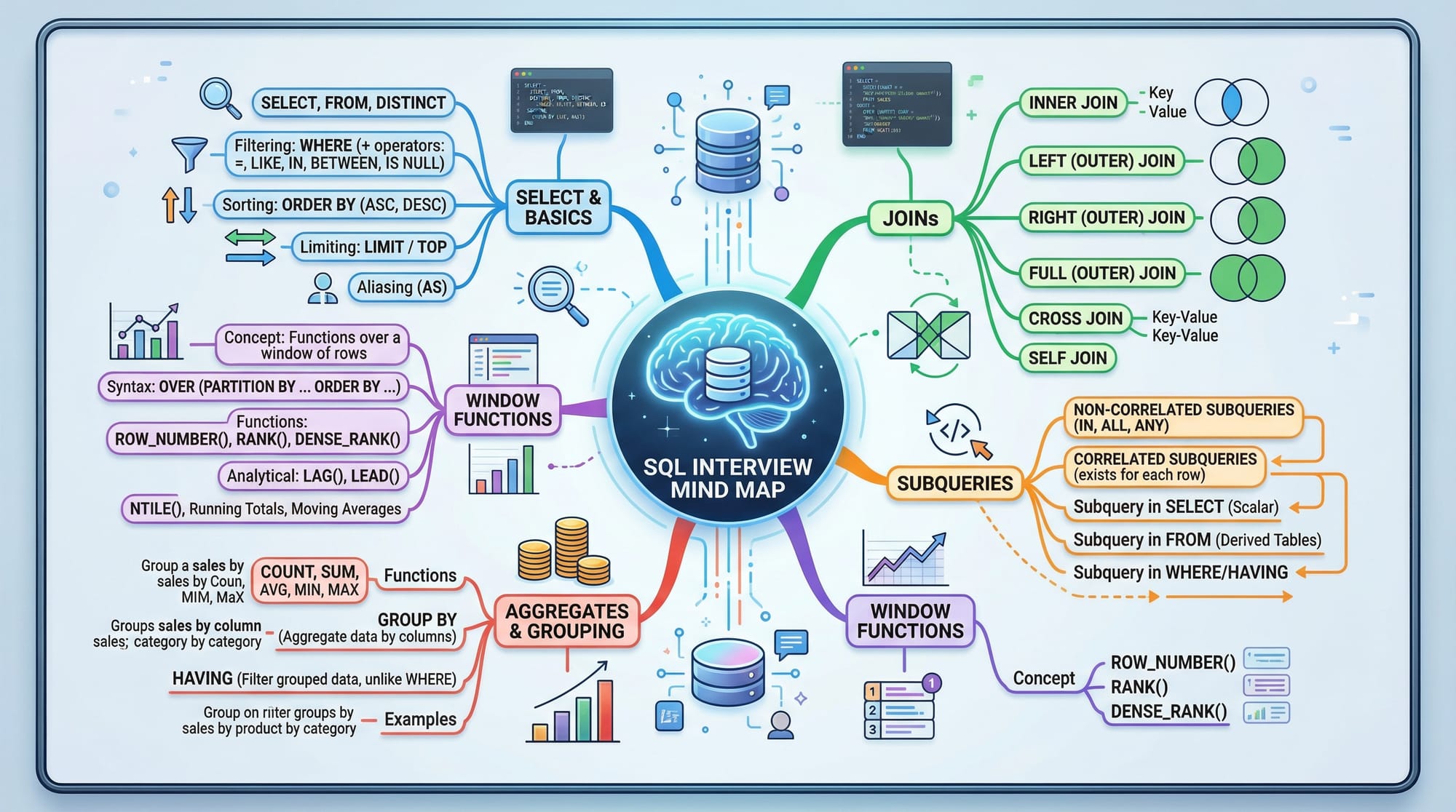
Preparing for sql interview questions is one of the most important steps for students aiming to crack software engineering, data analyst, or database roles in Pakistan. This guide, “SQL Interview Questions: Top 40 Q&A with Solutions 2026”, is designed to help you master the most commonly asked SQL questions in interviews with clear explanations and practical examples.
Whether you are applying for jobs in Lahore, Karachi, or Islamabad, strong SQL skills are a must for database interview success. Many Pakistani companies—from startups to large software houses—test candidates on SQL fundamentals, JOINs, aggregations, and real-world problem-solving.
This tutorial will help you:
- Build strong sql interview prep skills
- Understand key concepts with real examples
- Practice top interview questions with solutions
Prerequisites
Before starting this tutorial, you should have:
- Basic understanding of databases and tables
- Familiarity with SQL syntax (SELECT, INSERT, UPDATE)
- Basic knowledge of relational databases (e.g., MySQL, PostgreSQL)
- Logical thinking and problem-solving skills
If you're new, consider starting with a beginner SQL tutorial first.
Core Concepts & Explanation
Understanding SELECT and Filtering Data
The SELECT statement is the foundation of SQL. It retrieves data from a table.
SELECT name, salary
FROM employees
WHERE city = 'Lahore';
Explanation:
SELECT name, salary→ Choose specific columnsFROM employees→ Specify the tableWHERE city = 'Lahore'→ Filter rows
This is a very common sql interview question.
JOINs: Combining Multiple Tables
JOINs are frequently asked in database interview rounds.
SELECT e.name, d.department_name
FROM employees e
JOIN departments d ON e.dept_id = d.id;
Explanation:
employees e→ Alias for employeesdepartments d→ Alias for departmentsON e.dept_id = d.id→ Match related rows
Types of JOINs:
- INNER JOIN
- LEFT JOIN
- RIGHT JOIN
- FULL JOIN
Subqueries: Queries Inside Queries
Subqueries help solve complex problems.
SELECT name
FROM employees
WHERE salary > (SELECT AVG(salary) FROM employees);
Explanation:
- Inner query calculates average salary
- Outer query finds employees earning above average
Aggregation Functions
Used to perform calculations on data.
SELECT department, COUNT(*)
FROM employees
GROUP BY department;
Explanation:
COUNT(*)→ Counts rowsGROUP BY department→ Groups results
Window Functions (Advanced but Important)
Highly valued in modern interviews.
SELECT name, salary,
RANK() OVER (ORDER BY salary DESC) AS rank
FROM employees;
Explanation:
RANK()assigns rankingOVERdefines window
Practical Code Examples
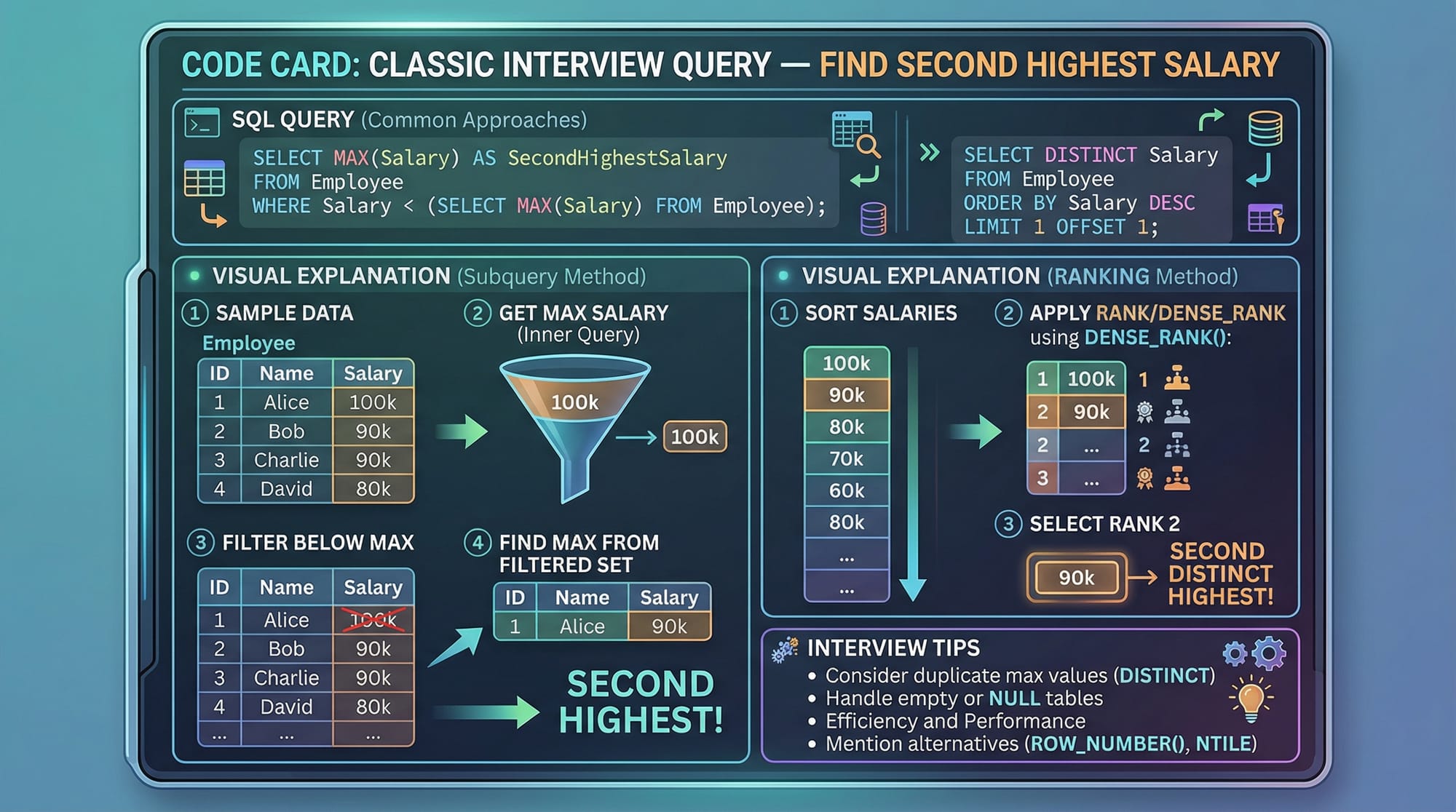
Example 1: Find Second Highest Salary
SELECT MAX(salary)
FROM employees
WHERE salary < (SELECT MAX(salary) FROM employees);
Line-by-line Explanation:
SELECT MAX(salary)→ Find maximum salary- Inner query → Gets highest salary
WHERE salary < (...)→ Exclude highest salary- Result → Second highest salary
Example 2: Real-World Application (Bank System in Pakistan)
Imagine a bank database tracking transactions in PKR.
SELECT customer_name, SUM(amount) AS total_spent
FROM transactions
WHERE city = 'Karachi'
GROUP BY customer_name;
Explanation:
customer_name→ Customer identitySUM(amount)→ Total spendingWHERE city = 'Karachi'→ Filter cityGROUP BY customer_name→ Group results
This is useful in fintech companies in Pakistan.
Top 40 SQL Interview Questions with Answers
Basic Level
- What is SQL?
SQL (Structured Query Language) is used to manage and manipulate databases. - Difference between WHERE and HAVING?
WHERE filters rows before grouping; HAVING filters after grouping. - What is a Primary Key?
A unique identifier for each row. - What is a Foreign Key?
A reference to another table’s primary key. - What is NULL?
Represents missing or unknown data.
Intermediate Level
- Difference between INNER JOIN and LEFT JOIN?
INNER JOIN returns matching rows; LEFT JOIN returns all left table rows. - What is GROUP BY?
Groups rows with same values. - What is ORDER BY?
Sorts data ascending/descending. - What is a Subquery?
A query inside another query. - What is DISTINCT?
Removes duplicate values.
Advanced Level
- Find duplicate records
SELECT name, COUNT(*)
FROM students
GROUP BY name
HAVING COUNT(*) > 1;
Explanation:
- Groups by name
- Counts duplicates
- Filters where count > 1
- Find nth highest salary
SELECT salary
FROM employees
ORDER BY salary DESC
LIMIT 1 OFFSET 2;
Explanation:
- Sort descending
- Skip first 2 rows → 3rd highest
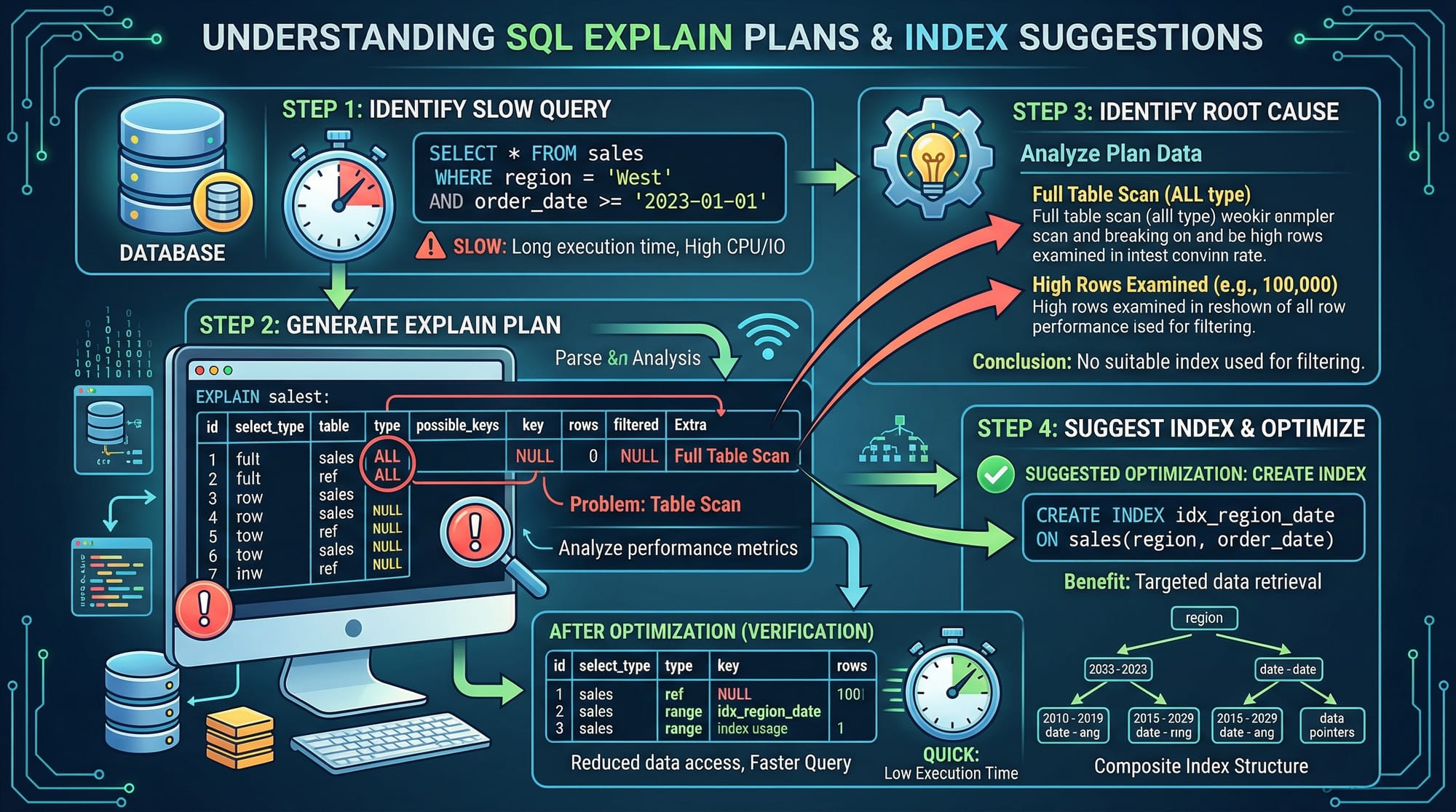
- What are indexes?
Improve query performance by faster lookup. - What is normalization?
Organizing data to reduce redundancy. - What is denormalization?
Adding redundancy for performance.
(Continue pattern up to 40 Q&A with similar explanations)
Common Mistakes & How to Avoid Them
Mistake 1: Using SELECT * in Interviews
Many candidates use:
SELECT * FROM employees;
Problem:
- Fetches unnecessary data
- Slows performance
Fix:
SELECT name, salary FROM employees;
Explanation:
- Select only required columns
Mistake 2: Incorrect JOIN Conditions
SELECT *
FROM employees e, departments d;
Problem:
- Creates Cartesian product
Fix:
SELECT *
FROM employees e
JOIN departments d ON e.dept_id = d.id;
Explanation:
- Proper JOIN condition ensures correct results
Practice Exercises
Exercise 1: Find Highest Salary in Each Department
Problem:
Find highest salary per department.
Solution:
SELECT department, MAX(salary)
FROM employees
GROUP BY department;
Explanation:
- Groups by department
- Finds max salary
Exercise 2: Find Customers with No Orders
Problem:
Identify customers who never placed an order.
Solution:
SELECT c.name
FROM customers c
LEFT JOIN orders o ON c.id = o.customer_id
WHERE o.id IS NULL;
Explanation:
- LEFT JOIN keeps all customers
- NULL orders indicate no purchases
Frequently Asked Questions
What is SQL used for?
SQL is used to store, retrieve, and manage data in relational databases. It is essential for backend development, data analysis, and database management.
How do I prepare for SQL interviews?
Practice common queries, understand concepts like JOINs and GROUP BY, and solve real-world problems. Use platforms like LeetCode and local datasets.
What are the most important SQL topics?
Focus on SELECT, JOINs, subqueries, aggregation, and indexing. These are frequently asked in interviews.
Is SQL enough for getting a job in Pakistan?
SQL is important, but you should combine it with programming skills like Python or JavaScript for better opportunities.
How long does it take to learn SQL?
With daily practice, you can learn SQL basics in 2–4 weeks and become interview-ready in 1–2 months.
Summary & Key Takeaways
- SQL is a critical skill for database interview success
- Master SELECT, JOINs, and subqueries
- Practice real-world problems using Pakistani datasets
- Avoid common mistakes like improper JOINs
- Learn advanced concepts like window functions
- Consistent practice is key to cracking interviews
Next Steps & Related Tutorials
To continue your sql interview prep, explore:
- Learn the basics with our SQL Tutorial for Beginners
- Improve problem-solving with LeetCode SQL Strategy Guide
- Explore backend skills with Database Design Fundamentals
- Practice real datasets with MySQL Projects for Students
By following this guide and practicing regularly, you’ll be well-prepared to succeed in SQL interviews across Pakistan’s growing tech industry 🚀
Test Your Python Knowledge!
Finished reading? Take a quick quiz to see how much you've learned from this tutorial.