Stacks & Queues Implementation Operations & Use Cases
Introduction
Stacks and queues are two of the most fundamental concepts in Data Structures & Algorithms (DSA). They help us organize and manage data efficiently, which is essential for building real-world applications such as web browsers, banking systems, and operating systems.
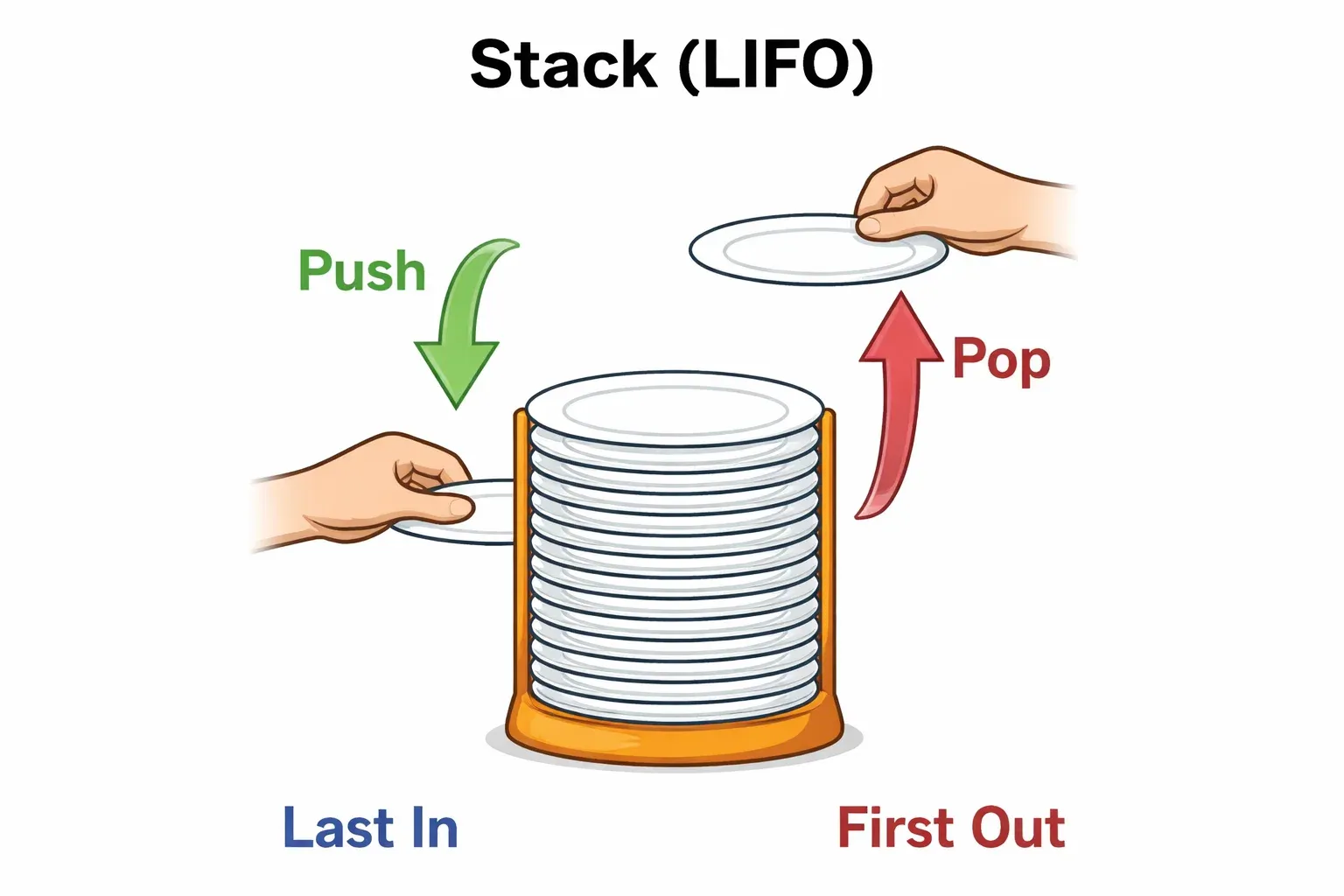
A stack data structure works on the principle of Last In, First Out (LIFO), while a queue data structure follows First In, First Out (FIFO). Understanding both will help you solve problems more efficiently and write cleaner code.
For Pakistani students—whether you're studying in Lahore, Karachi, or Islamabad—mastering stacks and queues is crucial for:
- University exams (BSCS, BSIT)
- Technical interviews
- Competitive programming
Prerequisites
Before starting this tutorial, you should have:
- Basic knowledge of programming (Python preferred)
- Understanding of variables, loops, and functions
- Familiarity with lists/arrays
- Basic problem-solving mindset
Core Concepts & Explanation
Stack Data Structure (LIFO Principle)
A stack is a linear data structure where elements are added and removed from the same end, called the top.
Key Operations:
- Push → Add element to the top
- Pop → Remove element from the top
- Peek/Top → View the top element
- isEmpty → Check if stack is empty
Example:
Imagine Ahmad stacking books:
- Ahmad places Math book
- Then Physics book
- Then Chemistry book
Now, the last book (Chemistry) will be removed first.
Stack:
Top → Chemistry
        Physics
        Math
Queue Data Structure (FIFO Principle)
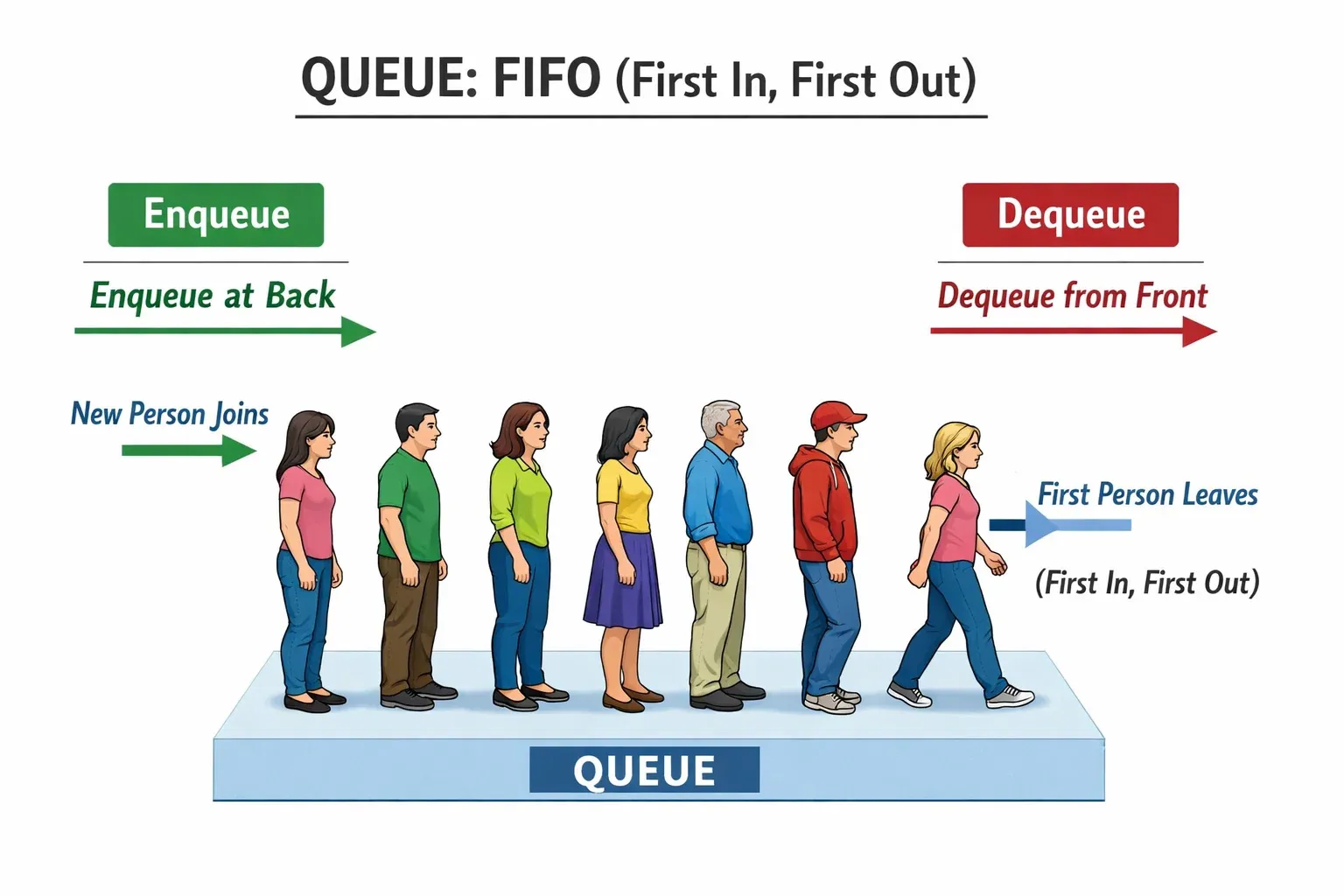
A queue is a linear data structure where elements are added at the rear and removed from the front.
Key Operations:
- Enqueue → Add element to the rear
- Dequeue → Remove element from the front
- Front → View first element
- isEmpty → Check if queue is empty
Example:
Fatima is standing in a queue at a bank in Karachi:
- Ali comes first
- Ahmad comes second
- Fatima comes third
Now, Ali will be served first, then Ahmad, then Fatima.
Stack vs Queue
| Feature | Stack | Queue |
|---|---|---|
| Principle | LIFO | FIFO |
| Insertion | Top | Rear |
| Deletion | Top | Front |
| Example | Undo operations | Waiting lines |
Practical Code Examples
Example 1: Implementing Stack in Python
# Create an empty stack
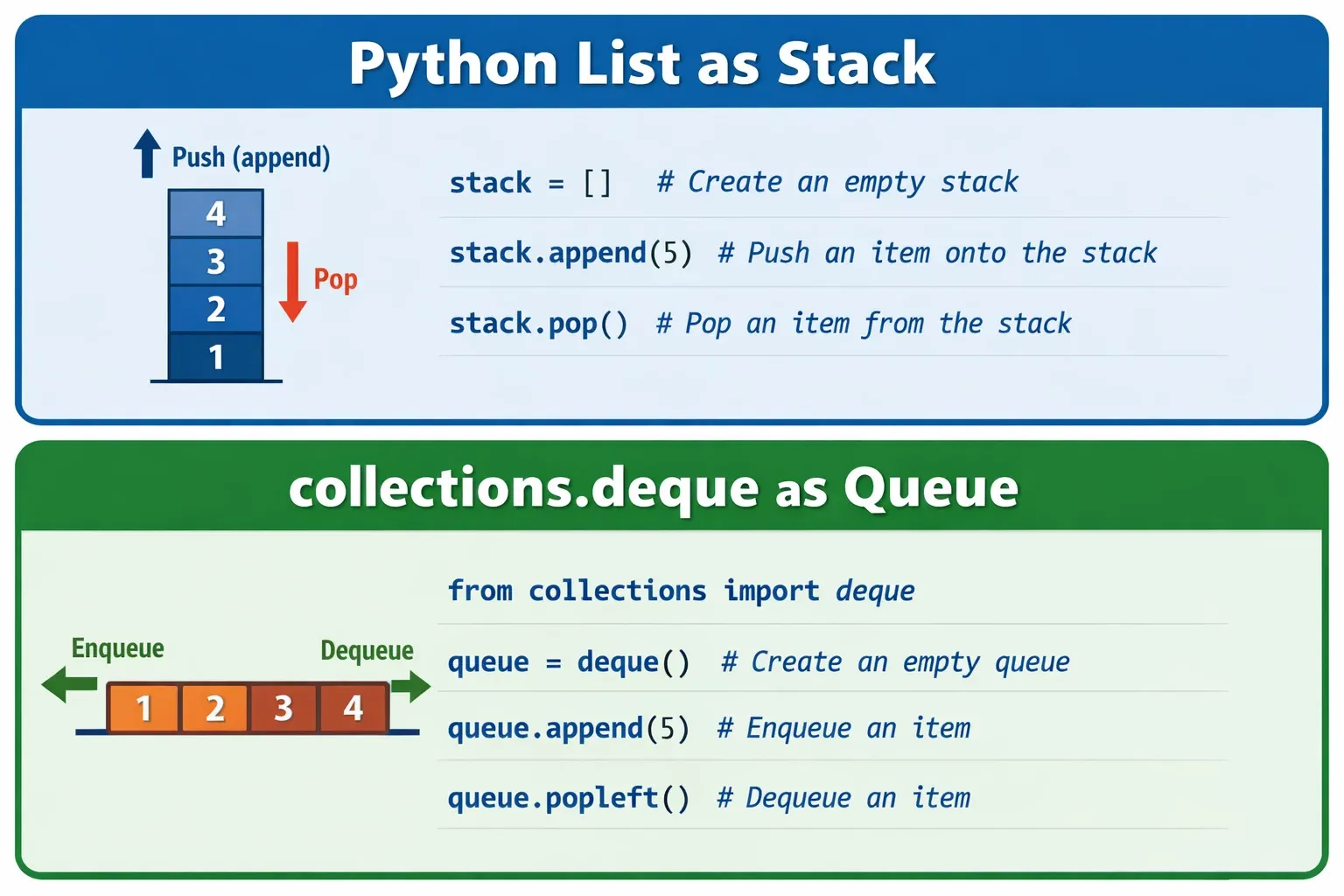
stack = []

# Push elements
stack.append(10)
stack.append(20)
stack.append(30)

print("Stack after pushes:", stack)

# Pop element
removed = stack.pop()
print("Popped element:", removed)

# Peek top element
top_element = stack[-1]
print("Top element:", top_element)
Line-by-line Explanation:
stack = []→ Creates an empty list to act as a stackappend()→ Adds elements to the top (push operation)print()→ Displays stack contentspop()→ Removes last element (LIFO behavior)stack[-1]→ Accesses the top element without removing it
Example 2: Real-World Application (Queue using deque)
from collections import deque

# Create a queue
queue = deque()

# Enqueue elements
queue.append("Ali")
queue.append("Ahmad")
queue.append("Fatima")

print("Queue:", queue)

# Dequeue element
served = queue.popleft()
print("Served:", served)

# Front element
print("Next in line:", queue[0])
Line-by-line Explanation:
from collections import deque→ Imports efficient queue structuredeque()→ Creates a queueappend()→ Adds element at rear (enqueue)popleft()→ Removes element from front (dequeue)queue[0]→ Shows front element
Common Mistakes & How to Avoid Them
Mistake 1: Using List for Queue Incorrectly
Many beginners use Python lists for queues:
queue = []
queue.append(10)
queue.pop(0)  # inefficient
Problem:
pop(0)is slow (O(n)) because it shifts elements
Solution:
Use deque instead:
from collections import deque
queue = deque()
queue.append(10)
queue.popleft()
Mistake 2: Stack Underflow (Popping Empty Stack)
stack = []
stack.pop()  # error!
Problem:
- Raises error if stack is empty
Solution:
Check before popping:
if stack:
    stack.pop()
else:
    print("Stack is empty")
Practice Exercises
Exercise 1: Reverse a String Using Stack
Problem:
Write a program to reverse a string using a stack.
Solution:
def reverse_string(s):
    stack = []

    # Push all characters
    for char in s:
        stack.append(char)

    reversed_str = ""

    # Pop all characters
    while stack:
        reversed_str += stack.pop()

    return reversed_str

print(reverse_string("Pakistan"))
Explanation:
- Characters pushed one by one
- Popped in reverse order (LIFO)
- Result becomes reversed string
Exercise 2: Implement Simple Queue System
Problem:
Simulate a queue where students enter and leave a lab.
Solution:
from collections import deque

def lab_queue():
    queue = deque()

    queue.append("Ali")
    queue.append("Fatima")
    queue.append("Ahmad")

    print("Initial queue:", queue)

    queue.popleft()
    print("After one leaves:", queue)

lab_queue()
Explanation:
- Students join queue (enqueue)
- First student leaves (dequeue)
- Queue updates accordingly
Frequently Asked Questions
What is a stack data structure?
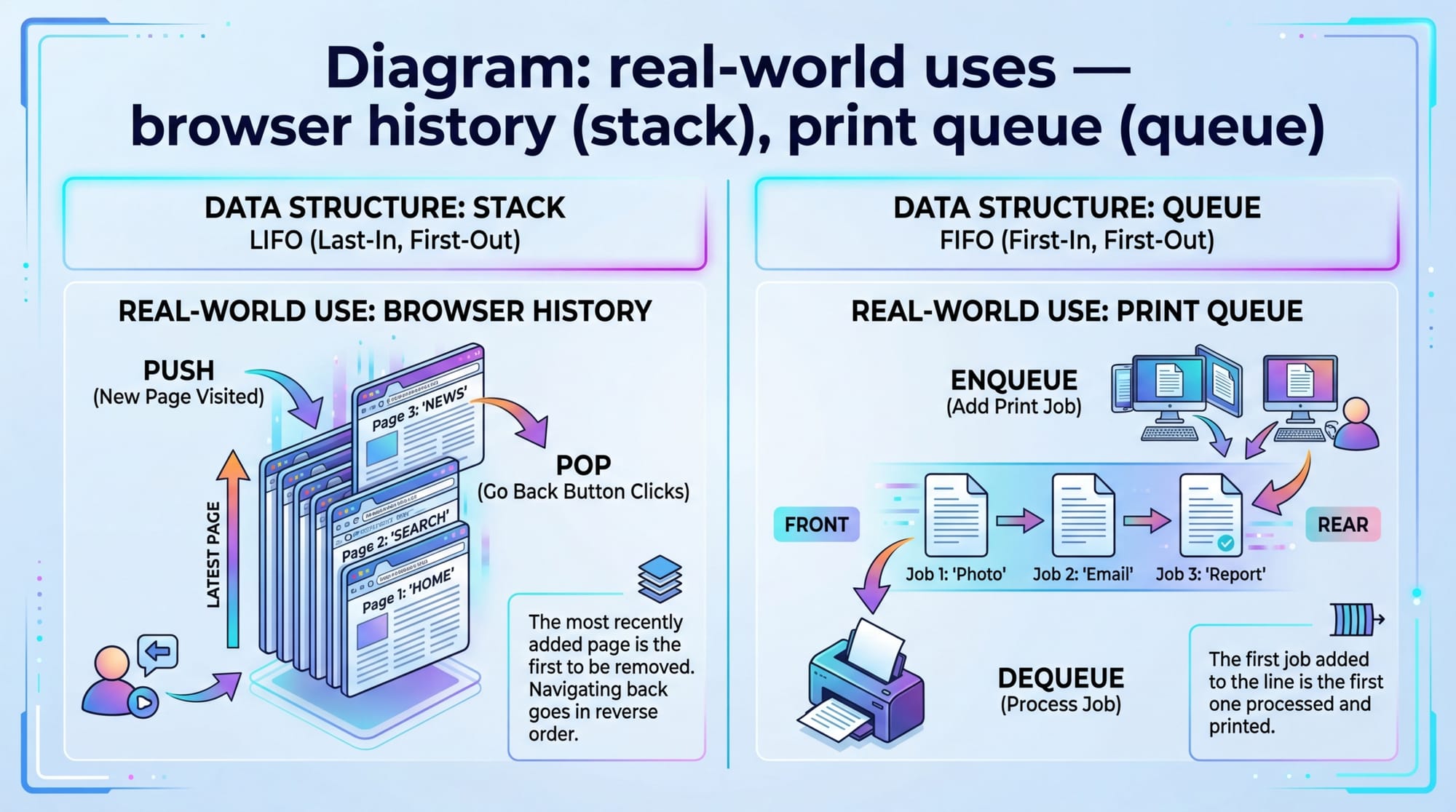
A stack is a linear data structure that follows the LIFO principle, where the last element added is the first one removed. It is commonly used in undo operations and recursion.
What is a queue data structure?
A queue is a linear data structure that follows FIFO, meaning the first element added is the first one removed. It is used in scheduling and buffering tasks.
How do I choose between stack vs queue?
Use a stack when you need reverse order processing (like undo/redo). Use a queue when tasks must be processed in order, such as print jobs or waiting lines.
How do I implement a stack in Python?
You can use a Python list with append() for push and pop() for removal. It is simple and efficient for most beginner use cases.
How do I avoid errors in stacks and queues?
Always check if the structure is empty before removing elements, and use appropriate data structures like deque for queues to improve performance.
Summary & Key Takeaways
- Stack follows LIFO, queue follows FIFO
- Stacks are used in undo operations, recursion, and expression evaluation
- Queues are used in task scheduling and real-world waiting systems
- Python lists work well for stacks, but use
dequefor queues - Avoid common errors like underflow and inefficient operations
- Understanding stack vs queue is essential for DSA mastery
Next Steps & Related Tutorials
To strengthen your DSA skills, continue with:
- Learn how data is stored using Arrays & Linked Lists
- Understand hierarchical structures with Binary Trees
- Explore searching and sorting algorithms for real-world problem solving
- Practice problem-solving on theiqra.edu.pk with beginner-friendly exercises
By mastering stacks and queues, you are building a strong foundation for advanced topics like graphs, recursion, and system design. Keep practicing—success in programming comes with consistency! 🚀
Test Your Python Knowledge!
Finished reading? Take a quick quiz to see how much you've learned from this tutorial.