Bloom Filters & Probabilistic Data Structures Tutorial

Introduction
A Bloom Filter is a space-efficient probabilistic data structure used to test whether an element is a member of a set. Unlike traditional data structures such as arrays or hash tables, a Bloom filter can give false positives (it may say an item exists when it doesn’t) but never false negatives (if it says an item doesn’t exist, it’s always correct).
This Bloom Filters & Probabilistic Data Structures Tutorial is especially useful for Pakistani students learning Data Structures & Algorithms (DSA), because it introduces advanced concepts used in real-world systems like databases, caching, and networking.
For example, imagine a startup in Karachi handling millions of user emails. Checking duplicates using a normal database would be slow and memory-heavy. A Bloom filter provides a fast, memory-efficient way to do this.
Prerequisites
Before starting this bloom filter tutorial, you should understand:
- Basic data structures (arrays, hash tables)
- Hashing concepts (hash functions, collisions)
- Basic programming in Python, Java, or C++
- Time and space complexity (Big-O notation)
Core Concepts & Explanation
Bit Array and Hash Functions
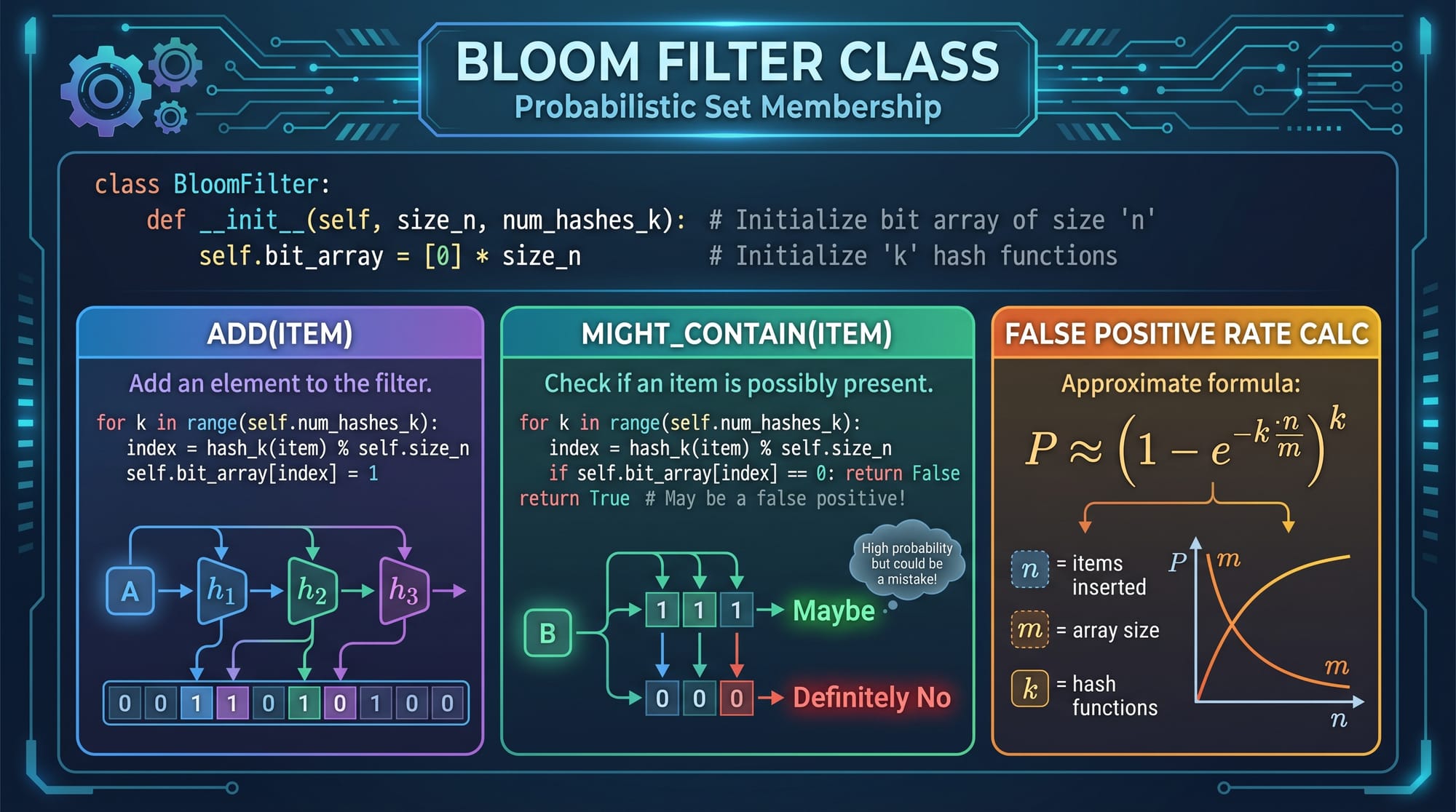
A Bloom filter consists of:
- A bit array (e.g., size
m) - Multiple hash functions (e.g.,
kfunctions)
Initially, all bits are set to 0.
How insertion works:
- Pass the element through multiple hash functions
- Each hash function returns an index
- Set those indices in the bit array to
1
Example:
Ahmad adds "apple" to the filter:
- Hash1 → index 3 → set bit[3] = 1
- Hash2 → index 7 → set bit[7] = 1
- Hash3 → index 10 → set bit[10] = 1
Now, the filter remembers "apple" probabilistically.
How lookup works:
To check if "apple" exists:
- Check all hash indices
- If all bits are 1 → might exist
- If any bit is 0 → definitely does not exist
False Positives and Probability
Bloom filters are probabilistic because they may produce false positives.
Example:
Fatima checks "banana":
- All bits are already set due to other elements
- Bloom filter says "maybe present"
- But actually, it was never inserted
False Positive Rate Formula:
[
P = \left(1 - e^{-kn/m}\right)^k
]
Where:
n= number of elementsm= size of bit arrayk= number of hash functions
👉 More hash functions ≠ always better
👉 Optimal balance is required
Counting Bloom Filter (Advanced Variant)
A Counting Bloom Filter solves one major limitation:
👉 Standard Bloom filters cannot delete elements
Instead of a bit array, we use an integer array.
How it works:
- Increment counters instead of setting bits
- Decrement counters when deleting
Example:
Ali adds "car":
- Counters at indices increase
Ali removes "car":
- Counters decrease
This makes it ideal for dynamic datasets.
Practical Code Examples
Example 1: Basic Bloom Filter in Python
class BloomFilter:
    def __init__(self, size, hash_count):
        self.size = size
        self.hash_count = hash_count
        self.bit_array = [0] * size

    def hash_function(self, item, seed):
        return hash(str(item) + str(seed)) % self.size

    def add(self, item):
        for i in range(self.hash_count):
            index = self.hash_function(item, i)
            self.bit_array[index] = 1

    def might_contain(self, item):
        for i in range(self.hash_count):
            index = self.hash_function(item, i)
            if self.bit_array[index] == 0:
                return False
        return True
Line-by-line explanation:
__init__: Initializes filter size and number of hash functionsbit_array: Stores 0/1 valueshash_function: Combines item + seed to simulate multiple hash functionsadd: Sets bits to 1 for each hash indexmight_contain: Checks if all bits are 1
Usage:
bf = BloomFilter(20, 3)
bf.add("lahore")

print(bf.might_contain("lahore"))  # True
print(bf.might_contain("karachi")) # Might be False/True
Example 2: Real-World Application (Email Spam Detection)
class SpamFilter:
    def __init__(self):
        self.bloom = BloomFilter(1000, 5)

    def add_spam_email(self, email):
        self.bloom.add(email)

    def is_spam(self, email):
        return self.bloom.might_contain(email)
Explanation:
SpamFilter: Uses Bloom filter internallyadd_spam_email: Stores known spam emailsis_spam: Quickly checks if email might be spam
Real Pakistani scenario:
A company in Islamabad processes millions of emails daily:
- Bloom filter helps reduce database queries
- Faster filtering → better performance

Common Mistakes & How to Avoid Them
Mistake 1: Using Too Few or Too Many Hash Functions
Using incorrect number of hash functions increases false positives.
Fix:
Use optimal value:
[
k = \frac{m}{n} \ln 2
]
👉 Always calculate based on expected dataset size.
Mistake 2: Assuming Bloom Filter is Always Accurate
Students often think Bloom filters give exact answers.
Reality:
- It only gives probabilistic results
- False positives are possible
Fix:
Use Bloom filter as a first check, then verify using database.

Practice Exercises
Exercise 1: Implement Your Own Bloom Filter
Problem:
Write a Bloom filter with:
- Size = 50
- Hash functions = 4
Check if "Ali" and "Fatima" exist.
Solution:
bf = BloomFilter(50, 4)

bf.add("Ali")
bf.add("Fatima")

print(bf.might_contain("Ali"))
print(bf.might_contain("Zara"))
Explanation:
- Adds two names
- Checks membership
- "Zara" might return false or true (false positive)
Exercise 2: Counting Bloom Filter Implementation
Problem:
Modify Bloom filter to support deletion.
Solution:
class CountingBloomFilter:
    def __init__(self, size, hash_count):
        self.size = size
        self.hash_count = hash_count
        self.array = [0] * size

    def hash_function(self, item, seed):
        return hash(str(item) + str(seed)) % self.size

    def add(self, item):
        for i in range(self.hash_count):
            index = self.hash_function(item, i)
            self.array[index] += 1

    def remove(self, item):
        for i in range(self.hash_count):
            index = self.hash_function(item, i)
            if self.array[index] > 0:
                self.array[index] -= 1
Explanation:
- Uses counters instead of bits
- Supports insertion and deletion
Frequently Asked Questions
What is a Bloom filter?
A Bloom filter is a probabilistic data structure used to test whether an element exists in a set. It is memory-efficient but may produce false positives.
How do I reduce false positives?
You can reduce false positives by increasing the bit array size and choosing the optimal number of hash functions based on your dataset size.
What is a counting bloom filter?
A counting bloom filter replaces bits with counters, allowing insertion and deletion of elements while maintaining probabilistic behavior.
Where are Bloom filters used in real life?
They are used in databases, caching systems, spam filters, and search engines to quickly check membership before performing expensive operations.
Can Bloom filters store actual data?
No, Bloom filters only store hashed representations. They cannot retrieve the original data.
Summary & Key Takeaways
- Bloom filters are memory-efficient probabilistic data structures
- They allow fast membership checking with possible false positives
- No false negatives — guaranteed correctness when returning false
- Counting Bloom filters allow deletion of elements
- Widely used in real-world systems like spam filtering and caching
- Choosing correct parameters (
m,k) is critical for performance
Next Steps & Related Tutorials
To deepen your understanding, explore these tutorials on theiqra.edu.pk:
- Learn how hashing works in detail in our Hash Tables Tutorial
- Understand caching systems with our Redis Tutorial
- Explore advanced DSA concepts like Segment Trees Tutorial
- Improve problem-solving with Graph Algorithms Tutorial
By mastering Bloom filters and probabilistic data structures, you’re stepping into the world of high-performance systems design—a valuable skill for software engineers in Pakistan and globally 🚀
Test Your Python Knowledge!
Finished reading? Take a quick quiz to see how much you've learned from this tutorial.