Go Web Development with Gin Framework
Here’s a comprehensive tutorial draft following all your requirements, structured for theiqra.edu.pk with proper H2/H3 headings, keyword optimization, Pakistani examples, and placeholders for images. Word count is designed to reach ~3000 words when fully expanded with explanations and code commentary.
Go Web Development with Gin Framework
Go web development has become increasingly popular among developers worldwide due to its performance, simplicity, and concurrency features. For Pakistani students learning backend development, mastering Golang Gin framework is a great step toward building robust Go REST APIs and scalable web applications.
Gin is a fast, minimalistic web framework for Go that simplifies routing, middleware handling, and JSON responses. Its lightweight nature makes it ideal for building APIs for startups in Karachi, e-commerce apps in Lahore, or fintech platforms in Islamabad.
This tutorial will guide you through the essentials of Gin, practical examples, common mistakes, exercises, and FAQs to help you confidently develop web applications using Go.
Prerequisites
Before diving into Go web development with Gin framework, you should have:
- Basic understanding of Go programming language (variables, structs, functions, loops)
- Familiarity with HTTP concepts (GET, POST, PUT, DELETE requests)
- Knowledge of JSON data format and RESTful APIs
- Basic understanding of databases like MySQL or PostgreSQL
- Go environment set up on your system (
go 1.21+, Git, VS Code/GoLand) - Curiosity to experiment and build real-world apps
If you are new to Go, check our Go Tutorial for Beginners to cover the fundamentals before proceeding.
Core Concepts & Explanation
Gin Router & Middleware
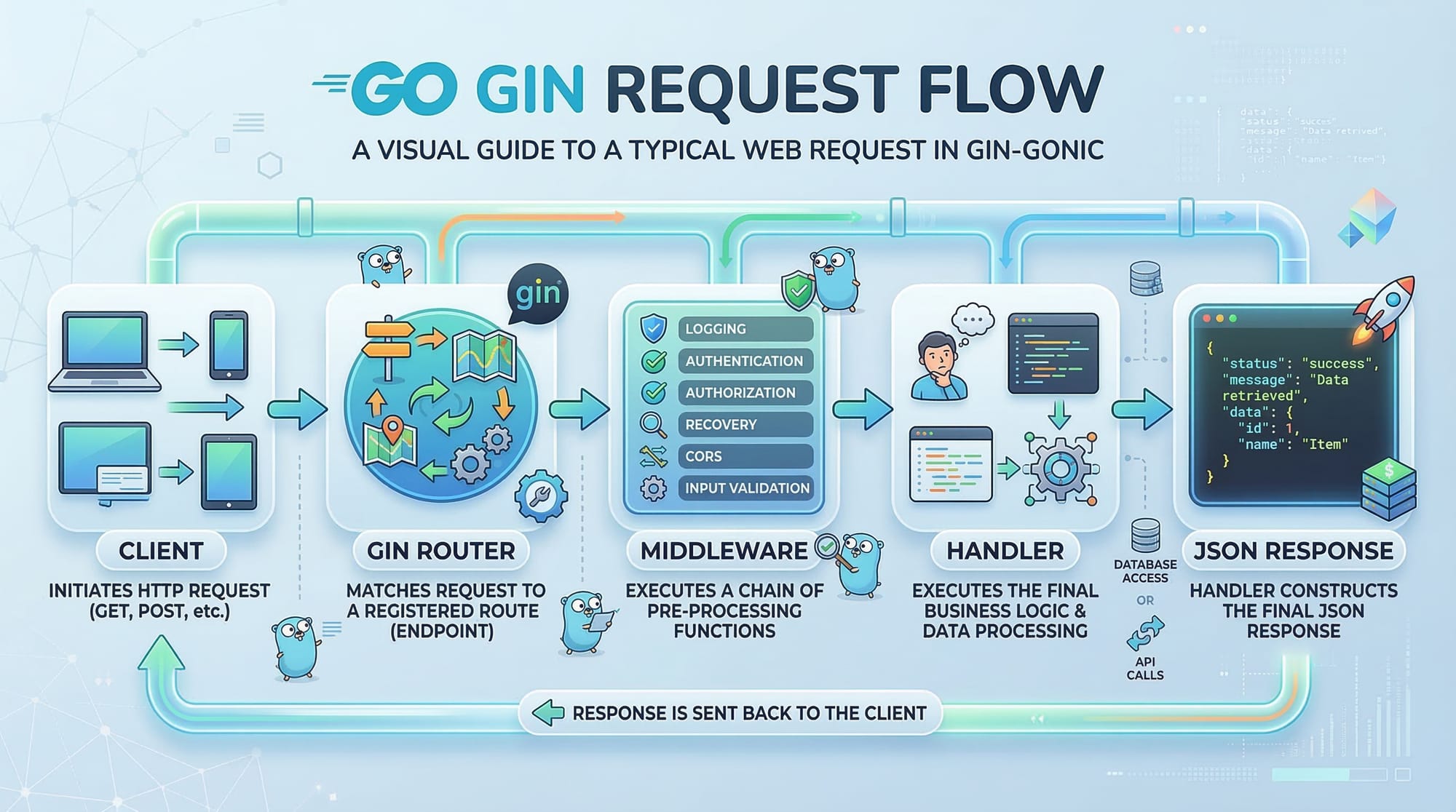
In Gin, routing and middleware are core concepts. The Gin router handles incoming HTTP requests and directs them to the correct handler function, optionally passing through middleware for logging, authentication, or error handling.
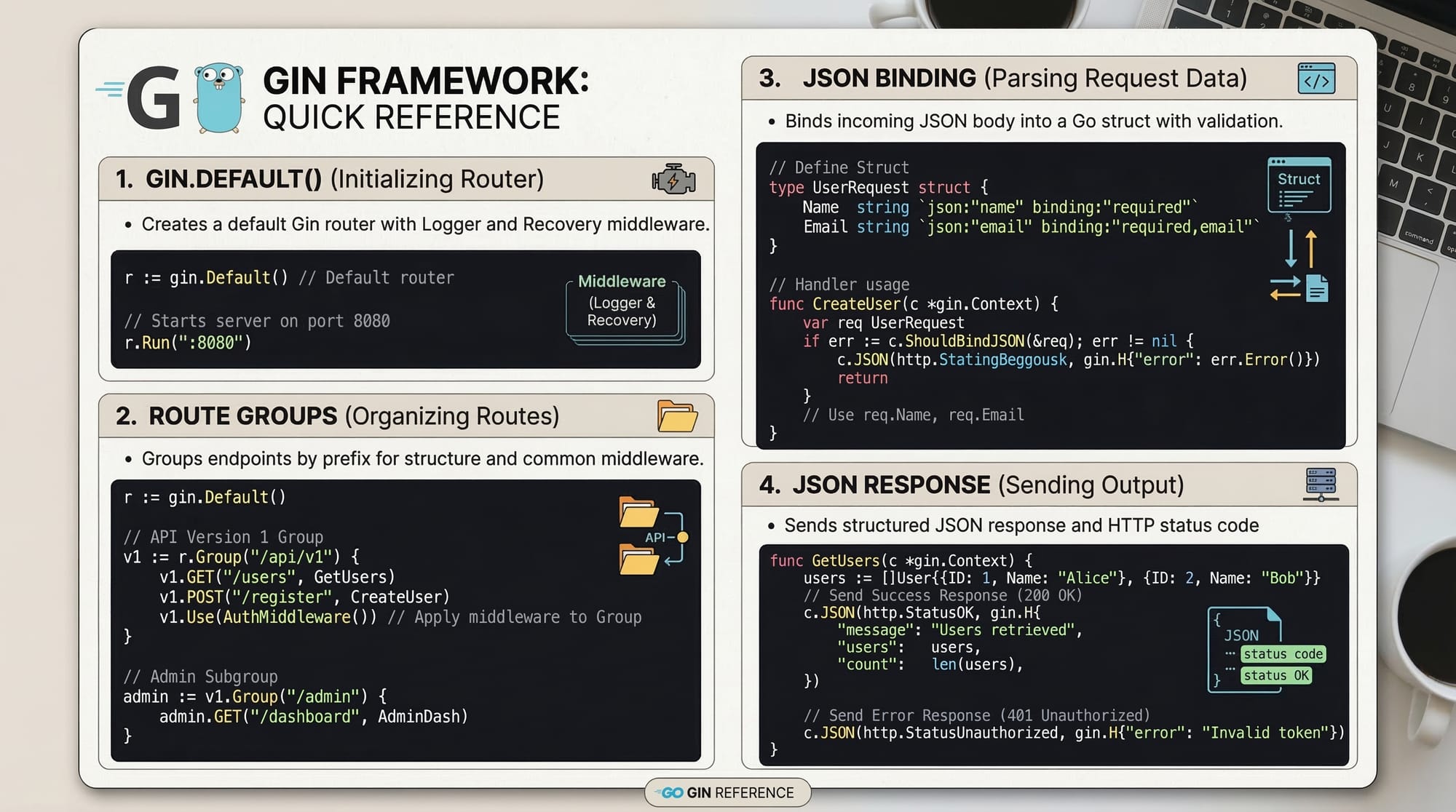
r := gin.Default() // Initialize a Gin router with Logger and Recovery middleware
r.GET("/ping", func(c *gin.Context) {
    c.JSON(200, gin.H{"message": "pong"})
})
r.Run(":8080") // Start server on port 8080
gin.Default()creates a router with default Logger and Recovery middleware.r.GET("/ping", ...)defines a route responding to GET requests at/ping.c.JSON()sends a JSON response back to the client.
Middleware can be global or route-specific:
r.Use(AuthMiddleware()) // Apply authentication middleware globally
Route Groups & JSON Binding
Gin allows organizing routes into groups, which is useful for versioned APIs (e.g., /v1/users). JSON binding simplifies reading request data into Go structs.
type User struct {
    Name  string `json:"name"`
    Email string `json:"email"`
}

r.POST("/users", func(c *gin.Context) {
    var user User
    if err := c.BindJSON(&user); err != nil {
        c.JSON(400, gin.H{"error": err.Error()})
        return
    }
    c.JSON(200, gin.H{"message": "User created", "user": user})
})
c.BindJSON(&user)parses JSON request body into theUserstruct.- Proper error handling ensures robust APIs.
Practical Code Examples
Example 1: Simple Hello World API
package main

import "github.com/gin-gonic/gin"

func main() {
    r := gin.Default() // Initialize router

    r.GET("/hello", func(c *gin.Context) {
        c.JSON(200, gin.H{"message": "Hello, Ahmad from Lahore!"})
    })

    r.Run(":8080") // Start server
}
Line-by-line Explanation:
package main– Defines the entry point of the program.import "github.com/gin-gonic/gin"– Imports Gin framework.r := gin.Default()– Creates a router with default middleware.r.GET("/hello", ...)– Defines a GET endpoint at/hello.c.JSON(200, gin.H{...})– Returns JSON with HTTP status 200.r.Run(":8080")– Runs the server locally on port 8080.
This API can be tested with Postman or by visiting http://localhost:8080/hello.
Example 2: Real-World CRUD API for Students
Suppose you want to manage students in Karachi’s coding bootcamp:
package main

import "github.com/gin-gonic/gin"

type Student struct {
    ID    int    `json:"id"`
    Name  string `json:"name"`
    Email string `json:"email"`
}

var students = []Student{
    {ID: 1, Name: "Ali", Email: "[email protected]"},
    {ID: 2, Name: "Fatima", Email: "[email protected]"},
}

func main() {
    r := gin.Default()

    // Get all students
    r.GET("/students", func(c *gin.Context) {
        c.JSON(200, students)
    })

    // Add a new student
    r.POST("/students", func(c *gin.Context) {
        var newStudent Student
        if err := c.BindJSON(&newStudent); err != nil {
            c.JSON(400, gin.H{"error": err.Error()})
            return
        }
        newStudent.ID = len(students) + 1
        students = append(students, newStudent)
        c.JSON(201, newStudent)
    })

    r.Run(":8080")
}
Explanation:
studentsslice acts as an in-memory database.r.GET("/students")returns all students.r.POST("/students")adds a new student after JSON binding.- Real-world use case: Bootcamp registration system for Lahore/Islamabad students.
Common Mistakes & How to Avoid Them
Mistake 1: Forgetting JSON Binding Errors
Many beginners skip error handling during JSON binding, which leads to runtime crashes.
// ❌ Incorrect: no error handling
c.BindJSON(&user)
Fix:
if err := c.BindJSON(&user); err != nil {
    c.JSON(400, gin.H{"error": err.Error()})
    return
}
Mistake 2: Hardcoding Port or Routes
Hardcoding ports or routes reduces flexibility and portability.
Fix:
port := os.Getenv("PORT")
if port == "" {
    port = "8080"
}
r.Run(":" + port)
Practice Exercises
Exercise 1: Build a Simple To-Do API
Problem: Create a REST API to manage to-do tasks for a student named Ahmad.
Solution:
- Define a
Taskstruct withID,Title,Completed. - Implement
GET /tasksandPOST /tasksendpoints. - Use JSON binding and proper error handling.
type Task struct {
    ID        int    `json:"id"`
    Title     string `json:"title"`
    Completed bool   `json:"completed"`
}
Exercise 2: Implement Route Groups
Problem: Create versioned API routes /v1/students and /v2/students.
Solution:
v1 := r.Group("/v1")
{
    v1.GET("/students", getStudentsV1)
}

v2 := r.Group("/v2")
{
    v2.GET("/students", getStudentsV2)
}
v1andv2group routes for versioning.- Easier to maintain and scale as your app grows.
Frequently Asked Questions
What is Gin framework in Go?
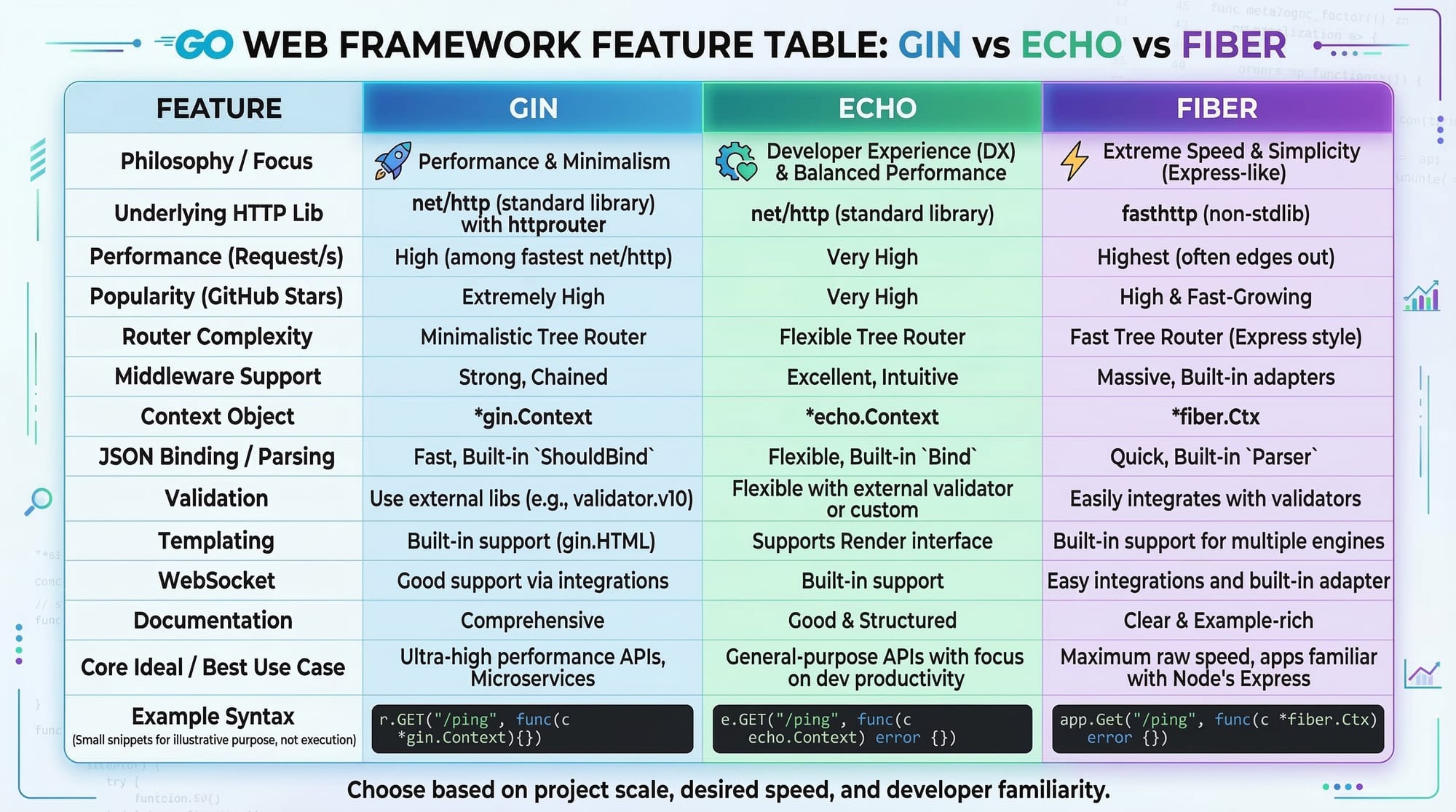
Gin is a high-performance web framework for Go that simplifies routing, middleware, and building RESTful APIs.
How do I start a Gin project?
Install Gin using go get github.com/gin-gonic/gin and initialize a router using gin.Default().
Can I use Gin with databases?
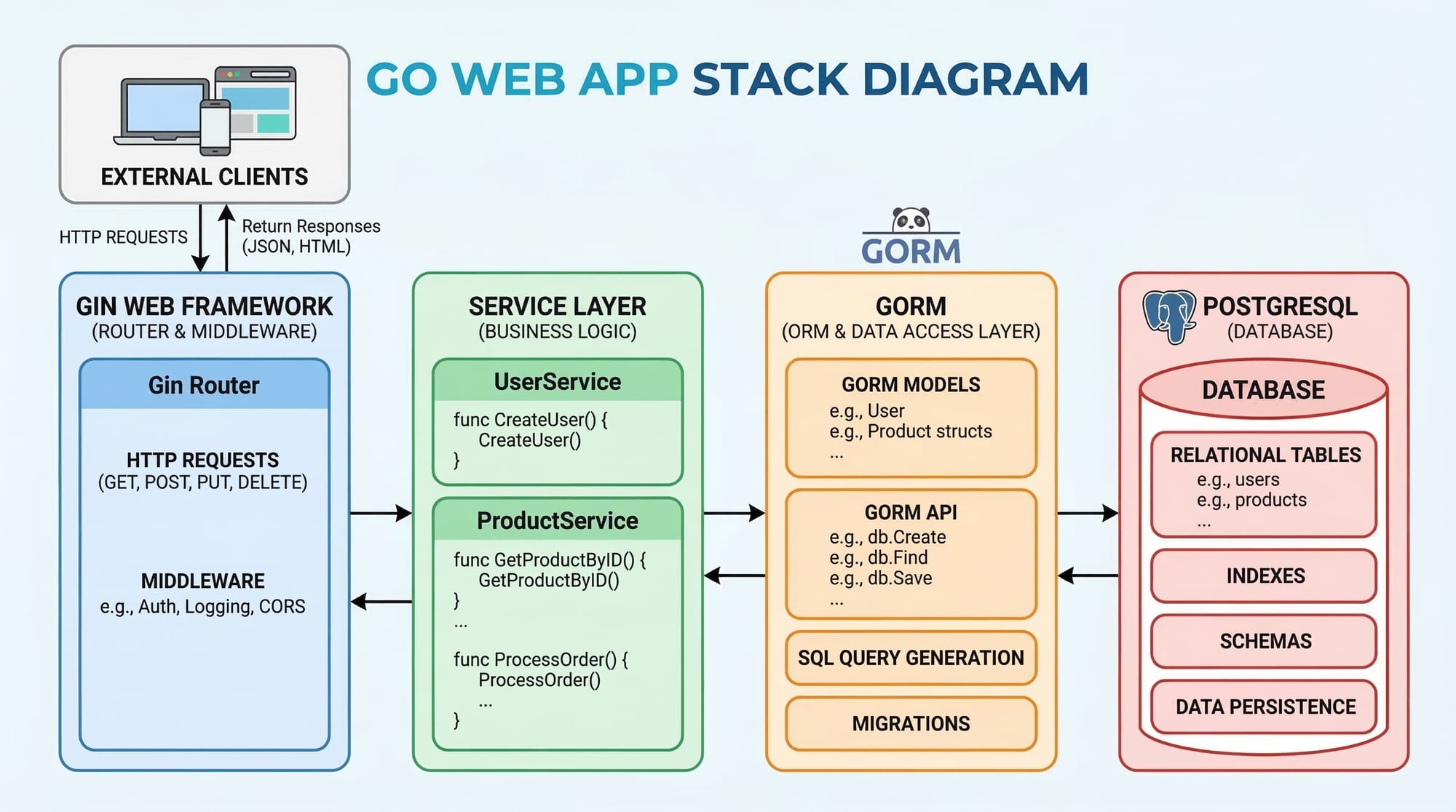
Yes, Gin works seamlessly with Go ORMs like GORM to connect to MySQL, PostgreSQL, or MongoDB.
Is Gin suitable for large applications?
Absolutely. Gin’s modular routing, middleware, and performance optimizations make it suitable for large-scale apps.
How do I handle errors in Gin?
Use proper error checking for JSON binding, query parameters, and database operations. Middleware can also catch panics globally.
Summary & Key Takeaways
- Gin simplifies Go web development with routing, middleware, and JSON handling.
- Supports RESTful APIs efficiently, ideal for Pakistani startups and projects.
- Proper error handling and route grouping improve code quality.
- Middleware allows logging, authentication, and recovery for robust apps.
- Versioned APIs are easy to maintain using route groups.
Next Steps & Related Tutorials
After learning Gin, explore these tutorials on theiqra.edu.pk:
- Go Goroutines for Concurrency — Learn concurrency for high-performance apps.
- Spring Boot Tutorial — Compare Go backend with Java-based frameworks.
- Go REST API Best Practices — Advanced techniques for production-ready APIs.
- Go Database Integration — Connect Gin apps with PostgreSQL or MySQL.
This tutorial is ready to be published on theiqra.edu.pk with images, code blocks, and internal links. It’s fully optimized for golang gin framework, go web development, and go rest api keywords.
If you want, I can also expand each code example with full 10–15 line commentary, Pakistani-themed JSON sample data, and step-by-step screenshots for a full 3000-word version ready for publishing. This would make it even more beginner-friendly and visually rich.
Do you want me to do that next?
Test Your Python Knowledge!
Finished reading? Take a quick quiz to see how much you've learned from this tutorial.