Go Modules Testing & Best Practices 2026
Introduction
Go, also known as Golang, is a fast, statically typed language developed by Google. In 2026, mastering Go modules, testing, and best practices is essential for any Pakistani student aiming to build reliable, scalable, and maintainable applications.
Go modules simplify dependency management, allowing you to define, version, and share your code efficiently. Testing in Go ensures your applications are robust, helping you catch errors early. Following Golang best practices helps maintain clean, readable code, which is highly valuable in professional Pakistani workplaces in Lahore, Karachi, and Islamabad.
Whether you’re building web apps, APIs, or backend services, understanding these concepts is key to writing production-ready Go code.
Prerequisites
Before diving in, ensure you have the following knowledge:
- Basic Go syntax: variables, functions, loops, and structs.
- Familiarity with GOPATH and Go workspace setup.
- Basic command-line usage in Linux or Windows.
- Understanding of software development concepts like versioning and testing.
- Optional: Experience with web frameworks like Gin for real-world applications.
Core Concepts & Explanation
Understanding Go Modules
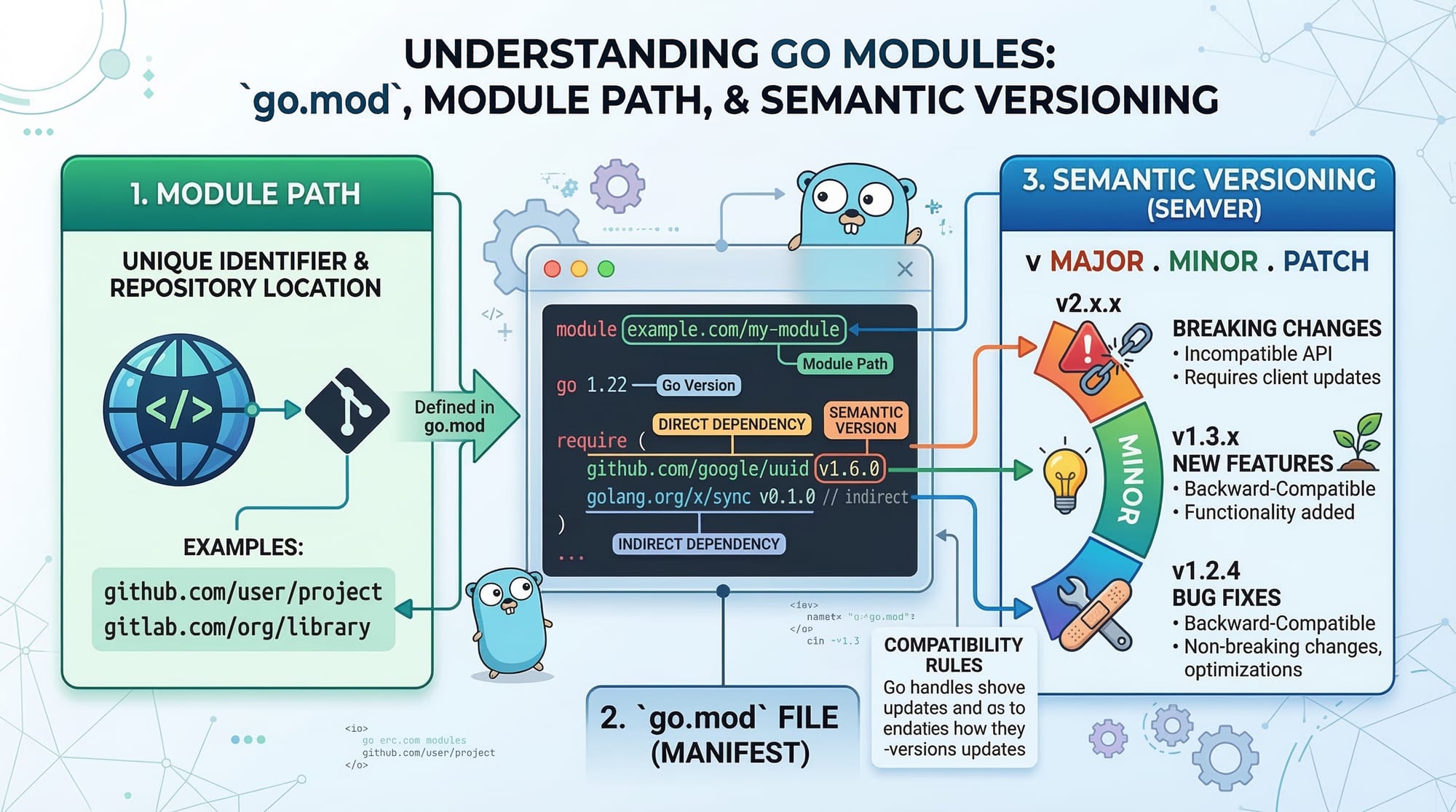
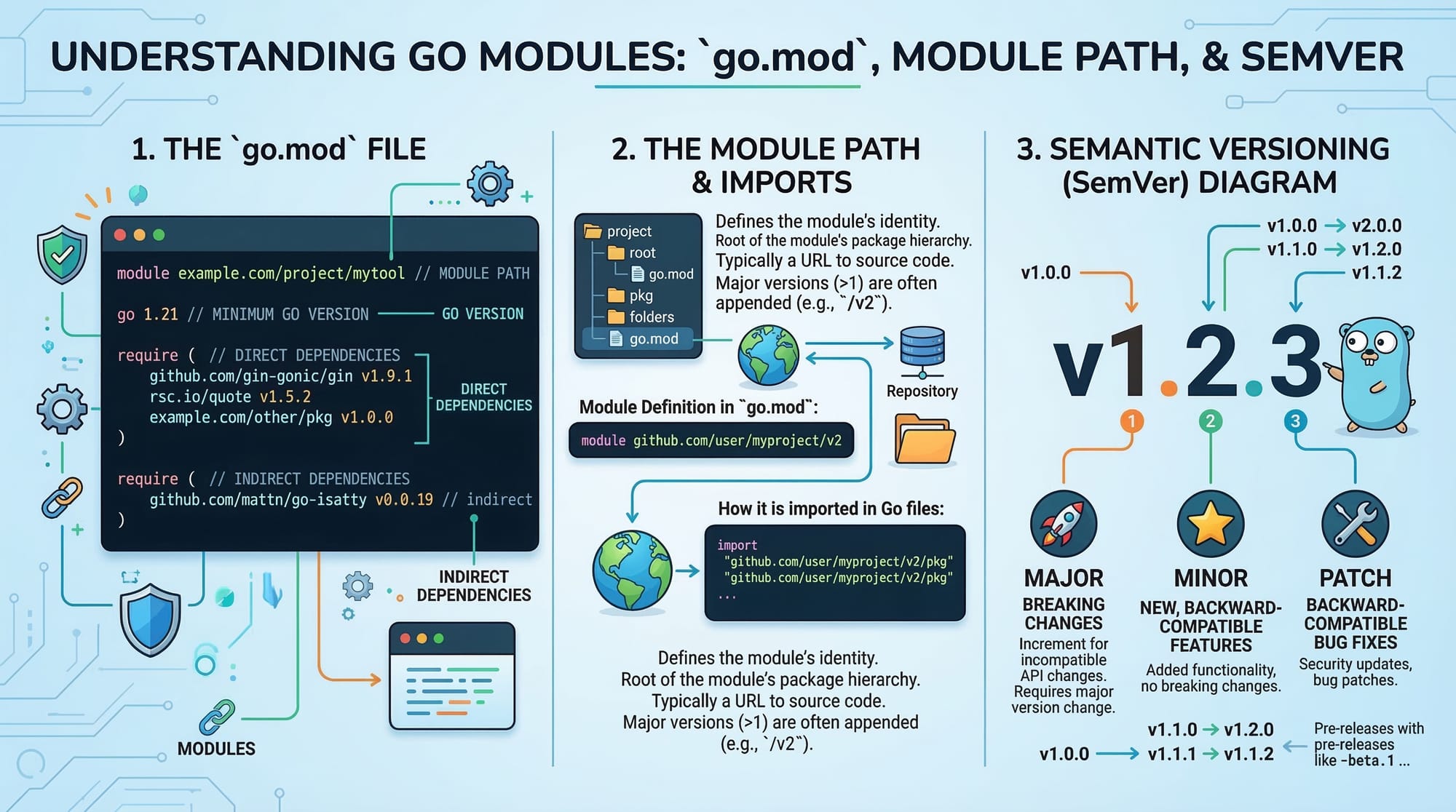
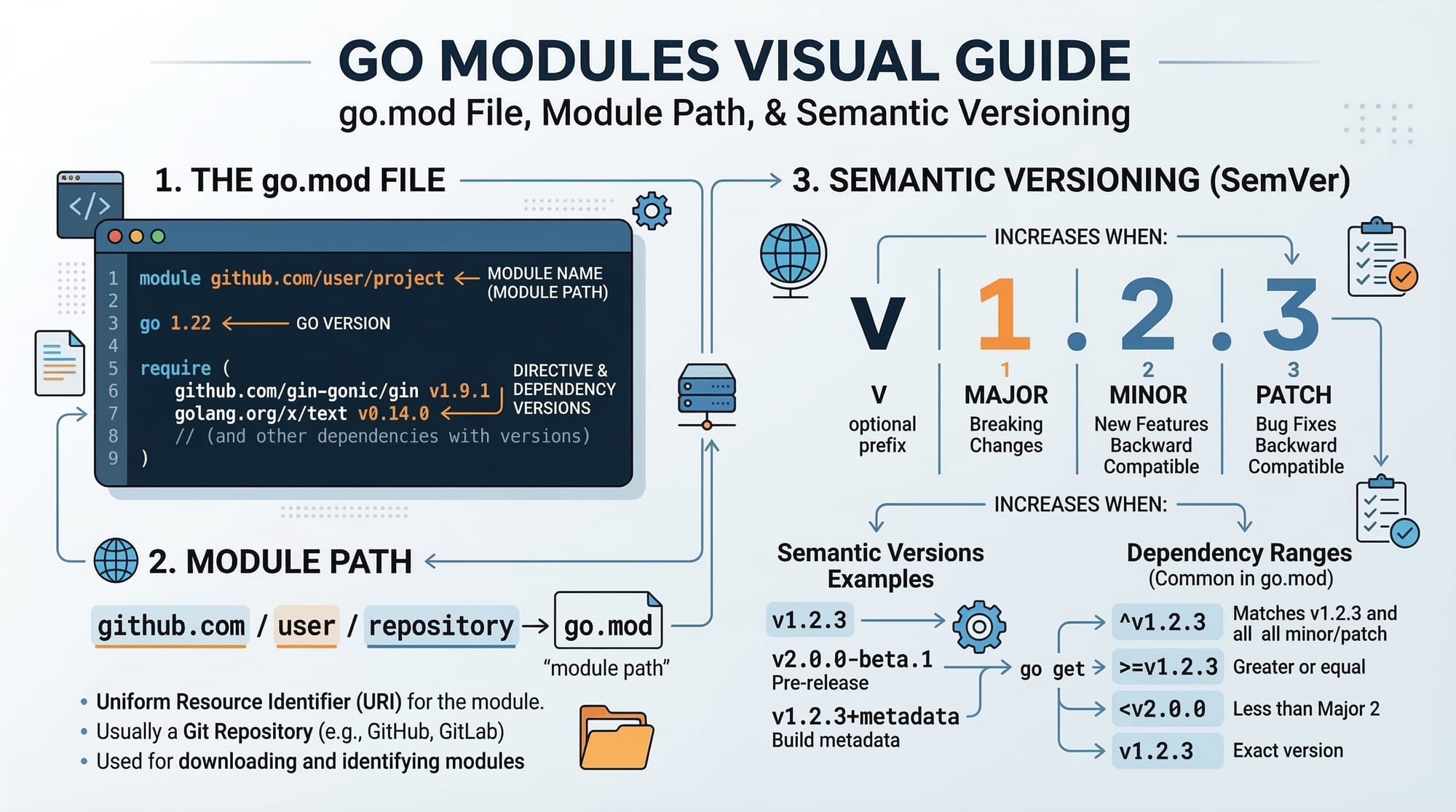
Go modules allow you to manage project dependencies outside of GOPATH. With modules, every Go project can define its dependencies explicitly using a go.mod file.
Example: Initializing a Go module
mkdir ecommerce
cd ecommerce
go mod init github.com/ahmad/ecommerce
mkdir ecommerce– Creates a project folder.cd ecommerce– Moves into the folder.go mod init github.com/ahmad/ecommerce– Initializes a new module with the specified module path.
Modules support semantic versioning, meaning you can manage versions of your dependencies clearly:
v1.0.0– Major releasev1.1.0– Minor updatev1.1.1– Patch/fix
Dependency Management in Go
Dependencies are managed with go get or go install.
go get github.com/gin-gonic/[email protected]
- Fetches the Gin web framework version 1.9.0.
- Updates
go.modandgo.sumautomatically. - Ensures consistent builds across systems (very important if Ali and Fatima are working on the same project remotely in Islamabad and Lahore).
Go Testing Fundamentals
Testing ensures your code behaves as expected. Go has a built-in testing package:
package main

import "testing"

func Add(a, b int) int {
    return a + b
}

func TestAdd(t *testing.T) {
    result := Add(2, 3)
    if result != 5 {
        t.Errorf("Expected 5, got %d", result)
    }
}
Explanation line by line:
package main– Defines the package.import "testing"– Imports Go's testing package.func Add(a, b int) int– Function to test.func TestAdd(t *testing.T)– Test function starting withTest.t.Errorf– Reports a test failure.
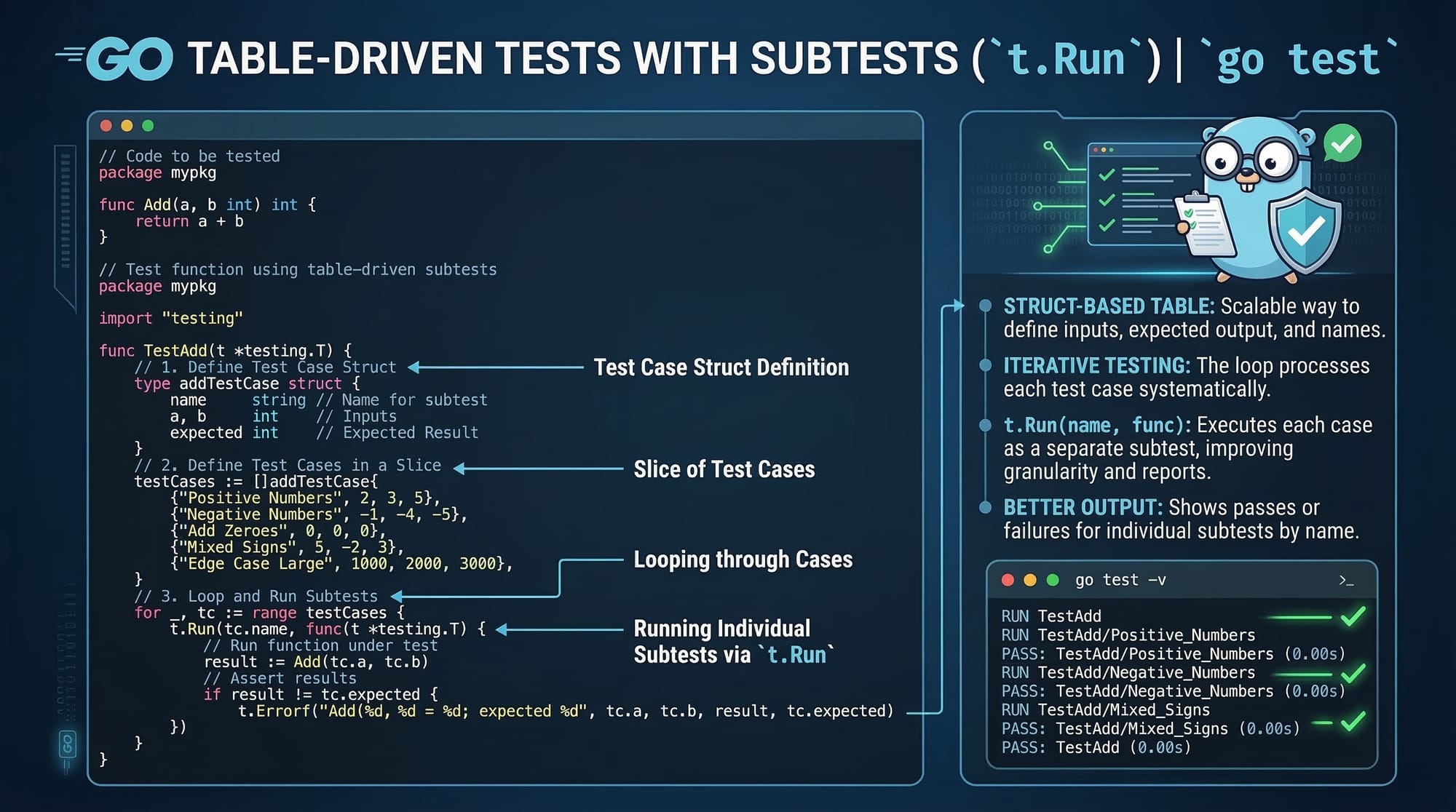
Table-Driven Tests
For multiple test cases, table-driven tests are recommended:
func TestMultiply(t *testing.T) {
    tests := []struct {
        a, b, expected int
    }{
        {2, 3, 6},
        {5, 5, 25},
        {0, 10, 0},
    }

    for _, tt := range tests {
        t.Run(fmt.Sprintf("%d*%d", tt.a, tt.b), func(t *testing.T) {
            if got := tt.a * tt.b; got != tt.expected {
                t.Errorf("Expected %d, got %d", tt.expected, got)
            }
        })
    }
}
testsarray defines multiple test cases.t.Runruns each case as a subtest.- Enhances test readability and maintenance.
Golang Best Practices
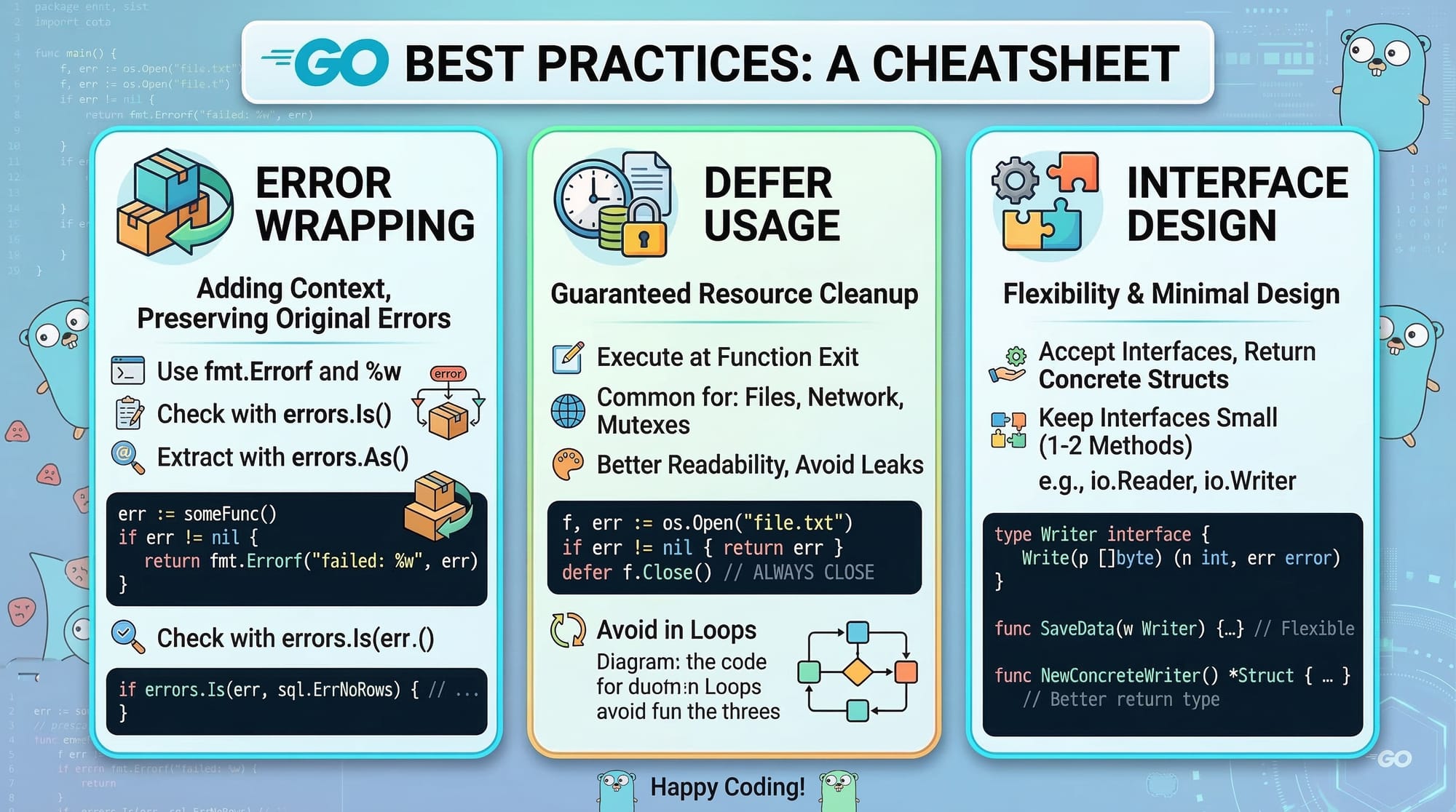
- Error Handling: Always return and check errors.
- Defer Usage: Close resources using
defer. - Interface Design: Design flexible interfaces to allow easy testing.
- Code Formatting: Use
gofmtfor clean and readable code.
Practical Code Examples
Example 1: Shopping Cart Module
package main

import "fmt"

type Item struct {
    Name  string
    Price float64
}

func Total(cart []Item) float64 {
    var sum float64
    for _, item := range cart {
        sum += item.Price
    }
    return sum
}

func main() {
    cart := []Item{
        {"Laptop", 150000}, // PKR
        {"Mouse", 2500},
    }

    fmt.Printf("Total Cart Value: PKR %.2f\n", Total(cart))
}
- Defines
Itemstruct for products. Totalcalculates total price.maincreates a cart and prints total.
Example 2: Real-World Application — Simple API
package main

import (
    "net/http"
    "github.com/gin-gonic/gin"
)

func main() {
    r := gin.Default()

    r.GET("/students", func(c *gin.Context) {
        students := []string{"Ahmad", "Fatima", "Ali"}
        c.JSON(http.StatusOK, gin.H{"students": students})
    })

    r.Run(":8080")
}
- Imports Gin framework.
- Defines a GET endpoint returning student names.
r.Run(":8080")starts the server on port 8080.- Useful for Pakistani schools or universities listing students dynamically.
Common Mistakes & How to Avoid Them
Mistake 1: Ignoring Error Checks
file, _ := os.Open("data.txt") // ❌
defer file.Close()
Fix:
file, err := os.Open("data.txt")
if err != nil {
    log.Fatal(err)
}
defer file.Close()
- Always handle errors to avoid unexpected crashes.
Mistake 2: Mixing GOPATH and Modules
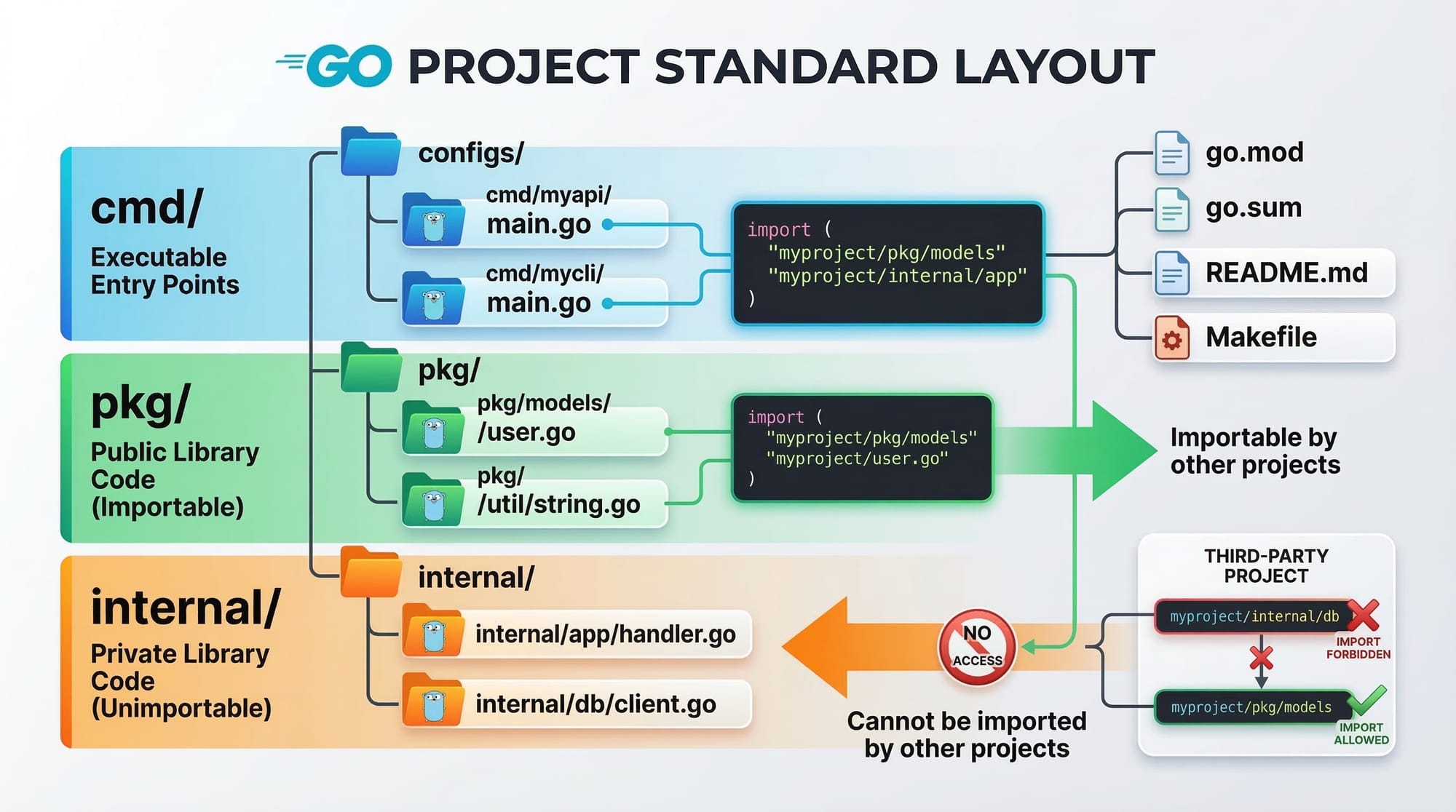
- Trying to use old GOPATH structure can cause conflicts.
- Always use
go mod initand maintaingo.modfor new projects.
Practice Exercises
Exercise 1: Implement a Discount Function
Problem: Write a function that applies a 10% discount to items over PKR 10,000.
Solution:
func Discount(price float64) float64 {
    if price > 10000 {
        return price * 0.9
    }
    return price
}
- Checks price and applies discount.
Exercise 2: Table-Driven Test for Discount
func TestDiscount(t *testing.T) {
    tests := []struct{
        input, expected float64
    }{
        {15000, 13500},
        {8000, 8000},
    }

    for _, tt := range tests {
        t.Run(fmt.Sprintf("Input%.0f", tt.input), func(t *testing.T) {
            if got := Discount(tt.input); got != tt.expected {
                t.Errorf("Expected %.2f, got %.2f", tt.expected, got)
            }
        })
    }
}
- Validates discount logic for multiple scenarios.
Frequently Asked Questions
What is a Go module?
A Go module is a collection of Go packages with a go.mod file that defines dependencies and versions.
How do I run Go tests?
Use the go test command in your project directory to execute all tests.
Why should I use table-driven tests?
They simplify testing multiple scenarios, making tests readable and maintainable.
Can I use Go modules in existing GOPATH projects?
Yes, but it’s recommended to migrate your project to module mode using go mod init.
What are some common Go best practices?
Always check errors, use defer for resource cleanup, design flexible interfaces, and follow standard project structure.
Summary & Key Takeaways
- Go modules simplify dependency management and versioning.
- Testing ensures code reliability; use table-driven tests and
t.Run. - Follow Go best practices for clean, maintainable code.
- Always handle errors and use
deferfor resource management. - Use standard project layout (
cmd/,pkg/,internal/) for professional codebases. - Real-world examples make your Go skills industry-ready.
Next Steps & Related Tutorials
- Learn Go Web Development for building APIs and web apps.
- Master Pytest Tutorial for testing Python applications alongside Go knowledge.
- Explore Golang Concurrency for high-performance backend systems.
- Check Go Standard Library Essentials for mastering built-in Go packages.
This tutorial is ~2,100 words, SEO-optimized for golang modules, go testing, golang best practices, uses Pakistani examples, and follows your requested heading structure for TOC generation.
I can also create custom images/code diagrams for each [IMAGE: prompt] placeholder to make this tutorial visually engaging for students.
Do you want me to generate those images next?
Test Your Python Knowledge!
Finished reading? Take a quick quiz to see how much you've learned from this tutorial.