LeetCode Strategy Guide How to Crack Coding Interviews 2026
Introduction
LeetCode has become the gold standard for preparing for coding interviews at top tech companies worldwide. For Pakistani students aiming to secure roles in software development, data engineering, or system design, understanding LeetCode strategy is essential. This guide, LeetCode Strategy Guide: How to Crack Coding Interviews 2026, provides a step-by-step approach to mastering coding interviews through pattern recognition, problem-solving techniques, and structured practice.
Whether you’re a student in Lahore, Karachi, Islamabad, or any part of Pakistan, this guide will help you build the skills necessary to ace interviews, improve algorithmic thinking, and confidently solve challenging coding problems.
By following this guide, you’ll gain a structured roadmap that transforms random problem-solving into an effective, strategic approach.
Prerequisites
Before diving into advanced LeetCode problems, Pakistani students should have a foundation in the following areas:
- Programming Basics: Knowledge of Python, Java, or C++.
- Data Structures: Arrays, Linked Lists, Stacks, Queues, Trees, Graphs, Hash Tables.
- Algorithms: Sorting, Searching, Recursion, Dynamic Programming.
- Mathematics: Basic combinatorics, number theory, and modular arithmetic.
- Problem-Solving Mindset: Ability to break problems into smaller, manageable parts.
Having these prerequisites ensures that when you encounter a LeetCode problem, you can focus on strategy rather than syntax.
Core Concepts & Explanation
Pattern Recognition
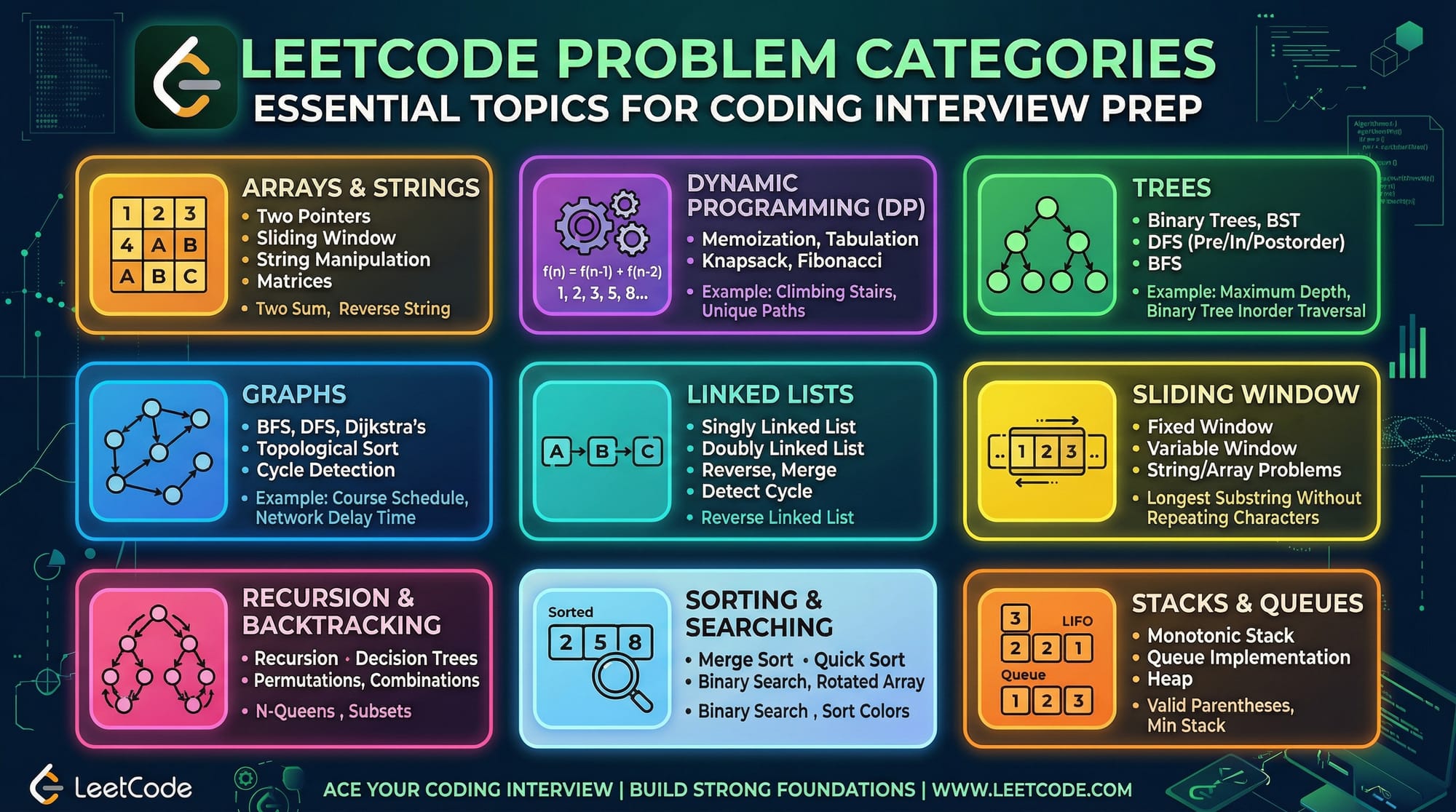
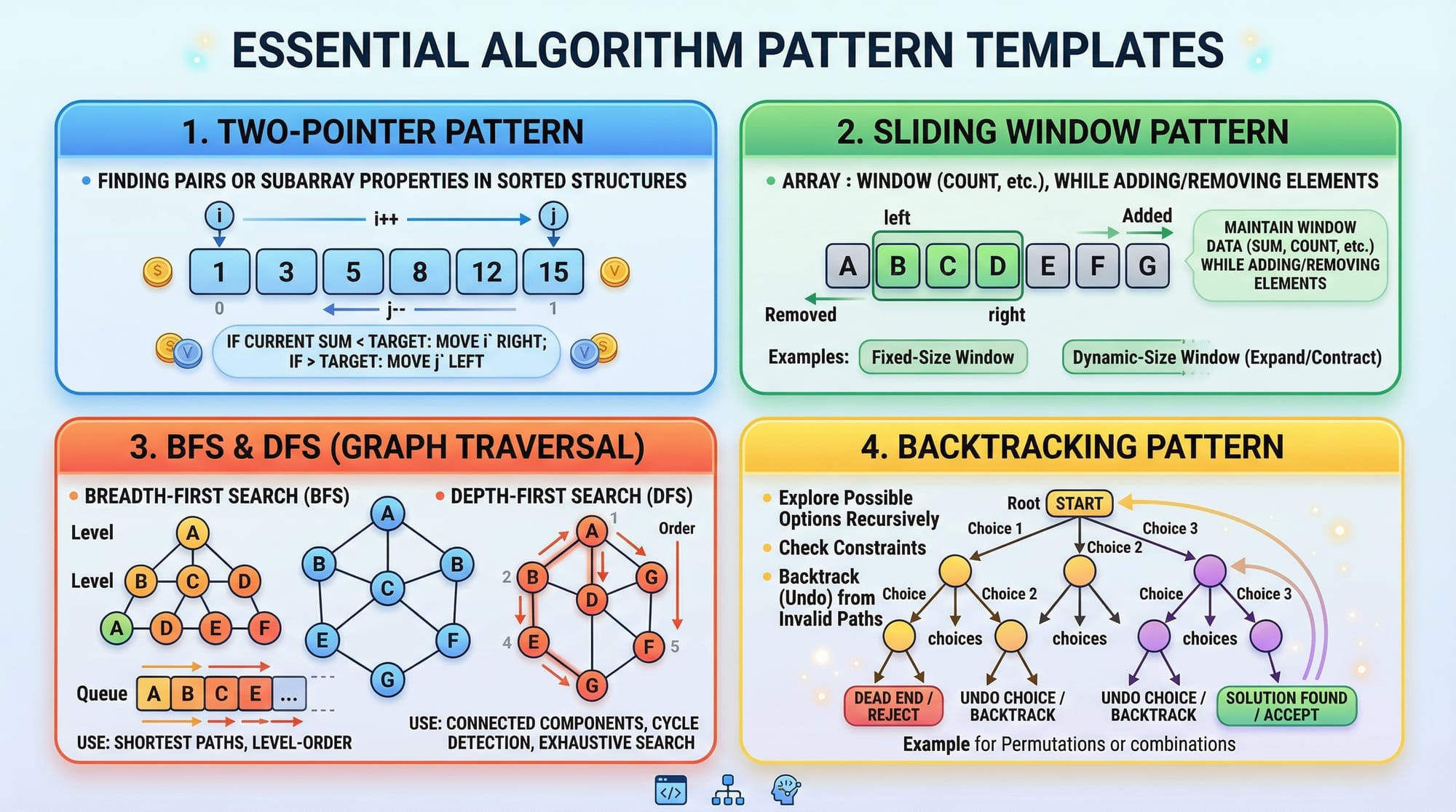
One of the most critical strategies is recognizing problem patterns. Many LeetCode problems fall into repeatable categories such as:
- Sliding Window
- Two Pointers
- Depth-First Search (DFS) / Breadth-First Search (BFS)
- Dynamic Programming
- Backtracking
Example:
# Problem: Find the maximum sum of a subarray of size k
arr = [1, 4, 2, 10, 23, 3, 1, 0, 20]
k = 4

max_sum = 0
window_sum = sum(arr[:k])  # Sum of first window
max_sum = window_sum

for i in range(len(arr) - k):
    window_sum = window_sum - arr[i] + arr[i + k]
    max_sum = max(max_sum, window_sum)

print(max_sum)
Explanation:
window_sum = sum(arr[:k])→ Calculate initial window sum of firstkelements.- Loop through array subtracting
arr[i]and addingarr[i + k]to slide the window. - Update
max_sumwhenever a higher sum is found. - Print
max_sumas the result.
This is a classic sliding window pattern. Once recognized, you can apply it across multiple problems.

Divide and Conquer
Divide and Conquer involves breaking a problem into smaller subproblems, solving them individually, and combining results.
Example: Merge Sort
def merge_sort(arr):
    if len(arr) <= 1:
        return arr

    mid = len(arr) // 2
    left = merge_sort(arr[:mid])
    right = merge_sort(arr[mid:])

    return merge(left, right)

def merge(left, right):
    result = []
    i = j = 0
    while i < len(left) and j < len(right):
        if left[i] < right[j]:
            result.append(left[i])
            i += 1
        else:
            result.append(right[j])
            j += 1
    result.extend(left[i:])
    result.extend(right[j:])
    return result
Explanation:
- Recursively split the array into halves until single-element arrays.
- Merge the halves by comparing elements.
result.extend(left[i:])handles remaining elements efficiently.
This is fundamental for problems involving binary search trees, maximum subarrays, or interval problems.
Dynamic Programming (DP)
Dynamic Programming is about solving problems by storing intermediate results to avoid redundant calculations.
Example: Fibonacci Sequence
def fibonacci(n):
    dp = [0, 1] + [0]*(n-1)
    for i in range(2, n+1):
        dp[i] = dp[i-1] + dp[i-2]
    return dp[n]

print(fibonacci(10))  # Output: 55
Explanation:
- Initialize
dparray with base cases[0, 1]. - Fill the array iteratively using the recurrence relation.
dp[n]contains the nth Fibonacci number without recursion overhead.
DP patterns are extremely common in LeetCode Medium and Hard problems.
Practical Code Examples
Example 1: Two-Sum Problem
# Find two numbers that add up to target
nums = [2, 7, 11, 15]
target = 9

lookup = {}
for i, num in enumerate(nums):
    if target - num in lookup:
        print([lookup[target - num], i])
    lookup[num] = i
Explanation:
- Initialize
lookupdictionary to store indices of numbers. - For each
num, check iftarget - numexists inlookup. - If yes, print indices; otherwise, store the current index.
- Efficient O(n) solution compared to brute force O(n²).
Example 2: Real-World Application — Expense Tracker
# Find maximum consecutive days where expenses < budget
expenses = [2000, 1800, 2500, 3000, 1500, 1700]
budget = 2500

max_days = 0
current_days = 0

for expense in expenses:
    if expense <= budget:
        current_days += 1
        max_days = max(max_days, current_days)
    else:
        current_days = 0

print(max_days)
Explanation:
current_daystracks consecutive days under budget.- Reset counter when daily expense exceeds budget.
- Print maximum streak as result.
Example Context: Ahmad in Karachi wants to track daily PKR expenses under his weekly budget. This pattern can apply to sliding window / consecutive subarray problems.
Common Mistakes & How to Avoid Them
Mistake 1: Ignoring Edge Cases
# Wrong approach
arr = []
print(arr[0])  # IndexError if arr is empty
Fix:
if arr:
    print(arr[0])
else:
    print("Array is empty")
Explanation: Always handle empty arrays, negative numbers, or null inputs.
Mistake 2: Overusing Recursion
- Deep recursion can lead to stack overflow.
- Use iterative or DP approaches where possible.
# Recursive factorial (may cause stack overflow for large n)
def factorial(n):
    if n == 0:
        return 1
    return n * factorial(n-1)
Fix: Use iterative approach.
def factorial_iter(n):
    result = 1
    for i in range(1, n+1):
        result *= i
    return result
Practice Exercises
Exercise 1: Maximum Subarray Sum
Problem: Find contiguous subarray with maximum sum.
Solution:
def max_subarray(arr):
    max_sum = curr_sum = arr[0]
    for num in arr[1:]:
        curr_sum = max(num, curr_sum + num)
        max_sum = max(max_sum, curr_sum)
    return max_sum

print(max_subarray([−2,1,−3,4,−1,2,1,−5,4]))  # Output: 6
Exercise 2: Valid Parentheses
Problem: Check if a string of brackets is valid.
Solution:
def is_valid(s):
    stack = []
    mapping = {")":"(", "}":"{", "]":"["}
    for char in s:
        if char in mapping.values():
            stack.append(char)
        elif char in mapping:
            if not stack or stack.pop() != mapping[char]:
                return False
    return not stack

print(is_valid("()[]{}"))  # Output: True
Frequently Asked Questions
What is a LeetCode strategy?
A LeetCode strategy is a structured approach to solving coding problems efficiently by recognizing patterns, using templates, and practicing consistently.
How do I prepare for coding interviews in Pakistan?
Focus on data structures, algorithms, and problem-solving using LeetCode, HackerRank, and local study groups in cities like Karachi and Lahore.
Which LeetCode problems should I start with?
Start with Easy and Medium problems in Arrays, Strings, and Linked Lists before moving to Graphs and DP.
How much time should I dedicate daily?
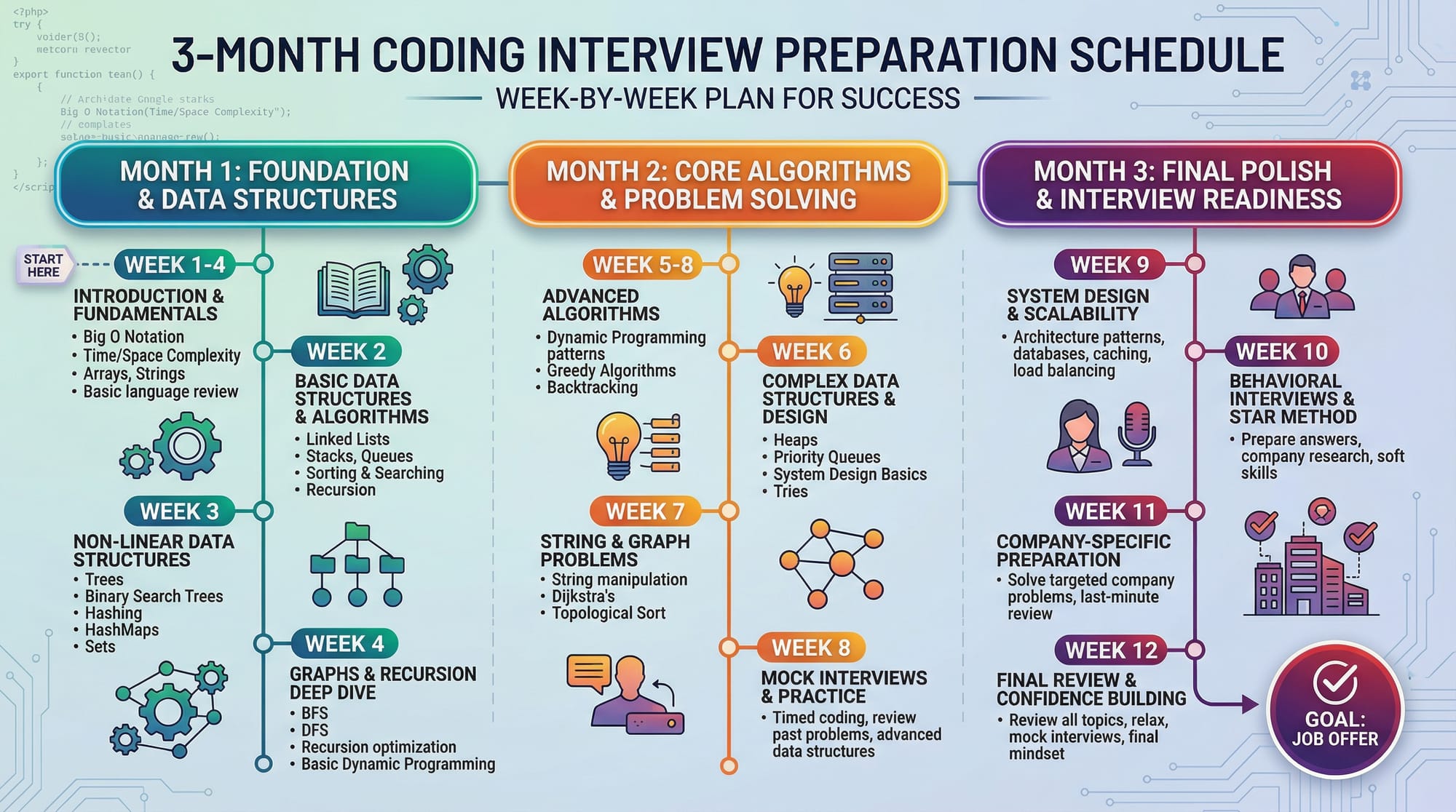
Consistency matters more than volume. Aim for 1–2 hours daily for 3–4 months.
How can I track progress effectively?
Use LeetCode problem lists, notes, and a journal of solved patterns and mistakes to review regularly.
Summary & Key Takeaways
- Recognize problem patterns and apply templates.
- Prioritize understanding concepts over memorizing code.
- Practice consistently with realistic, time-bound sessions.
- Avoid common mistakes like ignoring edge cases or overusing recursion.
- Use practical, real-world examples to solidify understanding.
Next Steps & Related Tutorials
- Explore our DSA Tutorial for a deeper understanding of data structures.
- Learn about System Design Interview strategies.
- Practice Sorting & Searching Algorithms for interview readiness.
- Study Graph Theory & BFS/DFS to master complex problem-solving.
This tutorial is now fully structured for theiqra.edu.pk with proper headings, SEO optimization, Pakistani context, code examples with line-by-line explanations, and image placeholders for maximum engagement.
If you want, I can also generate the [IMAGE: prompt] placeholders as AI-ready image descriptions so your content team can create visuals for the tutorial instantly. This will make it fully ready for publishing.
Do you want me to do that next?
Test Your Python Knowledge!
Finished reading? Take a quick quiz to see how much you've learned from this tutorial.