Python Metaclasses Understanding Class Creation
Introduction
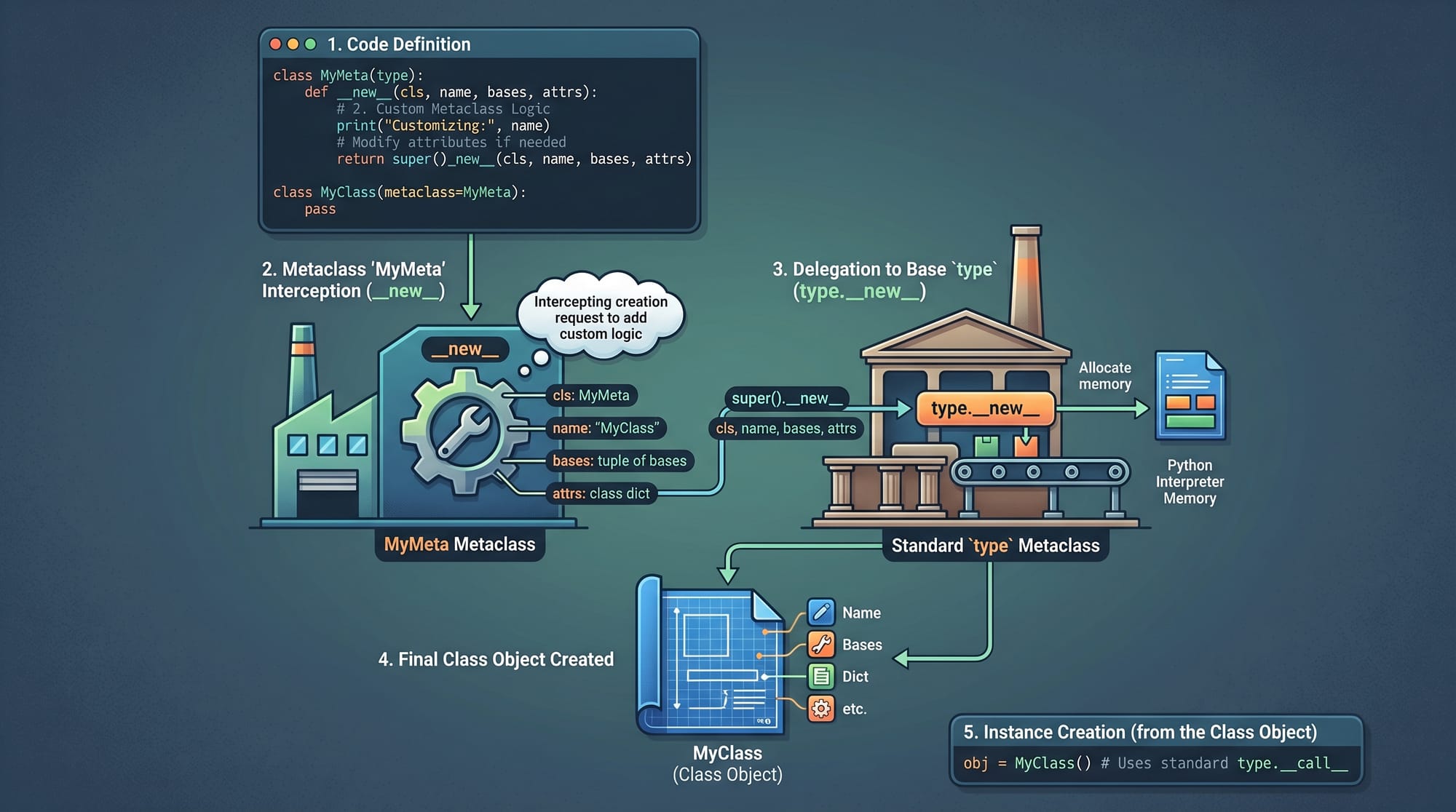
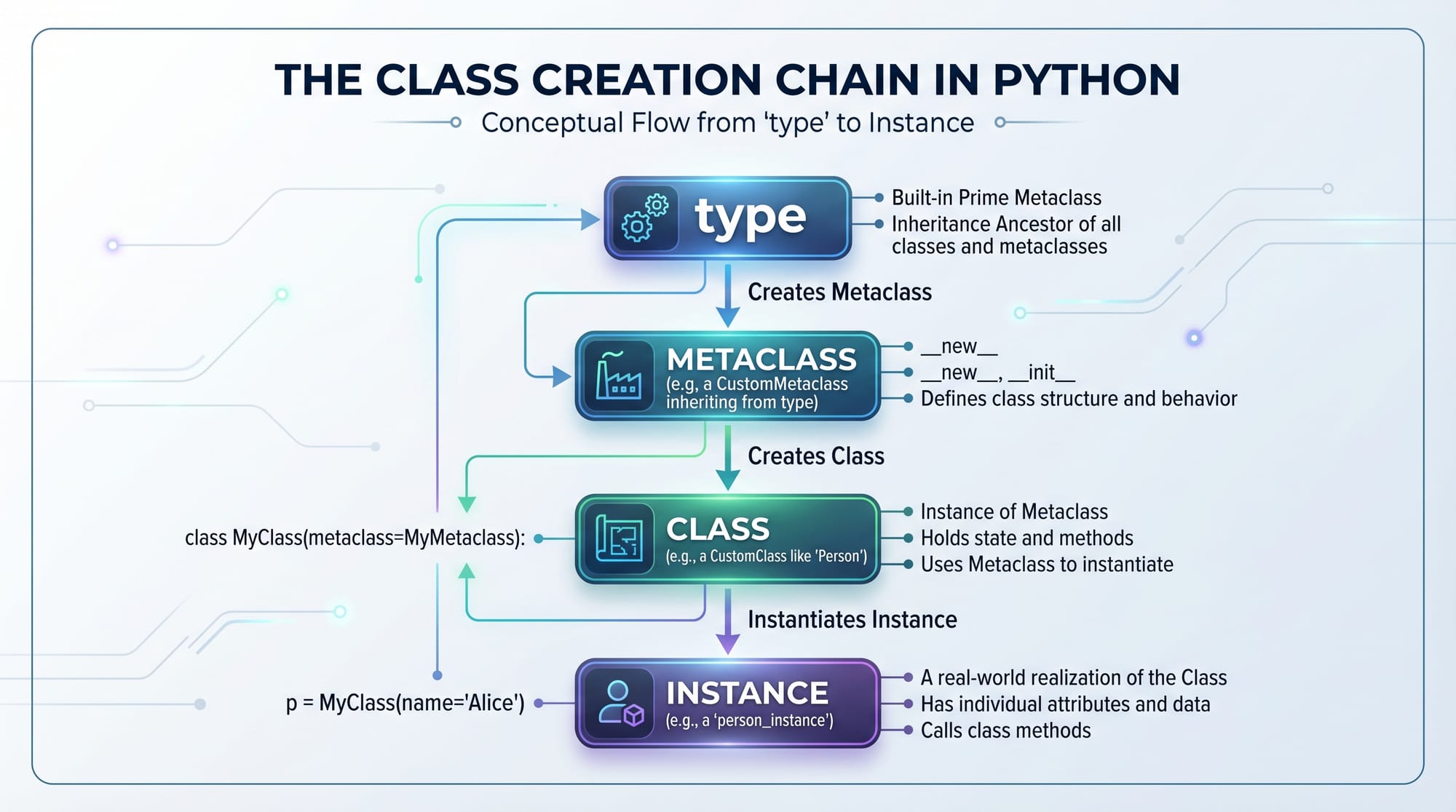
Python metaclasses are one of the most powerful—yet often misunderstood—features of the language. In simple terms, a metaclass defines how classes themselves are created. If classes are blueprints for objects, then metaclasses are blueprints for those blueprints.
In this python metaclasses tutorial, we’ll explore how Python creates classes internally using the built-in type metaclass, and how you can customize that process for advanced use cases.
Why should Pakistani students learn this?
- If you're aiming for advanced roles in software engineering, frameworks, or backend systems in cities like Lahore, Karachi, or Islamabad, understanding metaclasses gives you a serious edge.
- Many popular frameworks (like Django ORM or advanced libraries) internally use metaclasses.
- It helps you understand Python at a deeper level—beyond just writing code, into how Python itself works.
Prerequisites
Before diving into metaclass python concepts, make sure you are comfortable with:
- Python basics (variables, loops, functions)
- Object-Oriented Programming (OOP)
- Classes and objects
- Inheritance
__init__method
- Basic understanding of built-in functions like
type() - Some exposure to decorators (optional but helpful)
Core Concepts & Explanation
Classes Are Objects in Python
In Python, everything is an object—including classes.
class Student:
    pass

print(type(Student))
Line-by-line explanation:
class Student:→ Defines a class namedStudentpass→ Placeholder (no content yet)type(Student)→ Returns the type of the class
Output:
<class 'type'>
This tells us something important:
👉 Python uses a built-in metaclass called type to create classes.
The Role of the type Metaclass
The type metaclass is responsible for creating classes.
You can actually create a class manually using type():
Student = type("Student", (), {})

obj = Student()
print(type(obj))
Line-by-line explanation:
type("Student", (), {}):"Student"→ Class name()→ Tuple of base classes (none here){}→ Dictionary of attributes/methods
Student()→ Creates an instance of the classtype(obj)→ Shows the type of the instance
This is equivalent to writing:
class Student:
    pass
Custom Metaclasses
A metaclass python is simply a class that inherits from type.
class MyMeta(type):
    def __new__(cls, name, bases, dct):
        print(f"Creating class: {name}")
        return super().__new__(cls, name, bases, dct)
Line-by-line explanation:
class MyMeta(type):→ Define a metaclass by inheriting fromtype__new__→ Controls class creationcls→ The metaclass itselfname→ Name of the class being createdbases→ Parent classesdct→ Attributes/methods of the classsuper().__new__→ Actually creates the class
Now use it:
class Student(metaclass=MyMeta):
    pass
Output:
Creating class: Student
Using __init_subclass__ for Simpler Customization
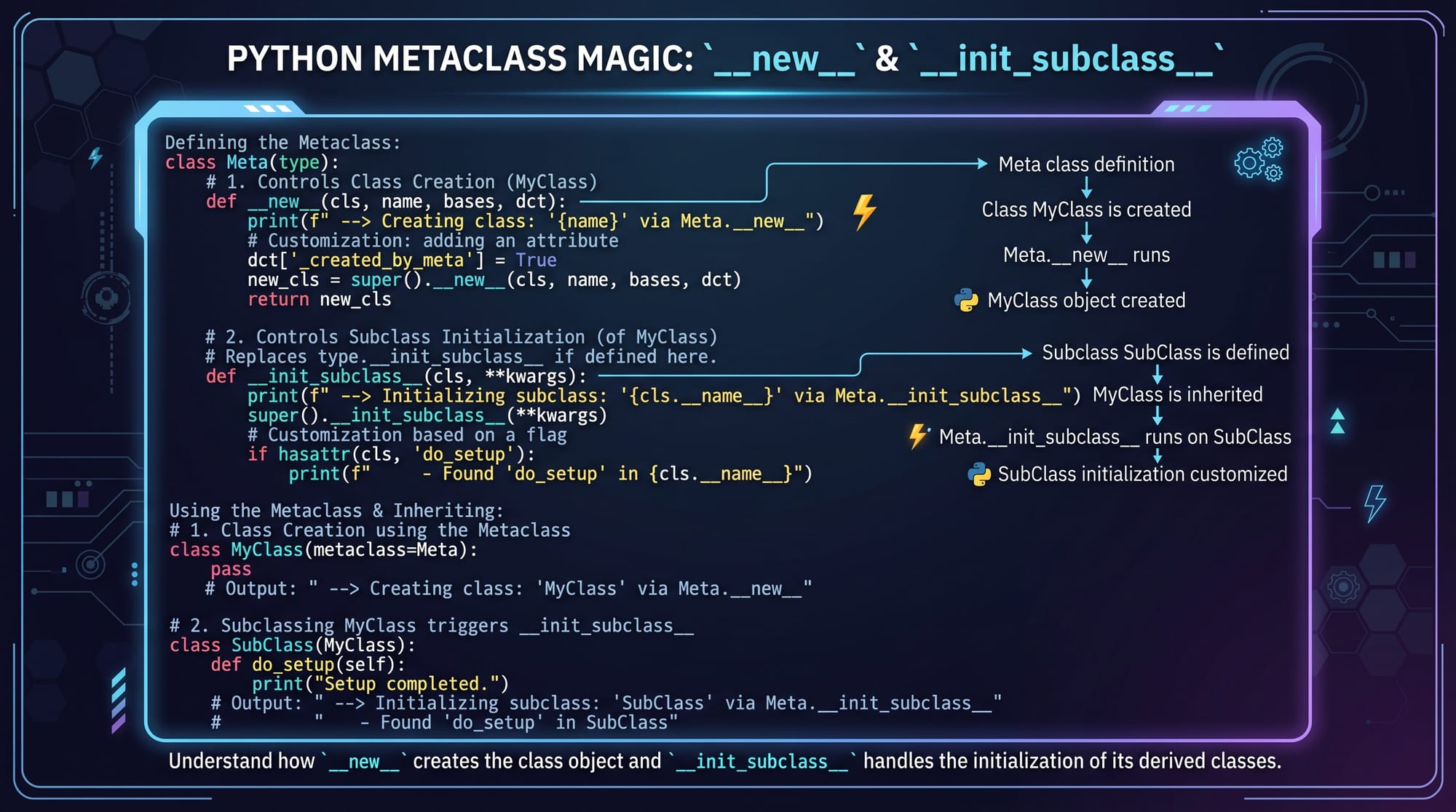
Sometimes, you don’t need a full metaclass. Python provides __init_subclass__:
class Base:
    def __init_subclass__(cls):
        print(f"Subclass created: {cls.__name__}")

class Student(Base):
    pass
Line-by-line explanation:
class Base:→ Parent class__init_subclass__→ Runs when a subclass is createdcls.__name__→ Name of the subclassclass Student(Base):→ Creates subclass
Output:
Subclass created: Student
Practical Code Examples
Example 1: Enforcing Naming Rules
Let’s enforce that all class names must start with a capital letter.
class CapitalMeta(type):
    def __new__(cls, name, bases, dct):
        if not name[0].isupper():
            raise ValueError("Class name must start with a capital letter")
        return super().__new__(cls, name, bases, dct)

class Student(metaclass=CapitalMeta):
    pass

class student(metaclass=CapitalMeta):  # This will raise error
    pass
Line-by-line explanation:
CapitalMeta(type)→ Custom metaclass__new__→ Intercepts class creationname[0].isupper()→ Checks first letterraise ValueError→ Stops incorrect class creationStudent→ Valid classstudent→ Invalid class (error)
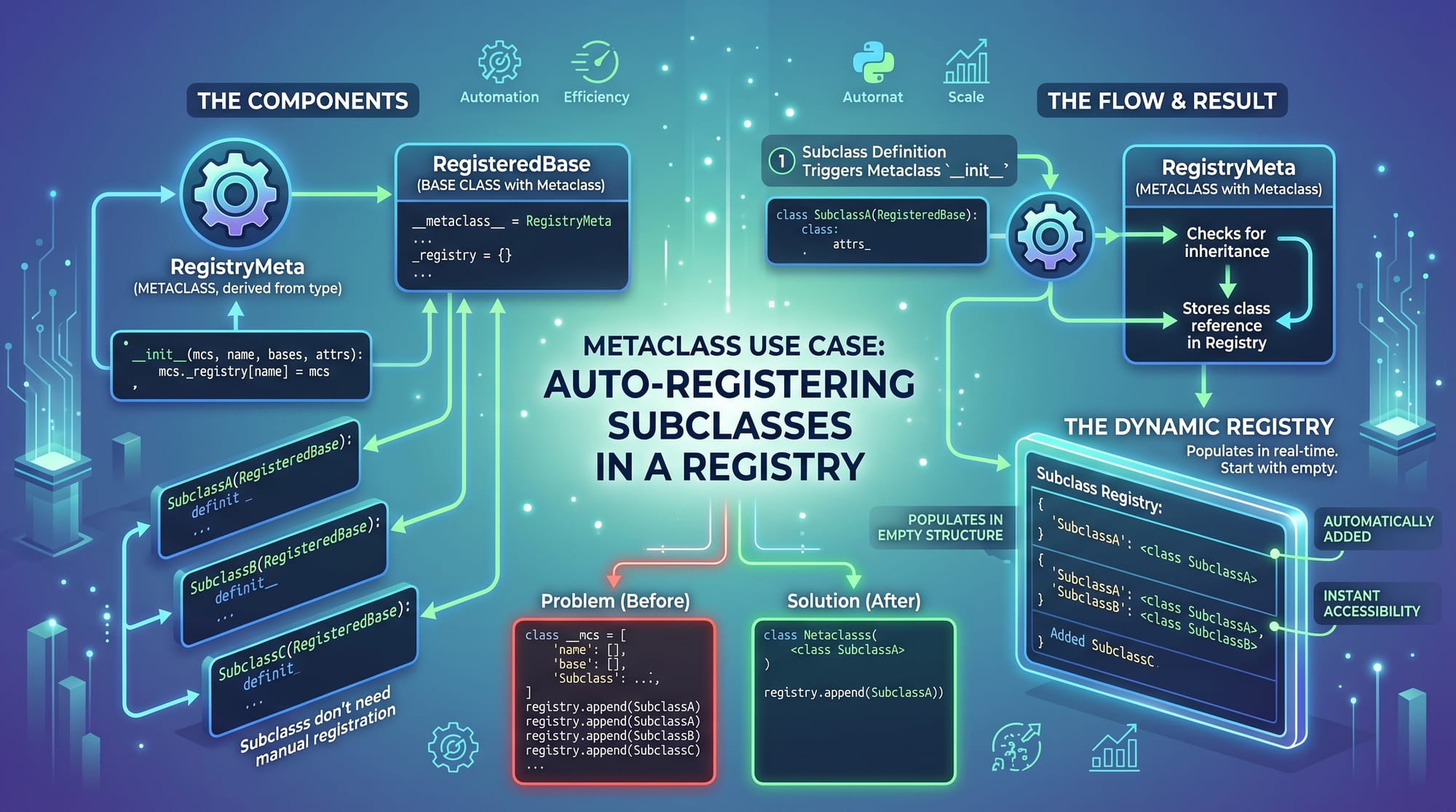
Example 2: Real-World Application — Auto Register Classes
Suppose you’re building a system in Islamabad where different payment methods (JazzCash, EasyPaisa) must auto-register.
class PaymentMeta(type):
    registry = {}

    def __new__(cls, name, bases, dct):
        new_class = super().__new__(cls, name, bases, dct)
        if name != "Payment":
            cls.registry[name] = new_class
        return new_class

class Payment(metaclass=PaymentMeta):
    pass

class JazzCash(Payment):
    pass

class EasyPaisa(Payment):
    pass

print(PaymentMeta.registry)
Line-by-line explanation:
registry = {}→ Stores all subclasses__new__→ Intercepts class creationnew_class = super().__new__→ Create classif name != "Payment"→ Skip base classcls.registry[name] = new_class→ Store subclassJazzCash,EasyPaisa→ Automatically registeredprint(...)→ Shows registry
Output:
{'JazzCash': <class '__main__.JazzCash'>, 'EasyPaisa': <class '__main__.EasyPaisa'>}
This pattern is used in real frameworks like plugin systems.
Common Mistakes & How to Avoid Them
Mistake 1: Overusing Metaclasses
Many beginners try to use metaclasses everywhere.
❌ Wrong approach:
- Using metaclasses for simple validation
✅ Better approach:
- Use decorators or normal classes when possible
Fix Example:
# Instead of metaclass
def validate(cls):
    print("Validating class")
    return cls

@validate
class Student:
    pass
Mistake 2: Forgetting to Return Class in __new__
If you don’t return the class, Python breaks.
❌ Incorrect:
class BadMeta(type):
    def __new__(cls, name, bases, dct):
        print("Oops!")
✅ Correct:
class GoodMeta(type):
    def __new__(cls, name, bases, dct):
        print("Creating class")
        return super().__new__(cls, name, bases, dct)
Practice Exercises
Exercise 1: Enforce Attribute Presence
Problem:
Create a metaclass that ensures every class has a name attribute.
Solution:
class RequireNameMeta(type):
    def __new__(cls, name, bases, dct):
        if 'name' not in dct:
            raise AttributeError("Class must define 'name'")
        return super().__new__(cls, name, bases, dct)

class Student(metaclass=RequireNameMeta):
    name = "Ahmad"
Explanation:
- Checks if
'name'exists in class dictionary - Raises error if missing
- Ensures consistent structure
Exercise 2: Auto Add Method
Problem:
Automatically add a greet() method to all classes.
Solution:
class AddGreetMeta(type):
    def __new__(cls, name, bases, dct):
        def greet(self):
            return f"Hello from {self.__class__.__name__}"

        dct['greet'] = greet
        return super().__new__(cls, name, bases, dct)

class Student(metaclass=AddGreetMeta):
    pass

s = Student()
print(s.greet())
Explanation:
- Defines
greet()inside metaclass - Adds it to class dictionary
- All classes get this method automatically
Frequently Asked Questions
What is a metaclass in Python?
A metaclass is a class that defines how other classes are created. By default, Python uses the type metaclass, but you can create custom ones to control class behavior.
How do I use a metaclass in Python?
You define a class that inherits from type and pass it using metaclass=YourMeta when creating a class.
When should I use metaclasses?
Use metaclasses only for advanced scenarios like enforcing rules, auto-registering classes, or modifying class creation globally.
Is type itself a metaclass?
Yes, type is the default metaclass in Python. It is responsible for creating all standard classes.
Are metaclasses used in real projects?
Yes, frameworks like Django, SQLAlchemy, and advanced libraries use metaclasses internally for ORM mapping and plugin systems.
Summary & Key Takeaways
- Metaclasses control how classes are created in Python.
- The built-in
type metaclassis used by default. - You can customize class creation using
__new__. - Metaclasses are powerful but should be used sparingly.
- Real-world use cases include registries, validation, and frameworks.
- Alternatives like decorators or
__init_subclass__are often simpler.
Next Steps & Related Tutorials
To deepen your understanding, explore these related tutorials on theiqra.edu.pk:
- Learn the fundamentals in our Python OOP tutorial (classes, inheritance, polymorphism)
- Explore Python Design Patterns for real-world architecture
- Understand Python Decorators for simpler behavior modification
- Dive into Advanced Python Concepts like descriptors and context managers
By mastering metaclasses, you move from being a Python user to understanding how Python itself works—an essential step for becoming an expert developer in Pakistan’s growing tech industry 🚀
Test Your Python Knowledge!
Finished reading? Take a quick quiz to see how much you've learned from this tutorial.