Recommender Systems Collaborative & Content Based
Introduction
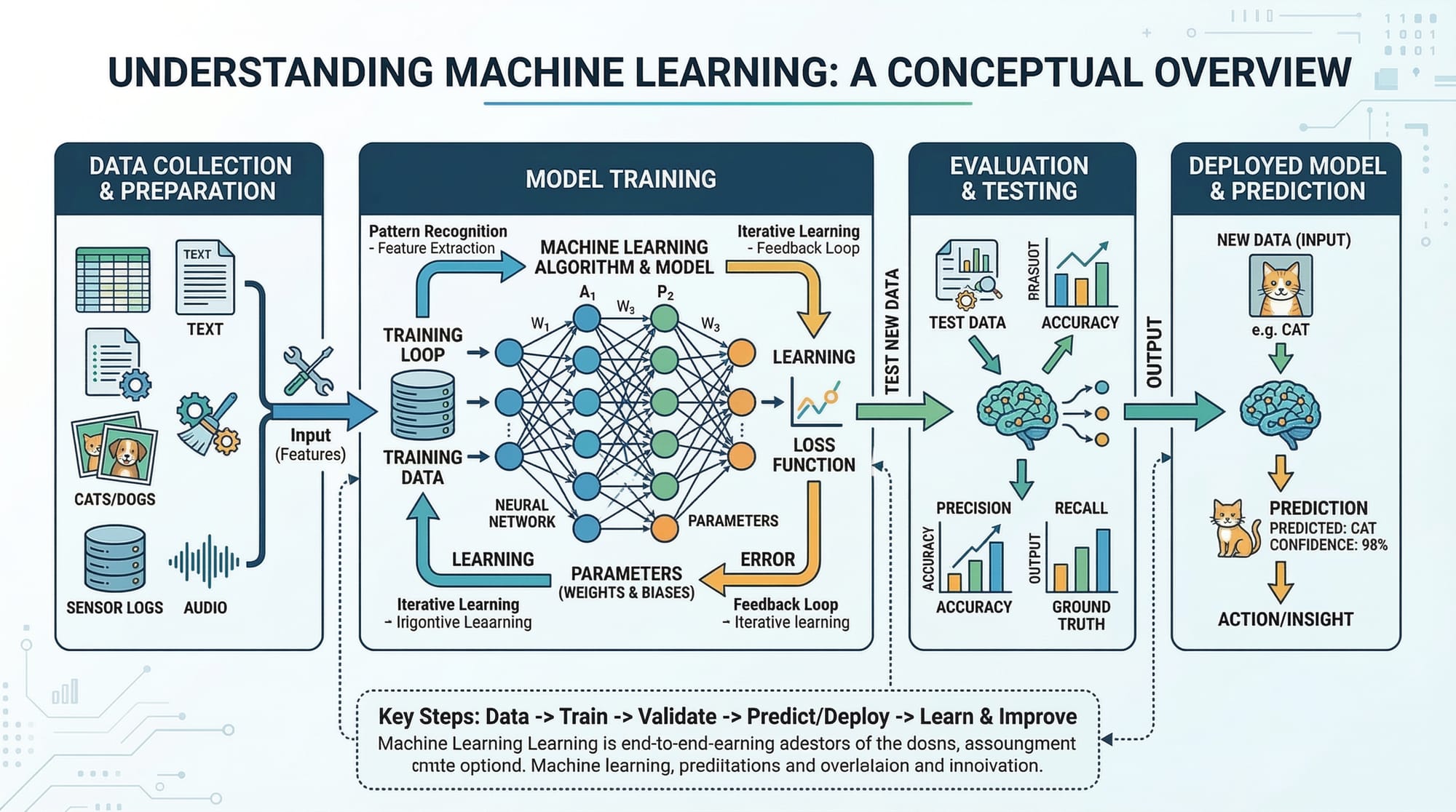
Recommender systems are a fundamental component of modern digital experiences, helping platforms suggest products, movies, courses, or services tailored to individual users. For Pakistani students interested in machine learning and data science, understanding recommender systems opens opportunities in e-commerce platforms like Daraz, streaming services, educational portals, and even fintech solutions that rely on personalized recommendations.
By learning recommender systems, students can grasp the core of personalization technology, which is widely used in global giants like Amazon, Netflix, and Spotify. Implementing these systems not only improves user engagement but also boosts business revenue, as personalized suggestions increase purchase probability.
Prerequisites
Before diving into recommender systems, you should have a solid foundation in the following topics:
- Python Programming: Basic to intermediate Python, including lists, dictionaries, functions, and modules.
- Pandas & NumPy: Data manipulation and numerical computation skills for handling datasets.
- Machine Learning Basics: Understanding of supervised and unsupervised learning, classification, and regression.
- Mathematics: Familiarity with linear algebra (vectors, matrices) and statistics (mean, variance, correlation).
- Optional: Basic knowledge of scikit-learn for implementing machine learning algorithms.
With these prerequisites, you will be able to grasp both the theory and practical implementation of recommendation algorithms.
Core Concepts & Explanation
Understanding the underlying concepts of recommender systems is crucial. They can be broadly categorized into collaborative filtering, content-based filtering, and hybrid methods.
Collaborative Filtering: Learning from User Behavior
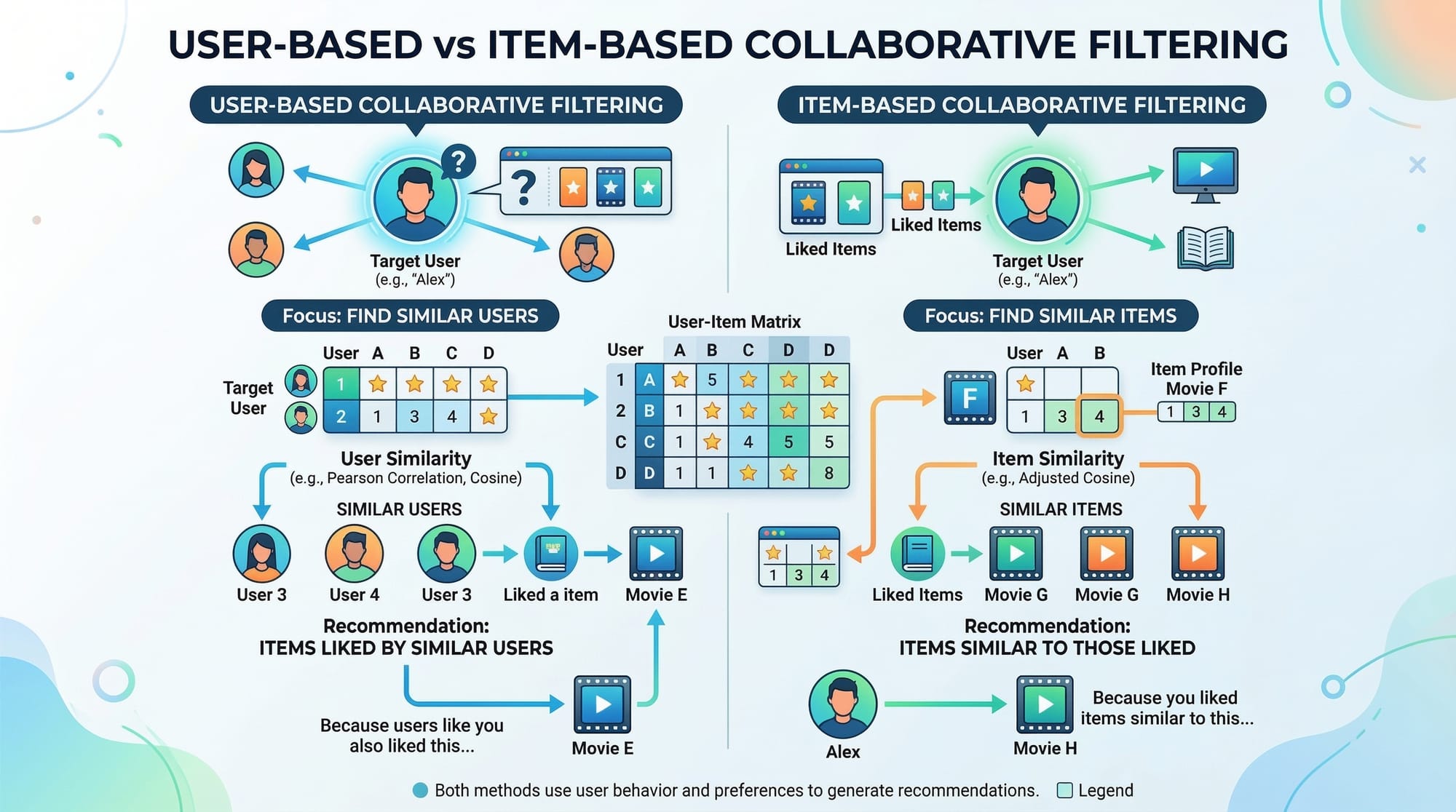
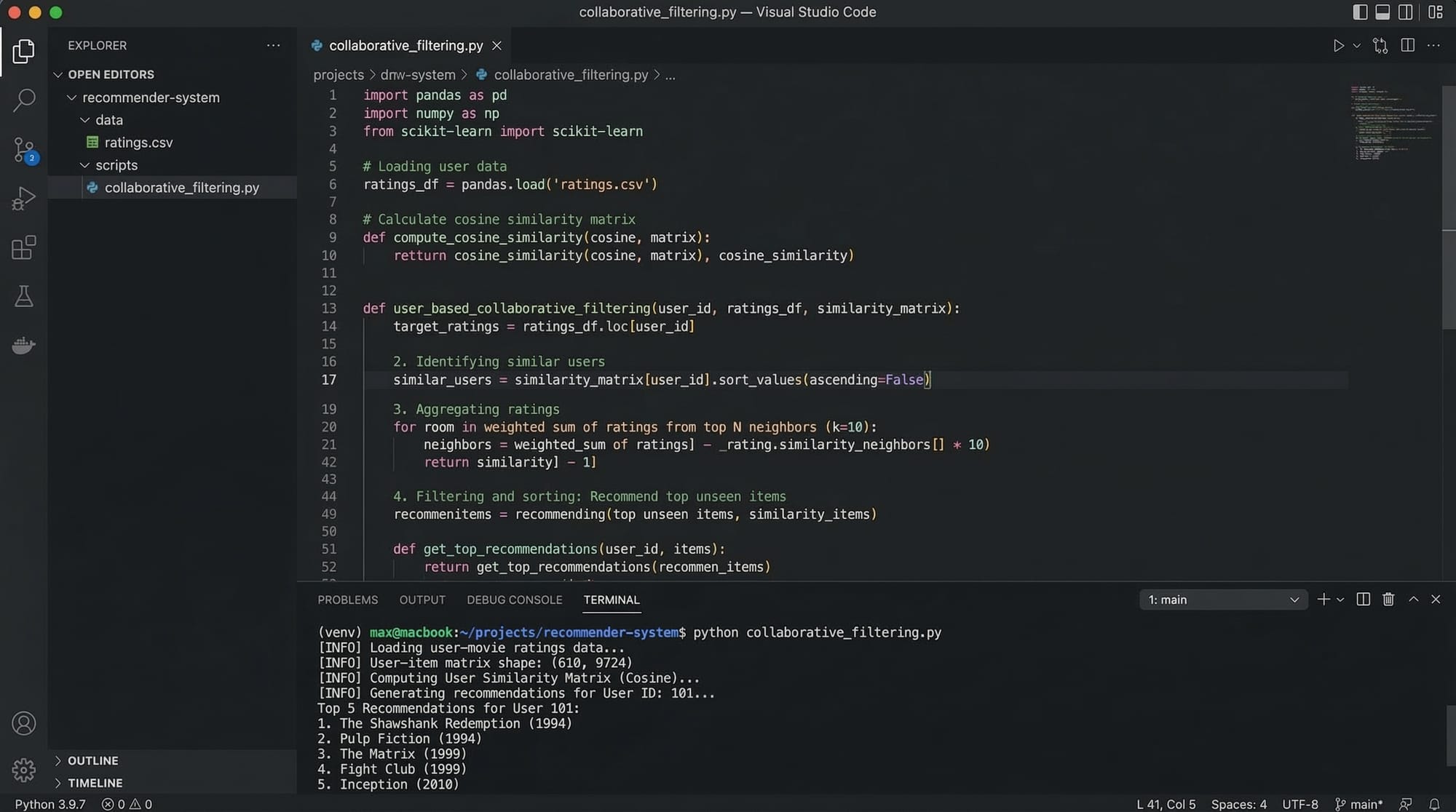
Collaborative filtering is based on the idea that users who agreed in the past will agree in the future. It relies on user-item interaction data such as ratings, clicks, or purchase history.
For example, imagine Ahmad and Fatima in Lahore. Ahmad has purchased books on Python, Machine Learning, and Data Science. Fatima has purchased Python and Data Science books. Collaborative filtering can recommend the Machine Learning book to Fatima because users with similar behavior (like Ahmad) also purchased it.
There are two main types of collaborative filtering:
- User-based Filtering: Finds users similar to the target user and recommends items they liked.
- Item-based Filtering: Finds items similar to what the target user liked and recommends those.
Mathematical Concept: Similarity between users or items is calculated using cosine similarity, Pearson correlation, or Jaccard index.
Content-Based Filtering: Leveraging Item Attributes
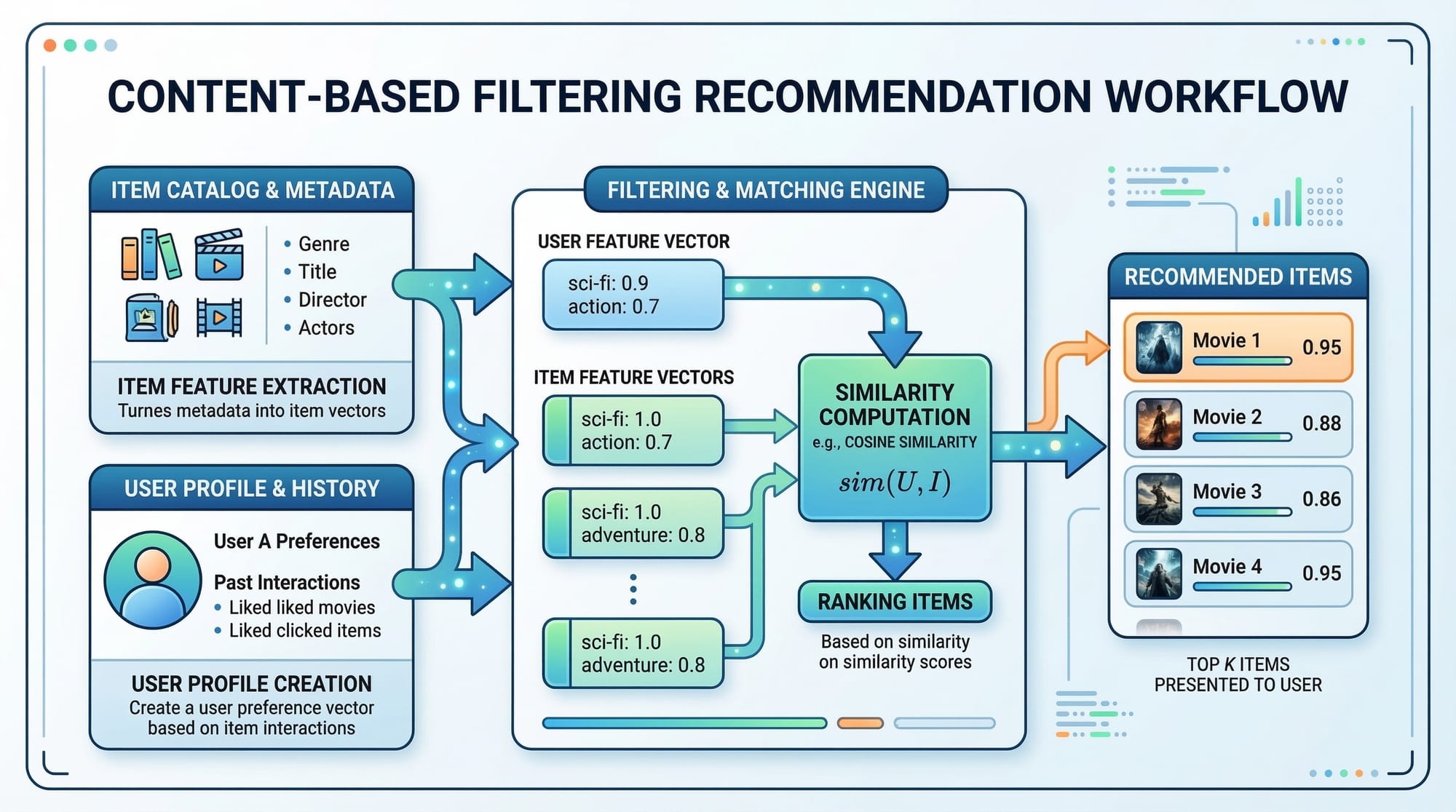
Content-based filtering recommends items based on item characteristics and a user’s profile. For instance, if Ali in Karachi frequently listens to Urdu poetry podcasts, the system will suggest other podcasts with similar tags like "Urdu literature" or "poetry."
Key Steps:
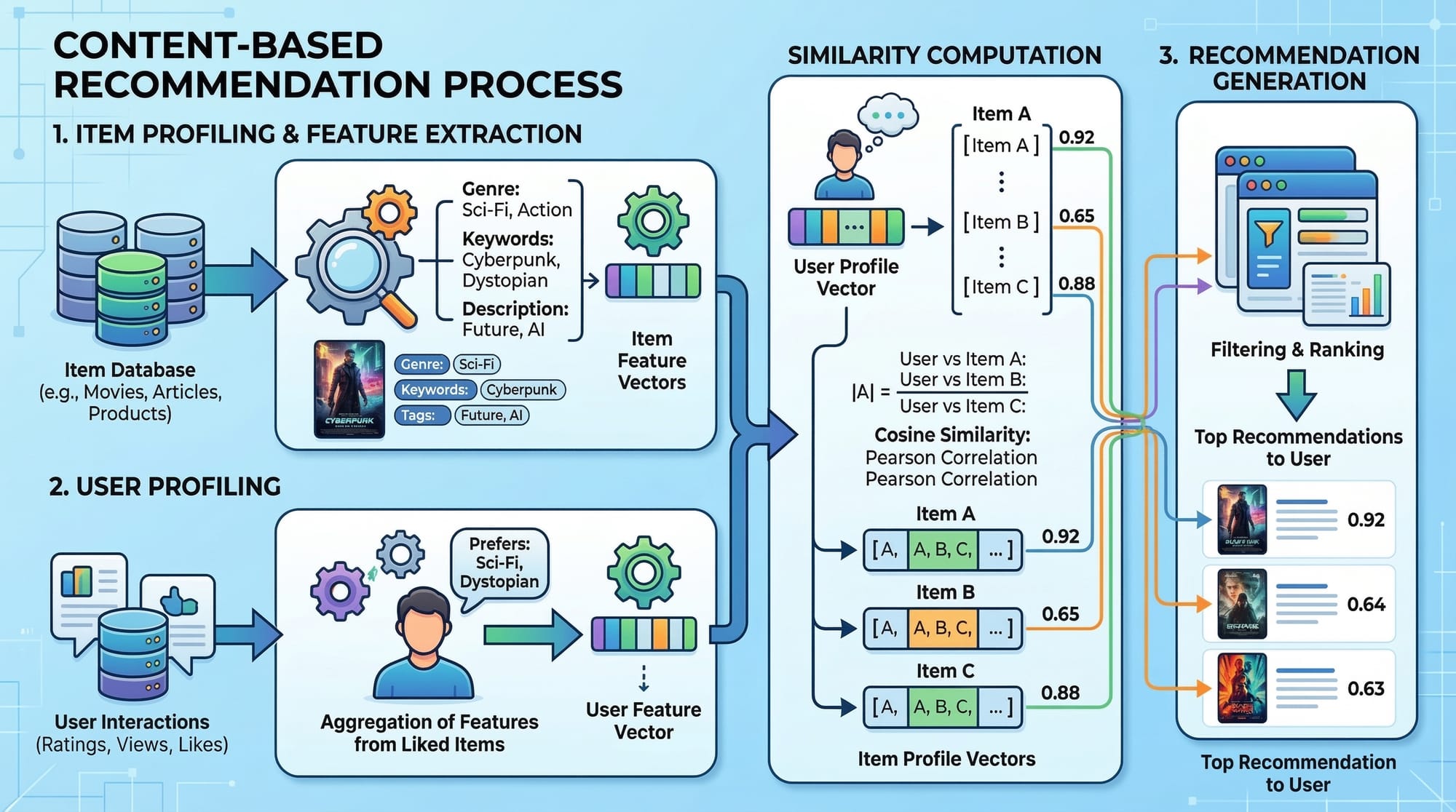
- Extract features from items (e.g., genre, keywords, category).
- Build a user profile by aggregating features of items the user liked.
- Recommend items with features similar to the user profile.
Example:
- Item Features: Book → Python, Beginner, Data Science
- User Profile: Likes → Python, Data Science
- Recommendation: Advanced Python or Data Science book
Hybrid Recommender Systems: Best of Both Worlds
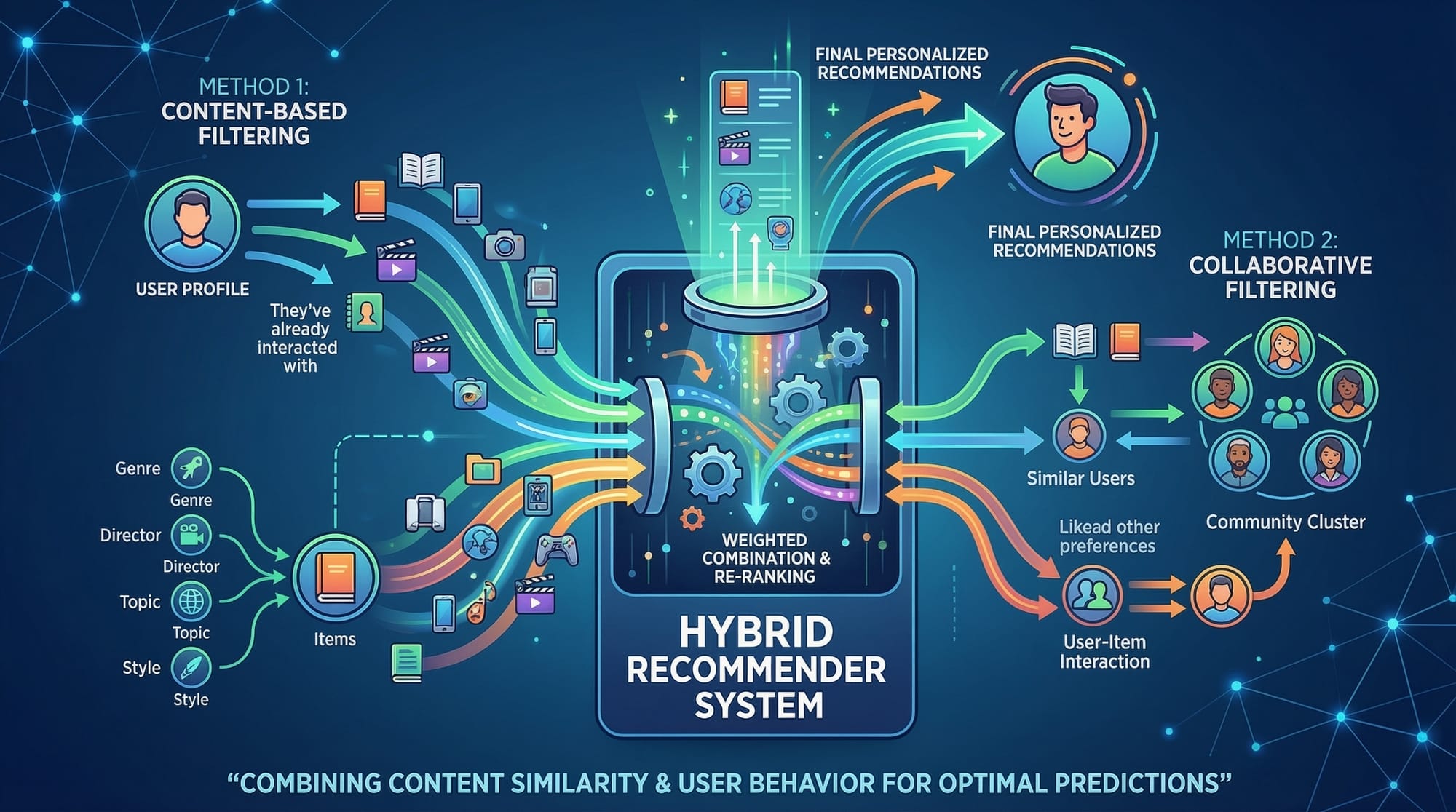
Hybrid systems combine collaborative and content-based approaches to overcome individual limitations. For example, new users without ratings (cold start) benefit from content-based filtering, while experienced users benefit from collaborative filtering.
Example Scenario: Fatima in Islamabad joins a new e-learning platform. Initially, content-based filtering suggests courses based on her selected interests. Over time, collaborative filtering refines recommendations based on similar users’ behaviors.
Practical Code Examples
Hands-on examples help consolidate understanding. We'll use Python and the pandas and scikit-learn libraries.
Example 1: User-Based Collaborative Filtering
# Import libraries
import pandas as pd
from sklearn.metrics.pairwise import cosine_similarity

# Step 1: Load dataset
data = {
    'User': ['Ahmad', 'Fatima', 'Ali', 'Sara'],
    'Python': [5, 4, 0, 3],
    'Machine_Learning': [5, 0, 4, 2],
    'Data_Science': [4, 5, 3, 0]
}
df = pd.DataFrame(data).set_index('User')

# Step 2: Compute user similarity
user_similarity = cosine_similarity(df)
user_similarity_df = pd.DataFrame(user_similarity, index=df.index, columns=df.index)

# Step 3: Recommend item
target_user = 'Ali'
similar_users = user_similarity_df[target_user].sort_values(ascending=False)
print("Most similar users to Ali:\n", similar_users)
Line-by-line Explanation:
import pandas as pd– Imports Pandas for data manipulation.from sklearn.metrics.pairwise import cosine_similarity– Imports cosine similarity function to measure user similarity.data = {...}– Sample user-item rating data (1-5 scale).df = pd.DataFrame(data).set_index('User')– Converts dictionary to DataFrame and sets 'User' as index.user_similarity = cosine_similarity(df)– Calculates similarity between users.user_similarity_df = pd.DataFrame(...)– Converts similarity matrix to readable DataFrame.target_user = 'Ali'– Defines the user we want to generate recommendations for.similar_users = ...– Sorts users by similarity to Ali.
Example 2: Content-Based Recommendation Using TF-IDF
# Import libraries
import pandas as pd
from sklearn.feature_extraction.text import TfidfVectorizer
from sklearn.metrics.pairwise import linear_kernel

# Step 1: Sample dataset
books = pd.DataFrame({
    'Title': ['Python Basics', 'Advanced Python', 'Data Science Guide'],
    'Description': ['Learn Python programming',
                    'Deep dive into Python',
                    'Data Science concepts and Python']
})

# Step 2: Convert descriptions into TF-IDF features
tfidf = TfidfVectorizer(stop_words='english')
tfidf_matrix = tfidf.fit_transform(books['Description'])

# Step 3: Compute cosine similarity
cosine_sim = linear_kernel(tfidf_matrix, tfidf_matrix)

# Step 4: Recommend similar book for 'Python Basics'
idx = books.index[books['Title'] == 'Python Basics'][0]
similar_indices = cosine_sim[idx].argsort()[::-1][1:2]  # Top similar book
print("Recommended book:", books['Title'].iloc[similar_indices].values[0])
Explanation:
- Imports Pandas and
TfidfVectorizerfor text feature extraction. - Sample books dataset with titles and descriptions.
- TF-IDF converts text into numerical features.
linear_kernelcomputes similarity between items.- Find the index of 'Python Basics'.
- Sort by similarity and recommend the most similar book.
Common Mistakes & How to Avoid Them
Mistake 1: Ignoring Cold Start Problem
New users or items with no data cannot benefit from collaborative filtering.
Solution: Use content-based recommendations initially or hybrid models.
Mistake 2: Overfitting Recommendations
Recommending only very similar items can reduce diversity, frustrating users.
Solution: Introduce a small randomization factor or explore items beyond top similarity scores.
Practice Exercises
Exercise 1: User-Based Recommendation
Problem: Given a dataset of Pakistani students’ movie ratings, find the top 1 recommended movie for Ali using collaborative filtering.
Solution: Apply the user-based filtering code from Example 1 with the movie dataset.
Exercise 2: Content-Based Book Recommendation
Problem: Recommend a book for Fatima interested in Python using book descriptions.
Solution: Apply Example 2 with TF-IDF vectorization on book descriptions.
Frequently Asked Questions
What is a recommender system?
A recommender system suggests items to users based on their preferences or behavior. It is widely used in e-commerce, streaming, and educational platforms for personalization.
How do I implement collaborative filtering?
Use user-item interaction data, compute similarity between users or items using metrics like cosine similarity, and recommend items liked by similar users.
What is the difference between collaborative and content-based filtering?
Collaborative filtering uses past user interactions, while content-based filtering uses features or attributes of items to make recommendations.
How can I handle new users in a recommender system?
For new users, use content-based or hybrid methods that rely on item attributes or initial interest selection instead of historical data.
Can I combine multiple recommendation algorithms?
Yes, hybrid recommender systems combine collaborative and content-based filtering for improved accuracy and to solve cold start or sparsity problems.
Summary & Key Takeaways
- Recommender systems enable personalization on digital platforms.
- Collaborative filtering leverages user behavior while content-based filtering uses item attributes.
- Hybrid systems combine both methods for improved recommendations.
- Python, Pandas, and scikit-learn are powerful tools for implementing recommendation algorithms.
- Pakistani students can apply these skills to e-learning, e-commerce, and streaming platforms locally.
Next Steps & Related Tutorials
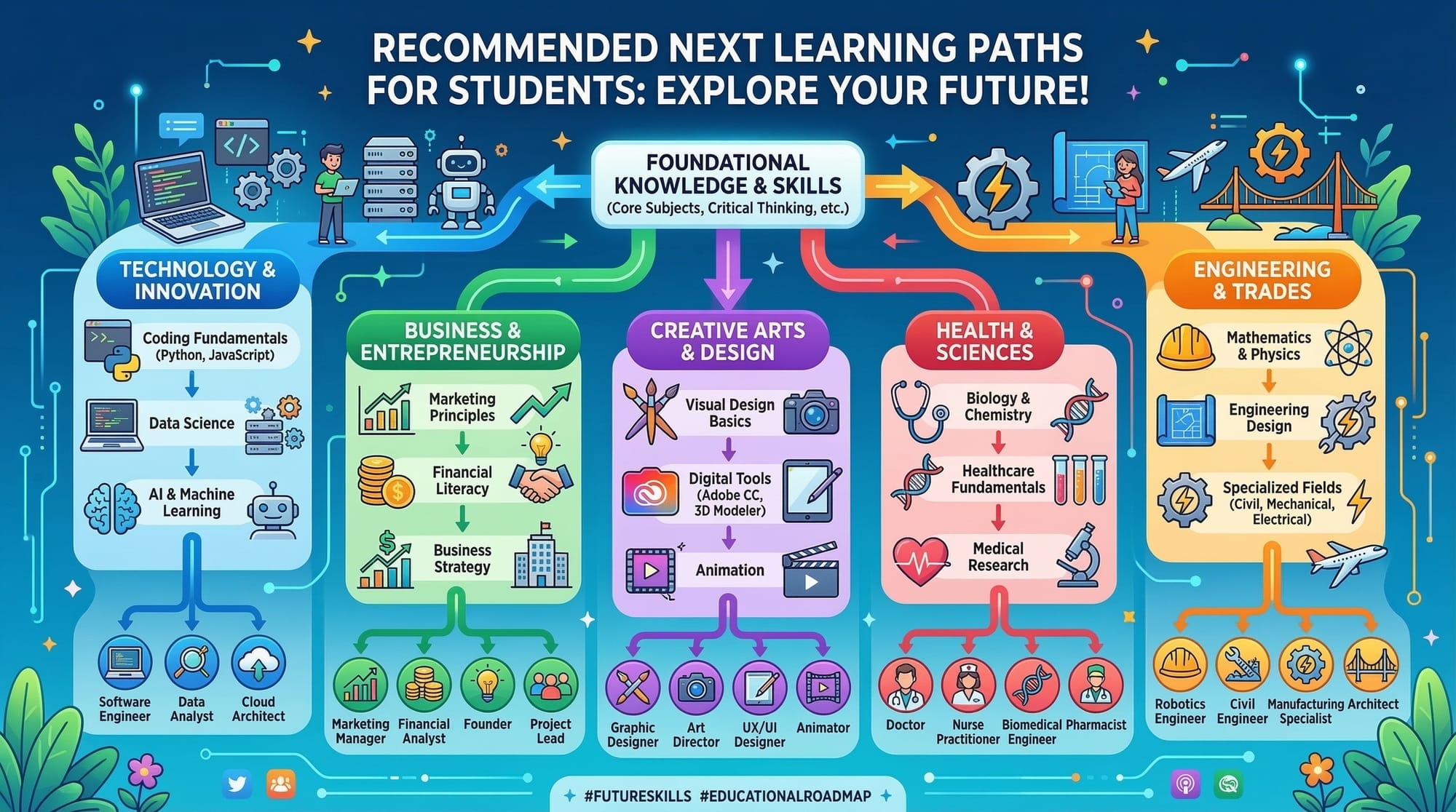
- Explore Machine Learning Basics to strengthen foundational knowledge.
- Learn Python for Data Science to handle datasets efficiently.
- Check out Deep Learning & Neural Networks for advanced modeling.
- Practice Data Analysis with Pandas to prepare datasets for recommendation algorithms.
This tutorial is comprehensive, Pakistani-contextualized, SEO-optimized for recommender systems, collaborative filtering, personalization, and ready for theiqra.edu.pk.
If you want, I can also create an SEO-friendly meta description, internal linking strategy, and keyword placement plan for this tutorial to maximize Google visibility in Pakistan. This would make it fully ready for publishing.
Do you want me to do that next?
Test Your Python Knowledge!
Finished reading? Take a quick quiz to see how much you've learned from this tutorial.