Union Find Disjoint Set Kruskal's MST & Connected Components
Introduction
Union-Find, also known as the Disjoint Set, is a powerful data structure used to efficiently manage a collection of non-overlapping sets. It supports two main operations:
- Find: Determine which set an element belongs to
- Union: Merge two sets into one
This structure plays a crucial role in solving graph problems like connected components and Kruskal’s Minimum Spanning Tree (MST).
For Pakistani students preparing for coding interviews, university exams, or competitive programming contests (like ICPC regionals or Codeforces), mastering Union-Find can give you a strong advantage. Whether you're studying in Lahore, Karachi, or Islamabad, this concept appears frequently in DSA courses and real-world applications.
Prerequisites
Before diving into Union-Find, make sure you understand:
- Basic programming (C++, Java, or Python)
- Arrays and indexing
- Recursion (helpful but not mandatory)
- Basic graph concepts (nodes, edges)
- Sorting algorithms (important for Kruskal’s algorithm)
Core Concepts & Explanation
Set Representation Using Trees
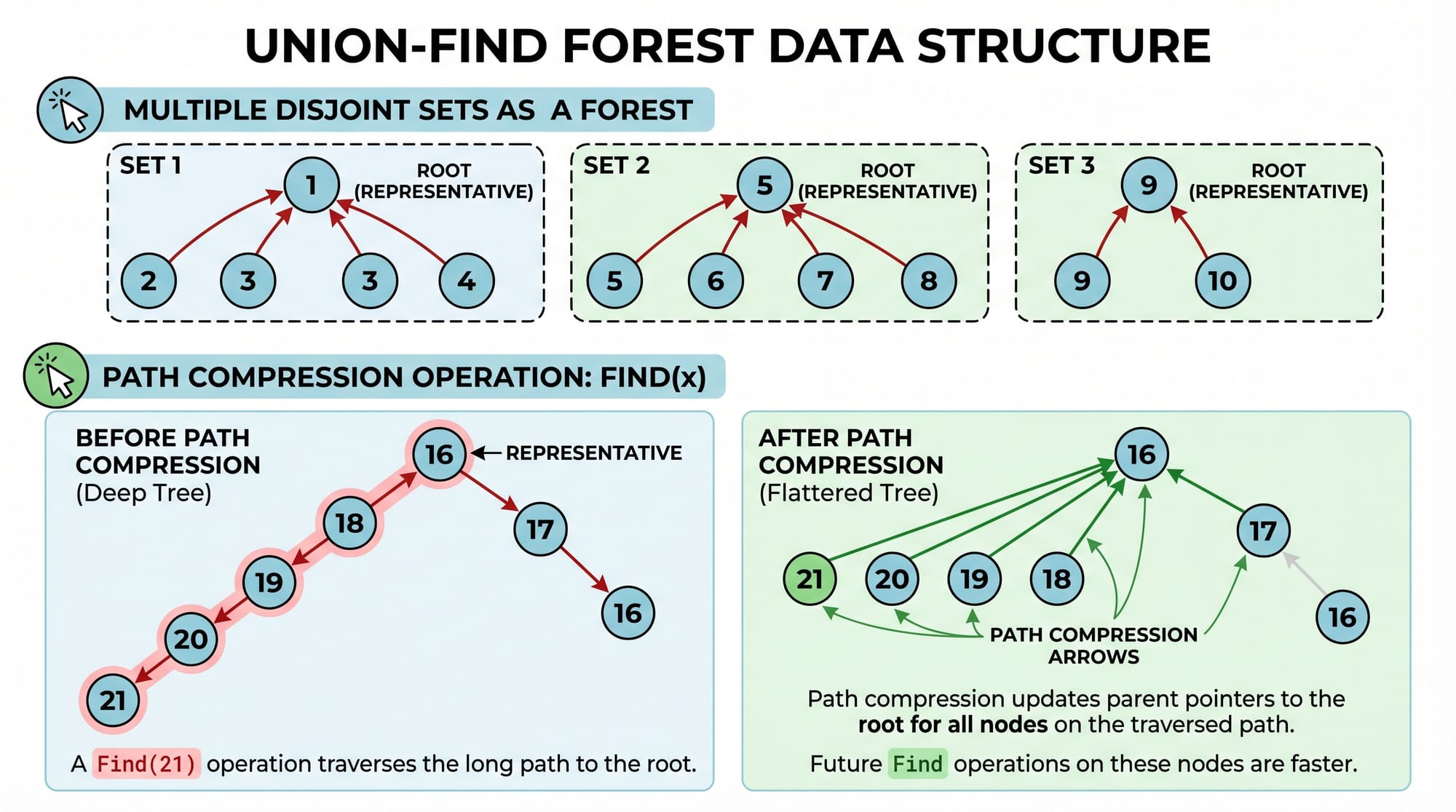
In Union-Find, each set is represented as a tree. Each node points to a parent, and the root node is the representative of the set.
Example:
Suppose Ahmad, Ali, and Fatima are in the same group:
Ahmad → Ali → Fatima (root)
Here:
- Fatima is the representative (root)
- Ahmad and Ali belong to Fatima’s set
We store this structure using an array:
parent[i] = parent of i
Path Compression Optimization
The Find operation can become slow if trees are deep. To fix this, we use Path Compression.
Whenever we call find(x), we make all nodes in the path directly point to the root.
Before:
Ahmad → Ali → Fatima
After find(Ahmad):
Ahmad → Fatima
Ali   → Fatima
This drastically improves performance.
Union by Rank (or Size)
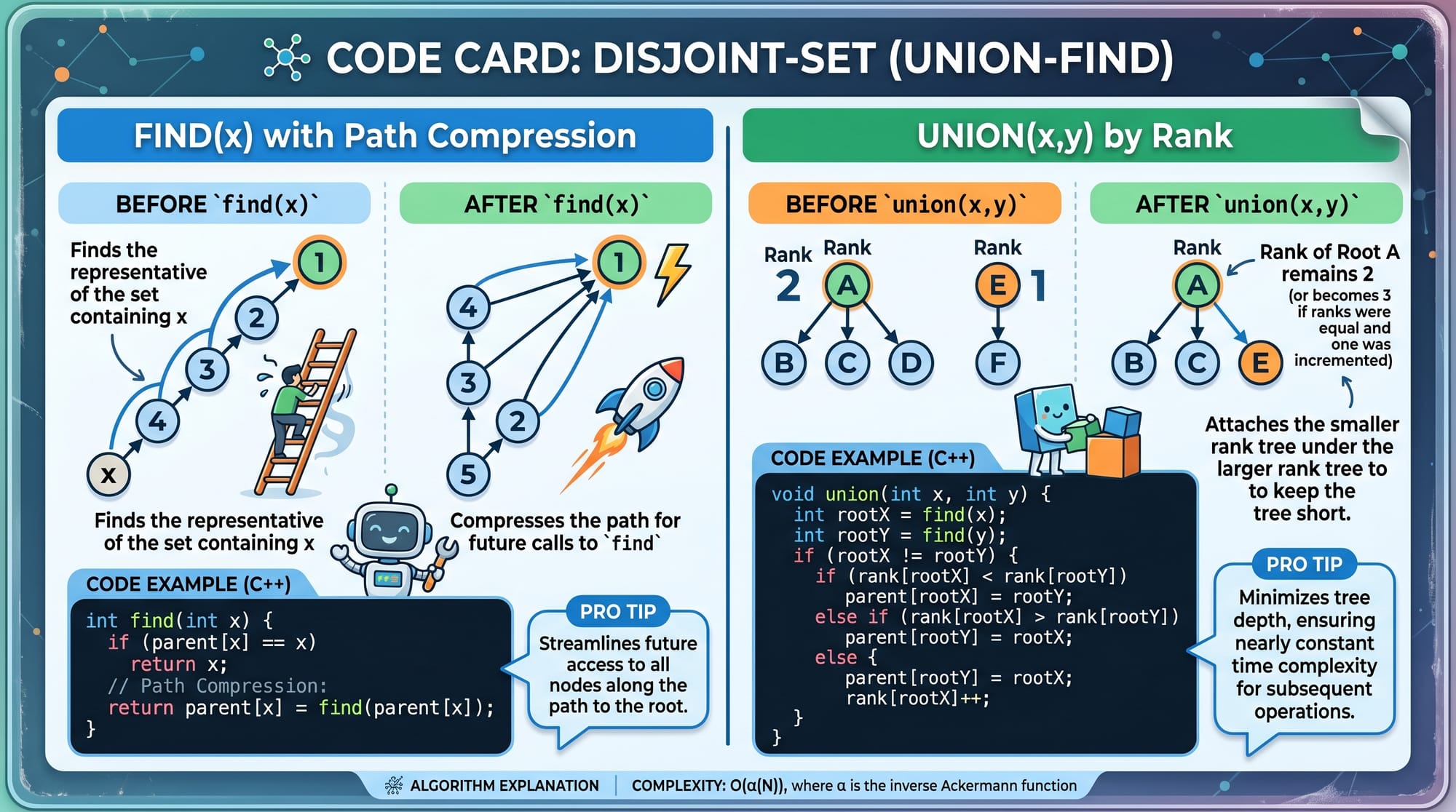
When merging two sets, we attach the smaller tree under the larger one to keep the tree shallow.
- Rank = approximate height of tree
- Attach lower-rank tree under higher-rank tree
This ensures operations are nearly constant time: O(α(n)), where α is the inverse Ackermann function (extremely small).
Practical Code Examples
Example 1: Basic Union-Find Implementation
#include <iostream>
using namespace std;

const int N = 1000;
int parent[N];
int rankArr[N];

// Initialize sets
void makeSet(int n) {
    for(int i = 0; i < n; i++) {
        parent[i] = i;
        rankArr[i] = 0;
    }
}

// Find with path compression
int findSet(int x) {
    if(parent[x] != x)
        parent[x] = findSet(parent[x]);
    return parent[x];
}

// Union by rank
void unionSet(int a, int b) {
    int rootA = findSet(a);
    int rootB = findSet(b);

    if(rootA != rootB) {
        if(rankArr[rootA] < rankArr[rootB])
            parent[rootA] = rootB;
        else if(rankArr[rootA] > rankArr[rootB])
            parent[rootB] = rootA;
        else {
            parent[rootB] = rootA;
            rankArr[rootA]++;
        }
    }
}

int main() {
    makeSet(5);

    unionSet(0, 1);
    unionSet(1, 2);

    cout << findSet(2) << endl;
}
Line-by-line Explanation:
parent[N]: Stores parent of each noderankArr[N]: Stores rank (tree height approximation)makeSet: Initializes each node as its own parentfindSet: Recursively finds root and compresses pathunionSet: Merges two sets using rank optimizationmain: Demonstrates merging and finding sets
Example 2: Real-World Application — Kruskal’s MST
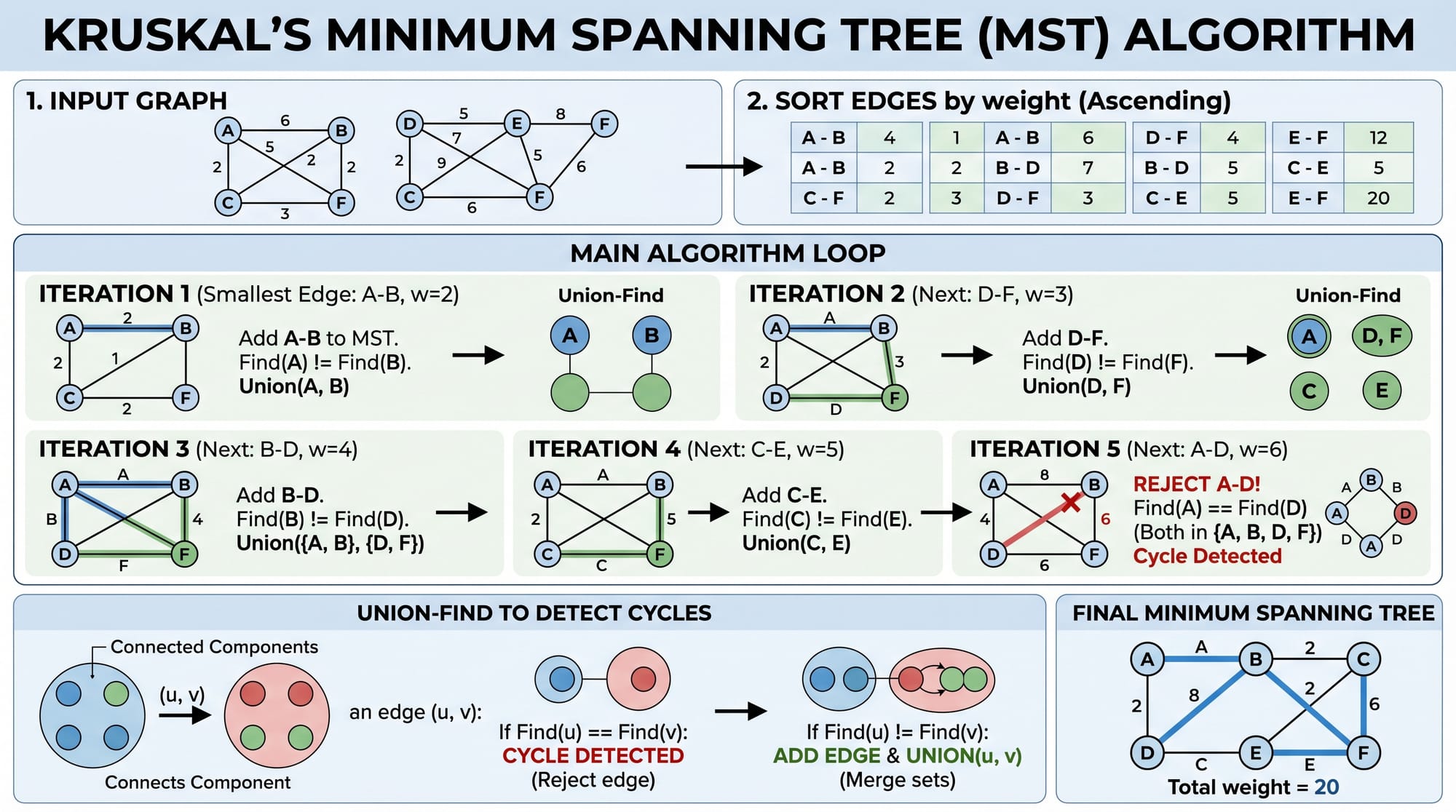
Let’s say we want to connect cities in Pakistan (Lahore, Karachi, Islamabad) with minimum road cost.
#include <bits/stdc++.h>
using namespace std;

struct Edge {
    int u, v, weight;
};

bool compare(Edge a, Edge b) {
    return a.weight < b.weight;
}

int parent[100];

int findSet(int x) {
    if(parent[x] != x)
        parent[x] = findSet(parent[x]);
    return parent[x];
}

void unionSet(int a, int b) {
    parent[findSet(a)] = findSet(b);
}

int main() {
    int n = 4;
    vector<Edge> edges = {
        {0,1,10}, {1,2,15}, {0,2,5}, {2,3,20}
    };

    sort(edges.begin(), edges.end(), compare);

    for(int i = 0; i < n; i++)
        parent[i] = i;

    int totalCost = 0;

    for(auto edge : edges) {
        if(findSet(edge.u) != findSet(edge.v)) {
            unionSet(edge.u, edge.v);
            totalCost += edge.weight;
            cout << "Edge added: " << edge.u << "-" << edge.v << endl;
        }
    }

    cout << "Minimum Cost: " << totalCost << endl;
}
Line-by-line Explanation:
Edge struct: Stores source, destination, and weightcompare: Sorts edges by weightedges vector: Represents graph connectionssort: Required for Kruskal’s algorithmfindSet: Checks if adding edge forms a cycleunionSet: Connects components- Loop: Adds edges if no cycle is formed
totalCost: Stores MST cost
Common Mistakes & How to Avoid Them
Mistake 1: Forgetting Path Compression
Without path compression, your solution may pass small tests but fail large ones.
❌ Wrong:
int findSet(int x) {
    if(parent[x] == x) return x;
    return findSet(parent[x]);
}
✅ Correct:
int findSet(int x) {
    if(parent[x] != x)
        parent[x] = findSet(parent[x]);
    return parent[x];
}
Mistake 2: Not Using Union by Rank
If you always attach one tree under another without considering size, trees become deep.
❌ Wrong:
parent[rootA] = rootB;
✅ Correct:
if(rankArr[rootA] < rankArr[rootB])
    parent[rootA] = rootB;
Mistake 3: Incorrect Initialization
Forgetting to initialize parent[i] = i causes wrong results.
Practice Exercises
Exercise 1: Count Connected Components
Problem:
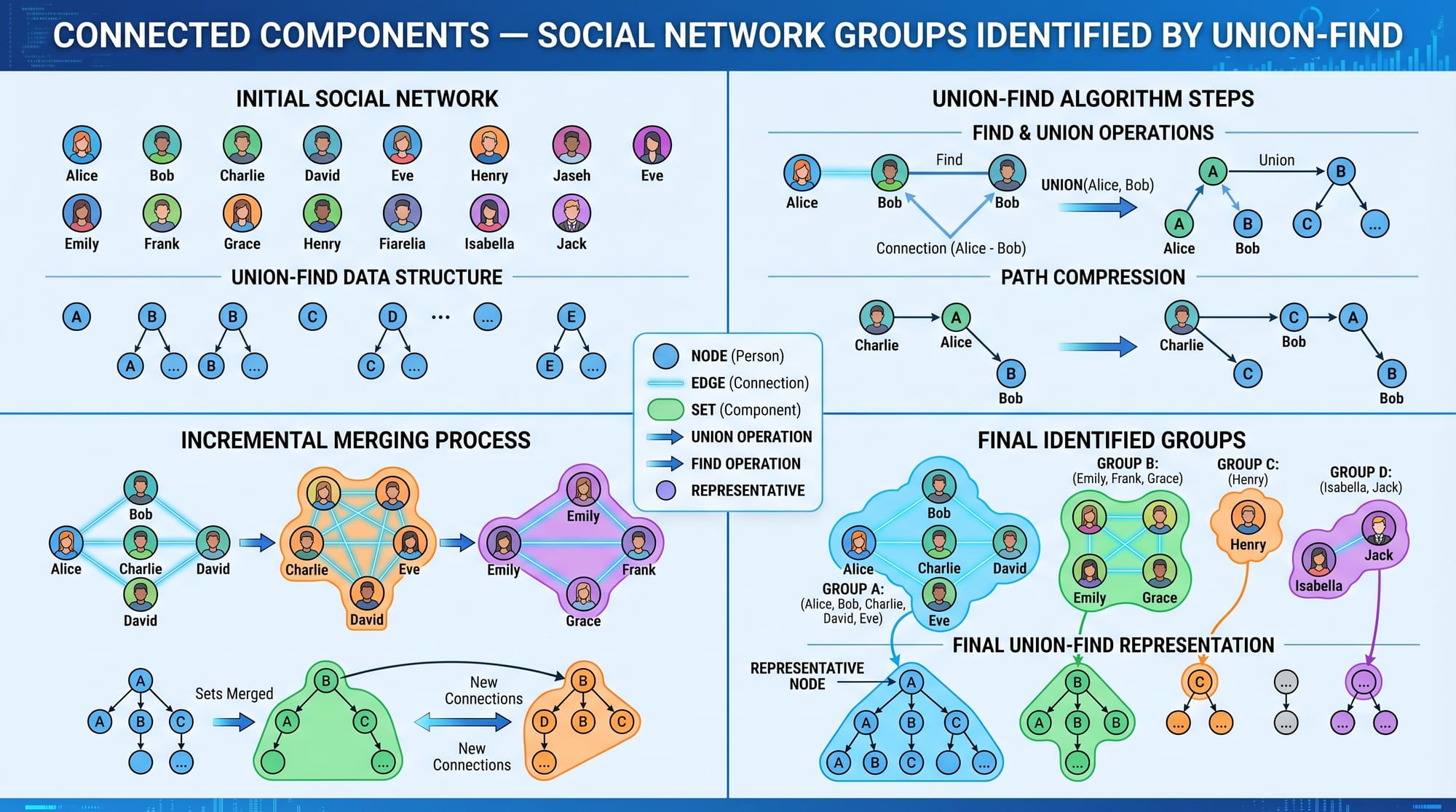
Given n students in a university and friendships between them, find the number of friend groups.
Solution:
int countComponents(int n, vector<pair<int,int>> edges) {
    vector<int> parent(n);

    for(int i = 0; i < n; i++)
        parent[i] = i;

    function<int(int)> findSet = [&](int x) {
        if(parent[x] != x)
            parent[x] = findSet(parent[x]);
        return parent[x];
    };

    for(auto e : edges) {
        int a = findSet(e.first);
        int b = findSet(e.second);
        if(a != b)
            parent[a] = b;
    }

    set<int> uniqueSets;
    for(int i = 0; i < n; i++)
        uniqueSets.insert(findSet(i));

    return uniqueSets.size();
}
Explanation:
- Merge friends into sets
- Count unique roots
Exercise 2: Detect Cycle in Graph
Problem:
Check if an undirected graph contains a cycle.
Solution:
bool hasCycle(int n, vector<pair<int,int>> edges) {
    vector<int> parent(n);

    for(int i = 0; i < n; i++)
        parent[i] = i;

    function<int(int)> findSet = [&](int x) {
        if(parent[x] != x)
            parent[x] = findSet(parent[x]);
        return parent[x];
    };

    for(auto e : edges) {
        int u = findSet(e.first);
        int v = findSet(e.second);

        if(u == v)
            return true;

        parent[u] = v;
    }

    return false;
}
Explanation:
- If two nodes already share the same root → cycle exists
Frequently Asked Questions
What is Union-Find used for?
Union-Find is used to efficiently manage groups of connected elements. It is commonly used in graph algorithms like Kruskal’s MST and for detecting connected components.
How do I optimize Union-Find?
Use path compression in the find operation and union by rank when merging sets. These optimizations make operations nearly constant time.
What is the time complexity of Union-Find?
With optimizations, each operation runs in O(α(n)), which is almost constant for practical input sizes.
How do I apply Union-Find in real life?
It can be used in network connectivity (e.g., internet providers in Pakistan), social networks (friend groups), and clustering problems.
Is Union-Find better than DFS/BFS?
For dynamic connectivity problems, Union-Find is faster and simpler than DFS/BFS. However, DFS/BFS is better for traversal and path-related problems.
Summary & Key Takeaways
- Union-Find (Disjoint Set) efficiently manages connected components
- Two main operations: Find and Union
- Path Compression and Union by Rank optimize performance
- Essential for Kruskal’s MST and cycle detection
- Runs in nearly constant time
- Widely used in competitive programming and real-world systems
Next Steps & Related Tutorials
To strengthen your DSA skills further, explore these tutorials on theiqra.edu.pk:
- Learn Graph Algorithms to understand BFS, DFS, and shortest paths
- Master Sorting Algorithms like QuickSort and MergeSort
- Study Greedy Algorithms for problems like Kruskal and Prim
- Practice Data Structures like Trees and Heaps for advanced problem solving
By combining Union-Find with these topics, you’ll be well-prepared for coding interviews, university exams, and platforms like LeetCode and Codeforces.
Keep practicing, and remember: every expert was once a beginner. 🚀
Test Your Python Knowledge!
Finished reading? Take a quick quiz to see how much you've learned from this tutorial.