Segment Trees Tutorial Range Queries & Lazy Propagation
Introduction
Segment trees are one of the most powerful data structures used in competitive programming and advanced algorithm design. In this segment tree tutorial: range queries & lazy propagation, you’ll learn how to efficiently process range-based queries and updates — something that simple arrays or prefix sums cannot handle efficiently.
Imagine Ahmad is managing sales data for a store in Lahore. He frequently needs to:
- Calculate total sales between day 10 and day 50
- Update multiple days when discounts are applied
Using a normal array, these operations can be slow (O(n) per query). A segment tree reduces this to O(log n) — a huge improvement.
For Pakistani students preparing for coding competitions like ICPC, or interviews at companies in Karachi and Islamabad, mastering this range query data structure is a must. Adding lazy propagation makes it even more powerful by handling bulk updates efficiently.
Prerequisites
Before diving into segment trees, make sure you understand:
- Basic arrays and indexing
- Recursion (very important)
- Time complexity (Big-O notation)
- Binary trees (helpful but not mandatory)
- Basic C++ or Python programming
Core Concepts & Explanation
Segment Tree Structure & Representation
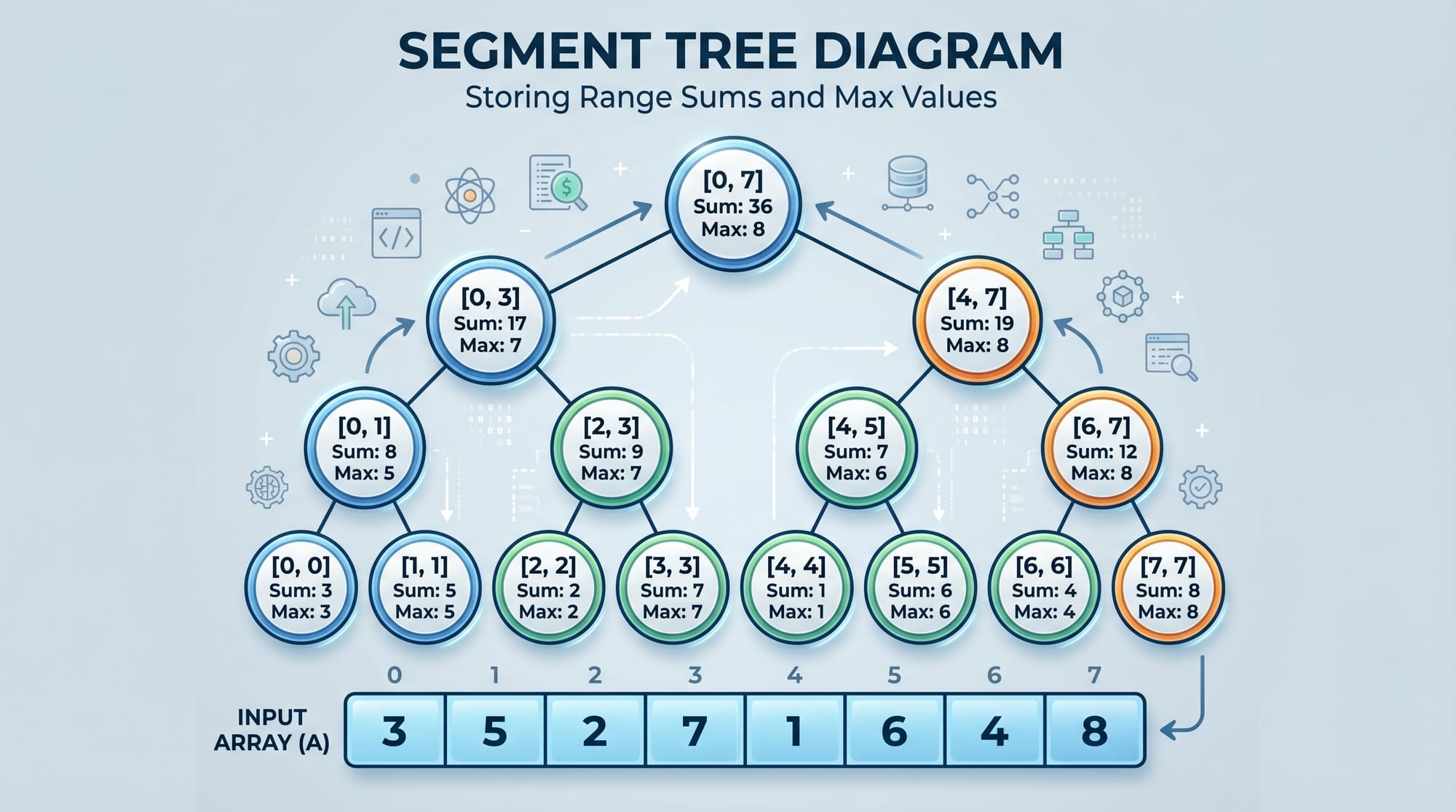
A segment tree is a binary tree where:
- Each node represents a range (segment) of the array
- The root represents the entire array
- Leaf nodes represent individual elements
For example:
Array = [2, 1, 5, 3, 4]
The segment tree stores:
- Root → sum of all elements
- Left child → sum of first half
- Right child → sum of second half
This allows queries like:
- Sum from index 1 to 3
- Maximum value in a range
Key Idea:
Instead of recomputing values, we reuse stored segments.
Range Queries & Lazy Propagation
Range Queries
A range query means:
- Compute something (sum, min, max) over a range
[l, r]
Instead of iterating over all elements:
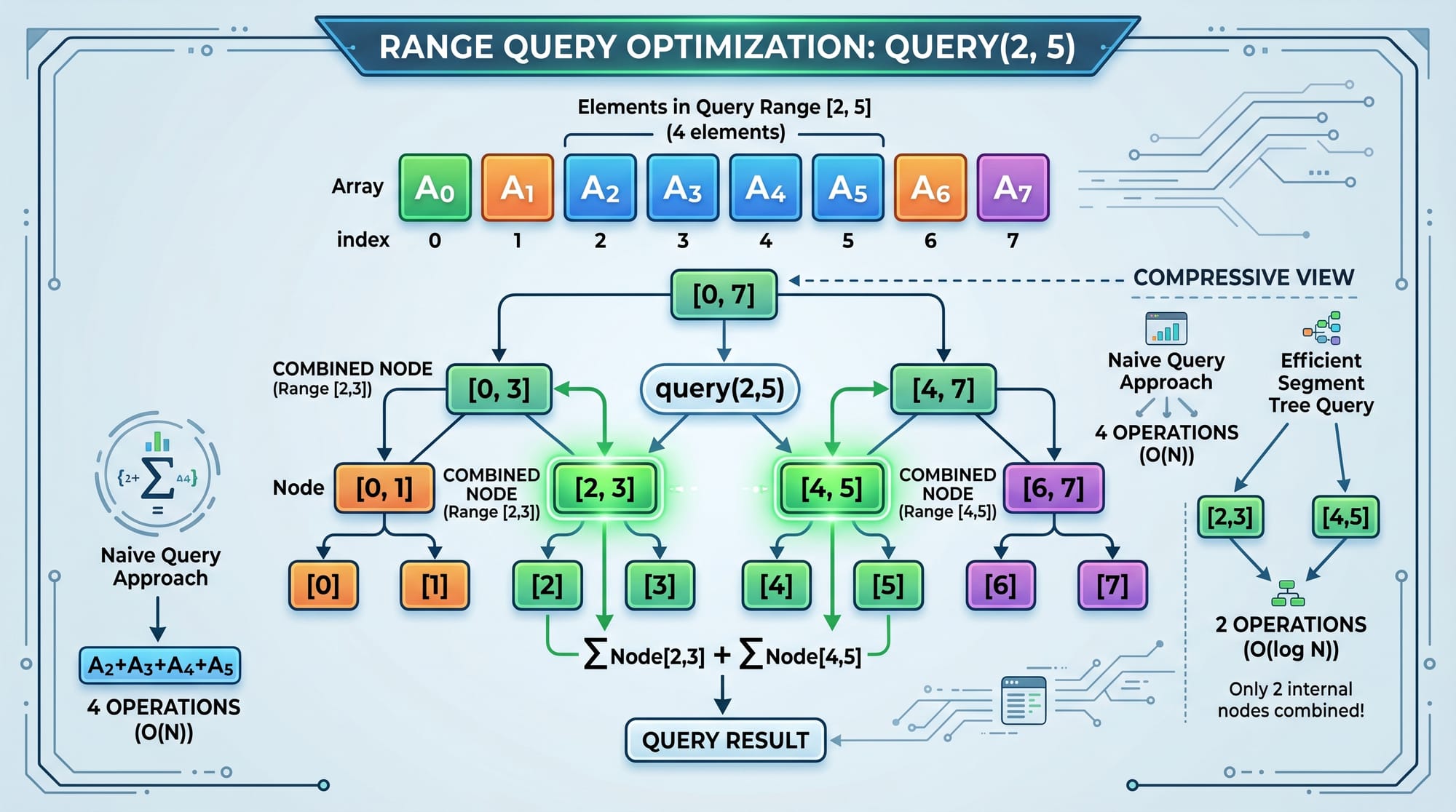
- Segment tree breaks the query into log(n) segments
Example:
Query(2,5) → combine results from a few nodes instead of 4 elements.
Lazy Propagation
Now consider Fatima needs to:
- Add +10 to all elements from index 1 to 1000
Without optimization:
- We update each element → O(n)
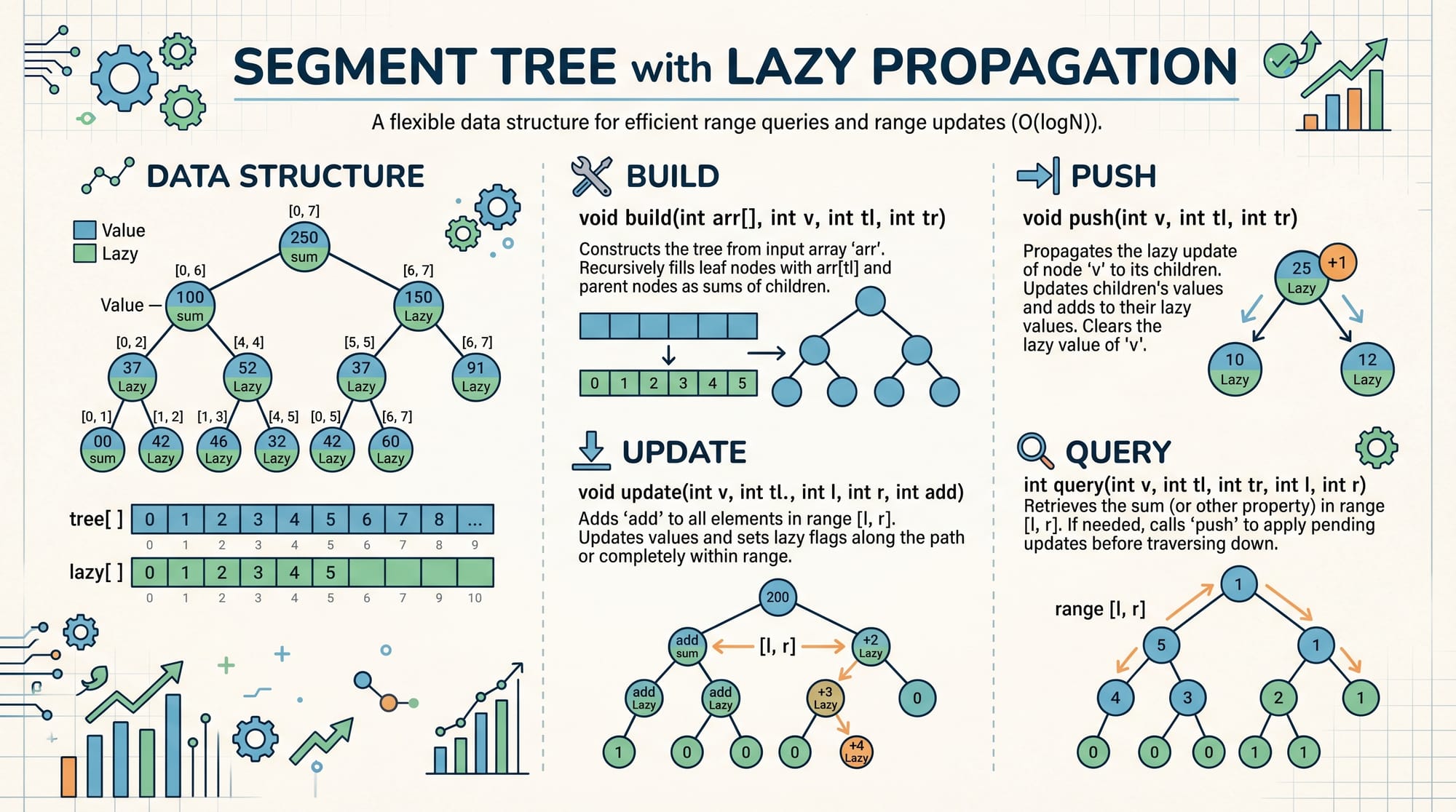
With lazy propagation:
- We delay updates and store them in a separate array (
lazy[]) - Only apply updates when needed
This reduces updates to O(log n).
Practical Code Examples
Example 1: Segment Tree for Range Sum
#include <bits/stdc++.h>
using namespace std;

const int MAX = 100000;
int tree[4 * MAX];
int arr[MAX];

// Build segment tree
void build(int node, int start, int end) {
    if (start == end) {
        tree[node] = arr[start]; // Leaf node
    } else {
        int mid = (start + end) / 2;
        build(2 * node, start, mid);       // Left child
        build(2 * node + 1, mid + 1, end); // Right child
        tree[node] = tree[2 * node] + tree[2 * node + 1];
    }
}

// Query range sum
int query(int node, int start, int end, int l, int r) {
    if (r < start || end < l) return 0; // No overlap
    if (l <= start && end <= r) return tree[node]; // Full overlap

    int mid = (start + end) / 2;
    int leftSum = query(2 * node, start, mid, l, r);
    int rightSum = query(2 * node + 1, mid + 1, end, l, r);

    return leftSum + rightSum;
}

// Update single value
void update(int node, int start, int end, int idx, int val) {
    if (start == end) {
        arr[idx] = val;
        tree[node] = val;
    } else {
        int mid = (start + end) / 2;
        if (idx <= mid)
            update(2 * node, start, mid, idx, val);
        else
            update(2 * node + 1, mid + 1, end, idx, val);

        tree[node] = tree[2 * node] + tree[2 * node + 1];
    }
}
Explanation (Line-by-Line)
tree[4 * MAX]→ stores segment tree (safe size)build()→ recursively builds treequery()→ handles:- No overlap → return 0
- Full overlap → return node value
- Partial → split and combine
update()→ updates a single index
Example 2: Lazy Propagation (Range Update)
int lazy[4 * MAX];

// Update range
void updateRange(int node, int start, int end, int l, int r, int val) {
    if (lazy[node] != 0) {
        tree[node] += (end - start + 1) * lazy[node];

        if (start != end) {
            lazy[2 * node] += lazy[node];
            lazy[2 * node + 1] += lazy[node];
        }

        lazy[node] = 0;
    }

    if (start > r || end < l) return;

    if (l <= start && end <= r) {
        tree[node] += (end - start + 1) * val;

        if (start != end) {
            lazy[2 * node] += val;
            lazy[2 * node + 1] += val;
        }
        return;
    }

    int mid = (start + end) / 2;
    updateRange(2 * node, start, mid, l, r, val);
    updateRange(2 * node + 1, mid + 1, end, l, r, val);

    tree[node] = tree[2 * node] + tree[2 * node + 1];
}
Explanation
lazy[]→ stores delayed updates- Before processing:
- Apply pending updates
- If range fully matches:
- Store update in lazy array
- Propagate later when needed
Common Mistakes & How to Avoid Them
Mistake 1: Incorrect Tree Size
Many students allocate insufficient memory.
❌ Wrong:
int tree[n];
✅ Correct:
int tree[4 * n];
Why?
Segment trees need extra space due to recursion.
Mistake 2: Forgetting Lazy Updates
Students often forget to apply lazy values before queries.
❌ Problem:
- Wrong answers in range queries
✅ Fix:
Always check:
if (lazy[node] != 0)
Apply pending updates before continuing.
Practice Exercises
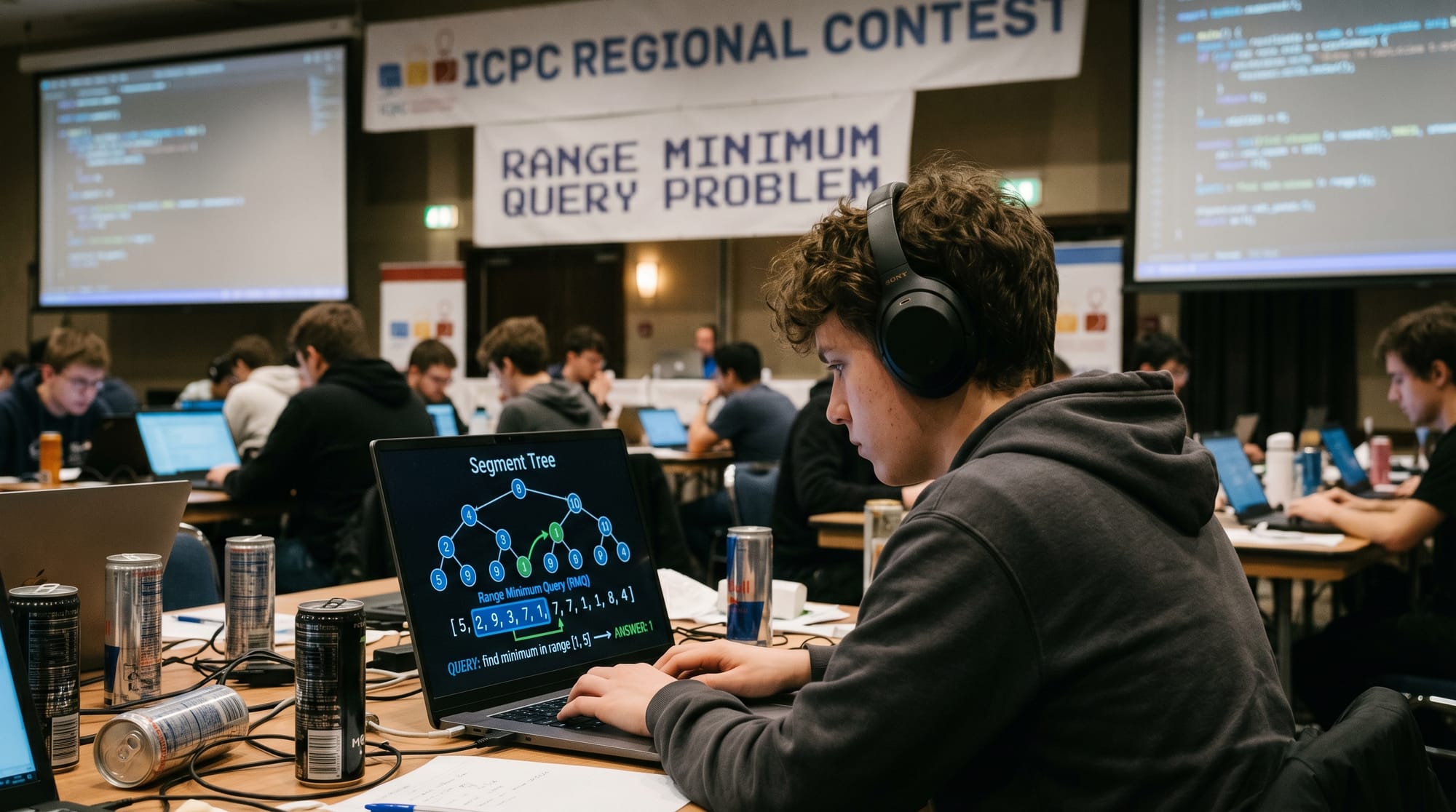
Exercise 1: Range Minimum Query
Problem:
Given an array, answer minimum queries efficiently.
Solution Idea:
- Modify segment tree to store
min()instead of sum
tree[node] = min(tree[2 * node], tree[2 * node + 1]);
Exercise 2: Salary Updates in Karachi Company
Problem:
Ali manages salaries (in PKR) and needs:
- Add bonus to range
- Query total salary
Solution:
Use lazy propagation.
Frequently Asked Questions
What is a segment tree?
A segment tree is a binary tree-based data structure used to efficiently perform range queries and updates on arrays. It reduces time complexity from O(n) to O(log n).
How do I implement lazy propagation?
You maintain a separate lazy[] array to store pending updates. Apply updates only when needed, which avoids unnecessary computations.
Why is segment tree faster than brute force?
Because it divides the problem into smaller segments and reuses results, reducing repeated calculations.
When should I use segment trees?
Use them when you need frequent range queries and updates, especially in competitive programming or large datasets.
Is segment tree better than Fenwick tree?
Segment trees are more flexible (support min, max, etc.), while Fenwick trees are simpler and faster for sum queries only.
Summary & Key Takeaways
- Segment trees enable efficient range queries in O(log n)
- Lazy propagation optimizes range updates
- Requires extra memory (
4 * n) - Essential for competitive programming
- Supports operations like sum, min, max
- Powerful for real-world data problems
Next Steps & Related Tutorials
To strengthen your understanding, explore these topics on theiqra.edu.pk:
- Learn Binary Trees to understand tree recursion fundamentals
- Study Dynamic Programming for optimization problems
- Explore Fenwick Tree (Binary Indexed Tree) as an alternative
- Practice Range Minimum Query (RMQ) problems
Mastering segment trees takes time — but once you get comfortable, you’ll unlock a powerful tool used by top programmers worldwide. Keep practicing, and don’t hesitate to revisit this segment tree tutorial whenever needed 🚀
Test Your Python Knowledge!
Finished reading? Take a quick quiz to see how much you've learned from this tutorial.