Trie Data Structure Prefix Trees & Autocomplete
Introduction
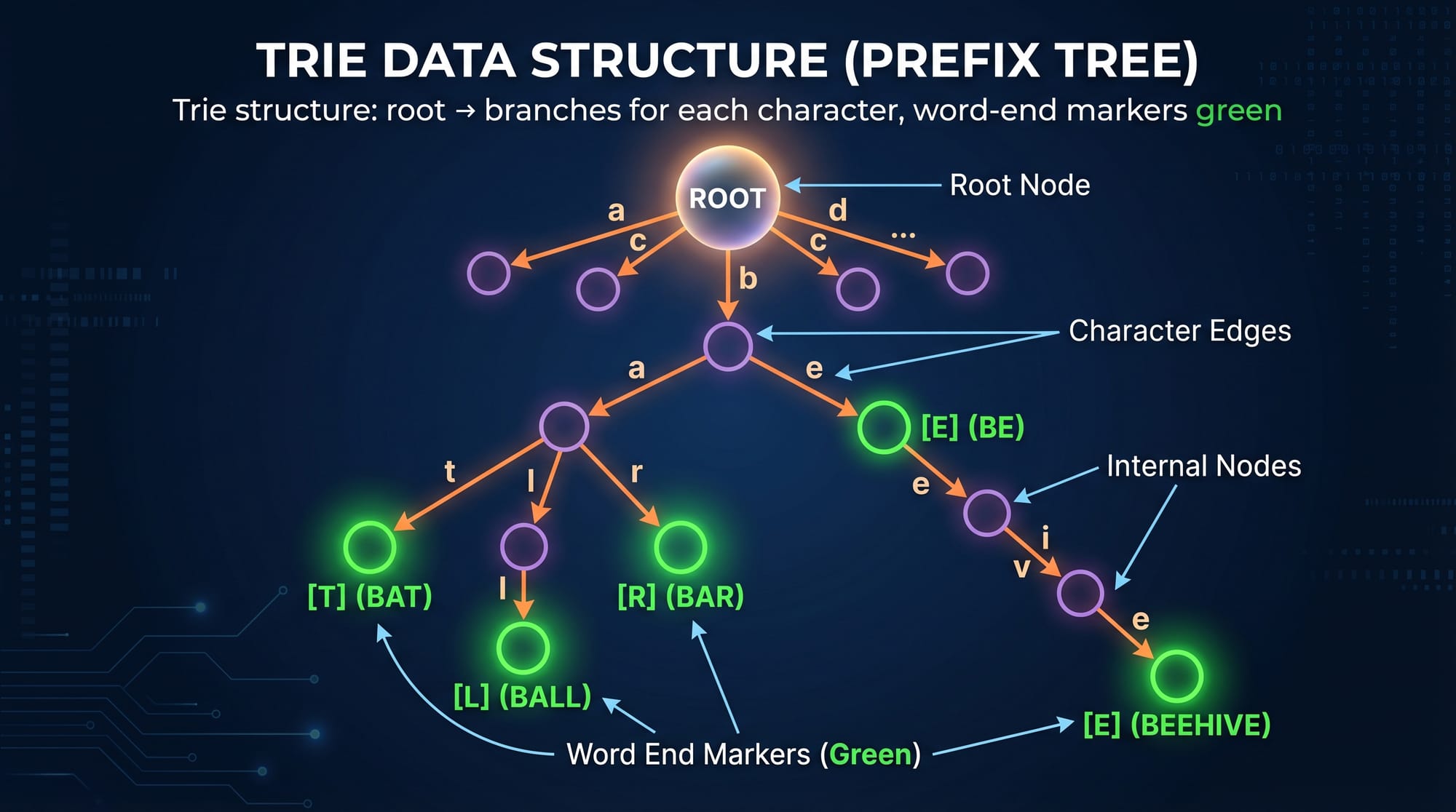
The Trie Data Structure: Prefix Trees & Autocomplete is one of the most powerful data structures used for fast string searching and prefix-based operations. A trie (pronounced “try”) is a tree-like structure that stores words character by character, making it extremely efficient for searching words, prefixes, and implementing autocomplete systems.
For Pakistani students learning Data Structures and Algorithms (DSA), understanding tries is very important because it frequently appears in coding interviews, competitive programming (Codeforces, LeetCode), and real-world applications like search engines, contact lists, and dictionary apps.
Imagine typing “pro” on your mobile keyboard and instantly seeing suggestions like “program,” “project,” and “promise.” This is exactly how an autocomplete trie works behind the scenes.
In this tutorial, we will break down tries step by step with simple explanations, Python code, and real-world Pakistani examples.
Prerequisites
Before learning trie data structure, you should already understand:
- Basic programming concepts (variables, loops, functions)
- Python basics (or any programming language)
- Basic data structures (arrays, dictionaries, or hash maps)
- Trees fundamentals (optional but helpful)
- Time complexity basics (Big O notation)
If you are familiar with Binary Search Trees or Hash Tables, this will make trie learning even easier.
Core Concepts & Explanation
Trie Node Structure (Building Blocks of Trie)
A trie is made up of nodes. Each node represents a single character of a word.
Each node typically contains:
- A dictionary (or array) of children nodes
- A boolean flag indicating end of word
Example:
- Root node → empty
- 'c' → 'a' → 't' forms “cat”
A simple TrieNode in Python:
class TrieNode:
    def __init__(self):
        self.children = {}
        self.is_end_of_word = False
Line-by-line explanation:
class TrieNode:→ Defines a node for trie__init__→ Constructor runs when node is createdself.children = {}→ Dictionary storing next charactersself.is_end_of_word = False→ Marks if a word ends here
This structure allows us to build words character by character efficiently.
Insert, Search, and Prefix Matching Logic
A trie supports three main operations:
1. Insert Operation
We insert words character by character.
2. Search Operation
We check if a complete word exists.
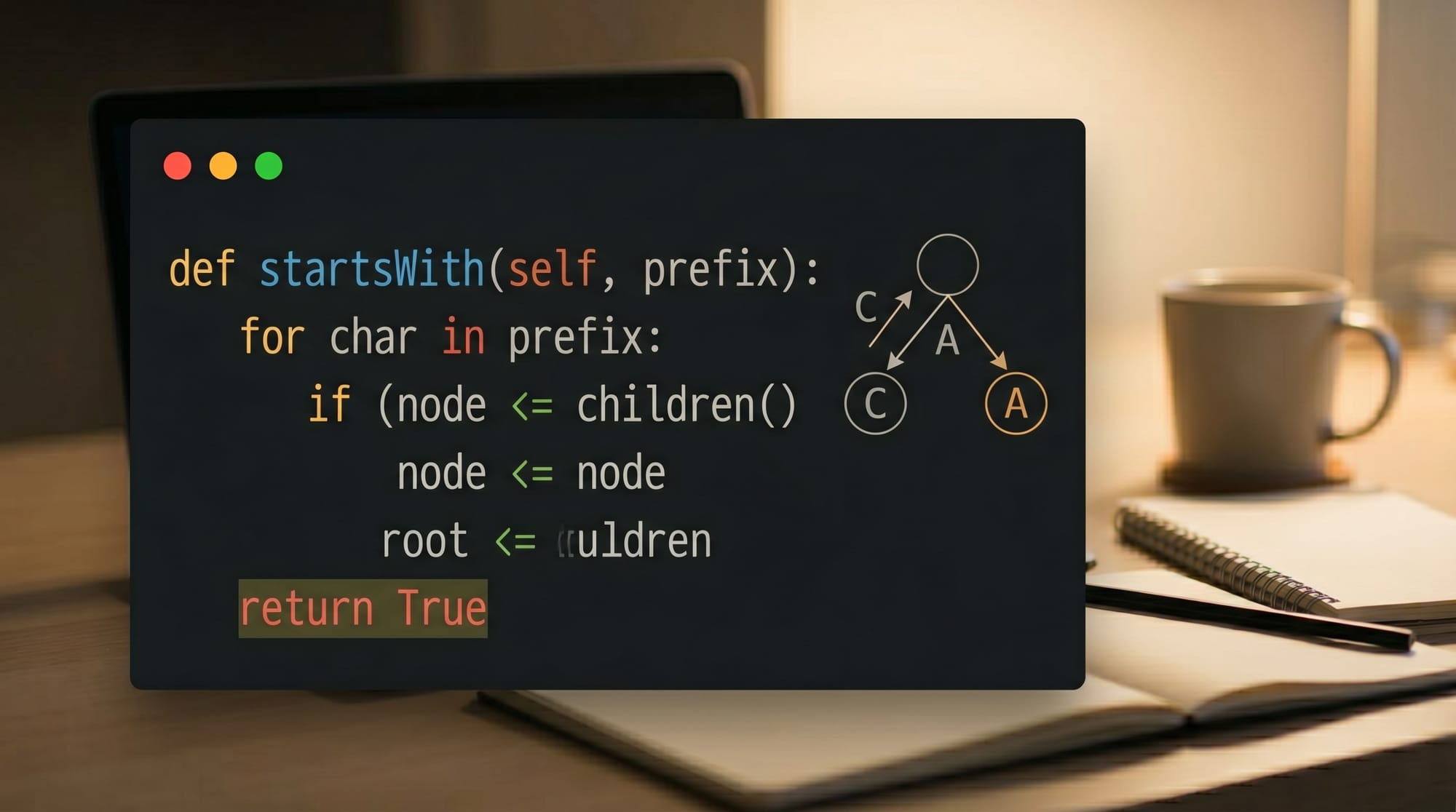
3. Prefix Search (startsWith)
We check if any word begins with a given prefix.
Practical Code Examples
Example 1: Building a Basic Trie (Insert + Search)
Let’s implement a simple trie in Python.
class Trie:
    def __init__(self):
        self.root = TrieNode()
Explanation:
- Creates Trie class
- Initializes root node
    def insert(self, word):
        node = self.root
Explanation:
- Start from root node
nodehelps traverse trie
for char in word:
Explanation:
- Loop through each character in word
            if char not in node.children:
                node.children[char] = TrieNode()
Explanation:
- If character not found, create new node
- Adds branch in trie
node = node.children[char]
Explanation:
- Move to next node
node.is_end_of_word = True
Explanation:
- Mark end of word (important step)
Search Function
    def search(self, word):
        node = self.root
Explanation:
- Start from root
for char in word:
Explanation:
- Traverse each character
            if char not in node.children:
                return False
Explanation:
- If character missing, word not found
node = node.children[char]
Explanation:
- Move deeper in trie
return node.is_end_of_word
Explanation:
- Only return True if full word exists
Example in Action (Pakistan Context)
trie = Trie()
trie.insert("ali")
trie.insert("ahmad")
trie.insert("amna")

print(trie.search("ali"))     # True
print(trie.search("al"))      # False
Explanation:
- We inserted Pakistani names: Ali, Ahmad, Amna
- Searching full word “ali” returns True
- Searching partial word “al” returns False
This shows how trie distinguishes between full words and prefixes.
Example 2: Real-World Autocomplete System
Autocomplete is one of the most important applications of trie.
Imagine a typing system in Karachi job portal where users type “dev”.
We want suggestions like:
- developer
- development
- devops
class Trie:
    def __init__(self):
        self.root = TrieNode()

    def insert(self, word):
        node = self.root
        for char in word:
            if char not in node.children:
                node.children[char] = TrieNode()
            node = node.children[char]
        node.is_end_of_word = True
Explanation:
- Same insert logic builds dictionary of words
Now autocomplete function:
    def autocomplete(self, prefix):
        node = self.root
Explanation:
- Start from root
        for char in prefix:
            if char not in node.children:
                return []
            node = node.children[char]
Explanation:
- Traverse prefix
- If prefix not found → return empty list
return self._find_words(node, prefix)
Explanation:
- Collect all words starting from prefix
Helper function:
    def _find_words(self, node, prefix):
        words = []
Explanation:
- Store all results
        if node.is_end_of_word:
            words.append(prefix)
Explanation:
- If word ends here, add to list
        for char in node.children:
            words.extend(self._find_words(node.children[char], prefix + char))
Explanation:
- Recursively explore all paths
return words
Explanation:
- Return all suggestions

Common Mistakes & How to Avoid Them
Mistake 1: Forgetting to Mark End of Word
Many beginners forget is_end_of_word = True.
Problem:
- Trie may treat prefix as full word
Fix:
Always mark word endings.
node.is_end_of_word = True
Without this, “ali” and “alina” become confusing.
Mistake 2: Assuming Trie is Memory Efficient for Small Data
Trie uses more memory than hash maps.
Problem:
- Students think trie is always best
Fix:
Use trie only when:
- Prefix search is required
- Large dictionary or autocomplete needed
Practice Exercises
Exercise 1: Insert and Search Words
Problem:
Insert these words: "karachi", "lahore", "islamabad" and check if "lahore" exists.
Solution:
trie.insert("karachi")
trie.insert("lahore")
trie.insert("islamabad")

print(trie.search("lahore"))  # True
Explanation:
- Words are inserted character by character
- Search finds exact match
Exercise 2: Prefix Checking
Problem:
Check if any word starts with "la".
Solution:
print(trie.startsWith("la")) # True
Explanation:
- Trie finds prefix “la” in “lahore”
Frequently Asked Questions
What is a trie data structure?
A trie is a tree-based data structure used to store strings in a way that allows fast prefix searching. Each node represents a character in a word.
Why is trie used in autocomplete systems?
Trie allows fast retrieval of all words starting with a prefix, making it ideal for autocomplete features in search engines and mobile keyboards.
Is trie better than hash map?
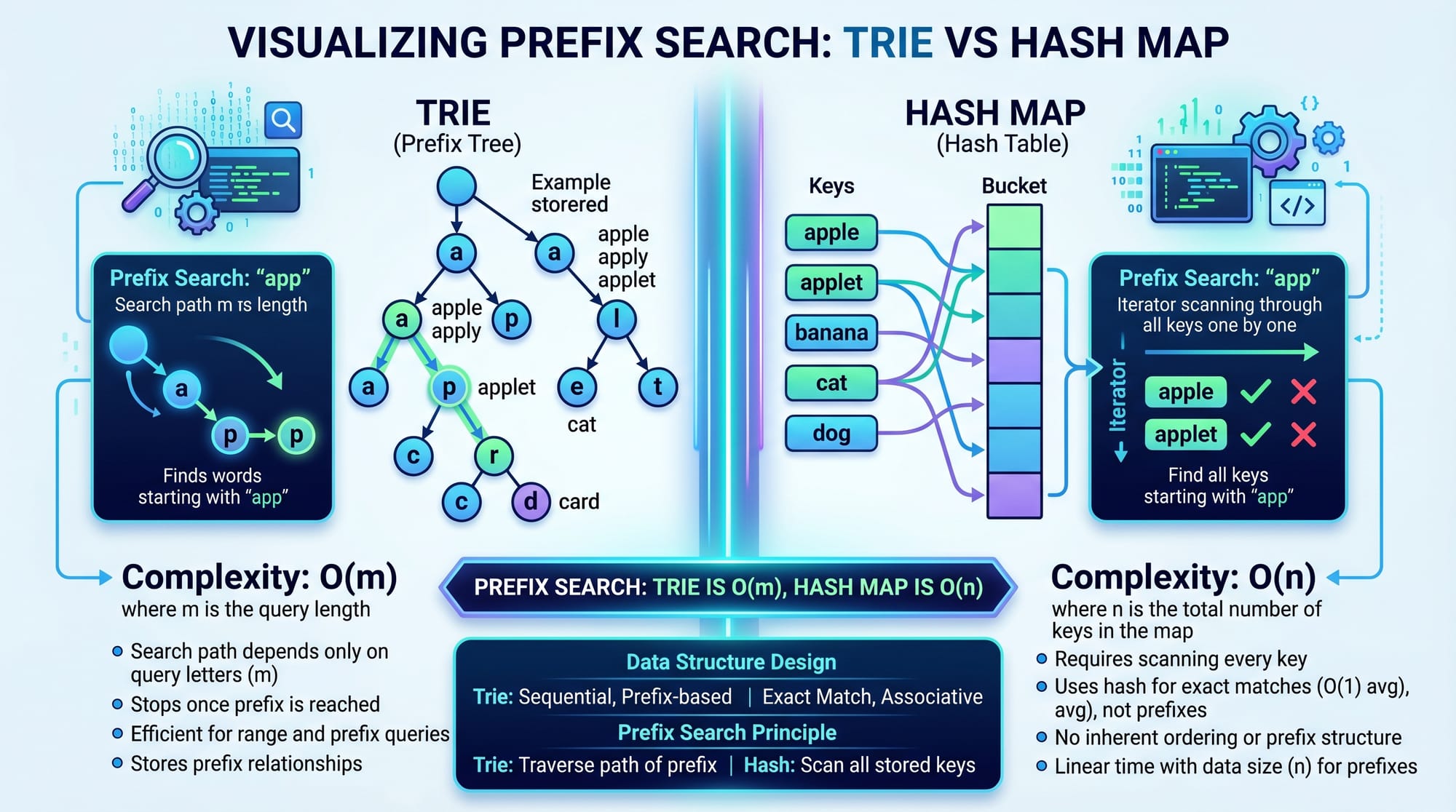
Trie is better for prefix-based searching, while hash maps are better for exact lookups. Trie uses more memory but provides faster prefix operations.
How does trie improve search speed?
Trie reduces search time to O(m), where m is the length of the word, because it processes character by character instead of scanning all words.
Where is trie used in real life?
Tries are used in search engines, contact lists, dictionary apps, and predictive text systems like those used in smartphones.
Summary & Key Takeaways
- Trie is a tree-based structure for storing strings efficiently
- It is ideal for prefix searching and autocomplete systems
- Each node represents a character
- Words are stored character by character
- It is widely used in search engines and dictionaries
- It trades memory for speed
Next Steps & Related Tutorials
To strengthen your DSA foundation, continue learning:
- Learn Binary Search Trees for hierarchical data understanding
- Explore Hash Tables for fast key-value lookups
- Study Graph Algorithms for advanced problem-solving
- Practice more string problems using tries
You can continue learning on theiqra.edu.pk with:
- [Binary Search Trees Tutorial]
- [Hash Tables in Data Structures]
- [Advanced String Algorithms]
If you want, I can also:
✅ Add diagrams in Mermaid format
✅ Convert this into WordPress blog format
✅ Or generate quiz + MCQs for students in Pakistan
Test Your Python Knowledge!
Finished reading? Take a quick quiz to see how much you've learned from this tutorial.