Rust Ownership Borrowing & Lifetimes Explained

Introduction
Rust is a modern systems programming language designed for performance, memory safety, and concurrency. One of the most unique and powerful aspects of Rust is its ownership system, which manages memory without needing a garbage collector.
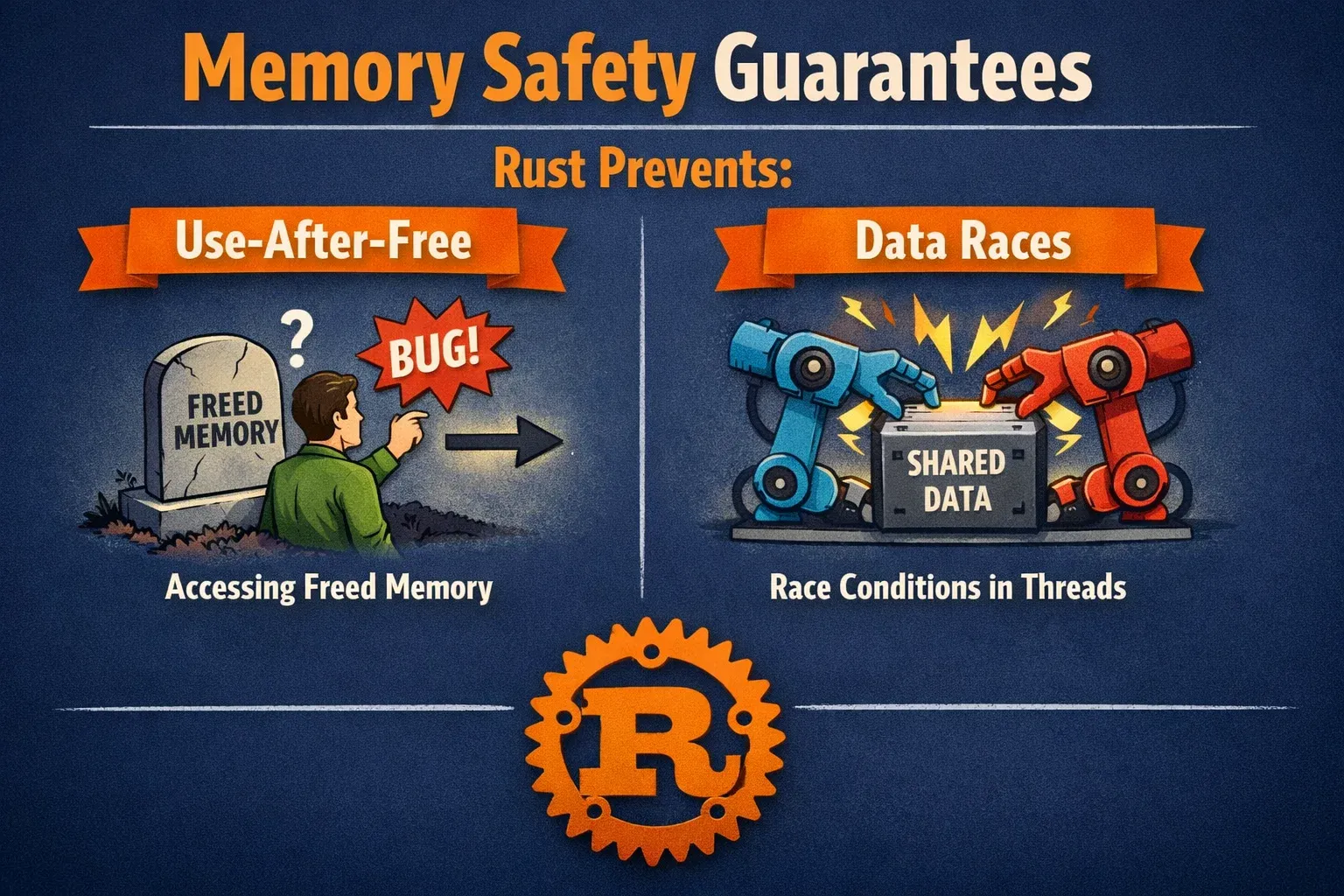
Understanding rust ownership, rust borrowing, and rust lifetimes is essential if you want to write efficient and safe Rust programs. These three concepts form the foundation of Rust’s memory safety guarantees, preventing common programming errors like:
- Use-after-free bugs
- Data races in concurrent programs
- Memory leaks
Unlike languages such as C or C++ that rely on manual memory management, or languages like Java that depend on garbage collection, Rust enforces safety at compile time through strict rules called the borrow checker.
For Pakistani students studying programming in universities such as those in Lahore, Karachi, or Islamabad, learning Rust’s ownership model is incredibly valuable because it teaches how memory actually works inside a computer.
For example, imagine Ahmad writing a high-performance backend system for a Pakistani fintech startup handling PKR transactions. Rust ensures that the system remains fast and safe without runtime crashes caused by memory bugs.
By the end of this tutorial, you will understand:
- How ownership works in Rust
- How borrowing allows safe references
- How lifetimes ensure references remain valid
Prerequisites
Before diving into ownership, borrowing, and lifetimes, you should be comfortable with the following Rust basics:
- Basic Rust syntax
- Variables and mutability
- Functions
- Basic data types (
i32,String,bool) - Control flow (
if,match, loops) - Basic understanding of memory (stack vs heap)
If you are new to Rust, start with Rust Tutorial for Beginners on theiqra.edu.pk before reading this guide.
You should also have:
- Rust installed via
rustup - A code editor like VS Code
- Basic command line knowledge
Core Concepts & Explanation
Rust Ownership Rules
Ownership is Rust’s system for managing memory.
Every value in Rust has a single owner.
Rust enforces three main rules:
- Each value has one owner.
- Only one owner exists at a time.
- When the owner goes out of scope, the value is dropped.
Example:
fn main() {
    let a = String::from("Karachi");
    let b = a;

    println!("{}", b);
}
Explanation:
Line 1
fn main() {
Program execution starts here.
Line 2
let a = String::from("Karachi");
A String is created on the heap, and a becomes its owner.
Line 3
let b = a;
Ownership of the String moves from a to b.
Line 4
If we try:
println!("{}", a);
The compiler throws an error because a no longer owns the value.
This prevents double free errors.
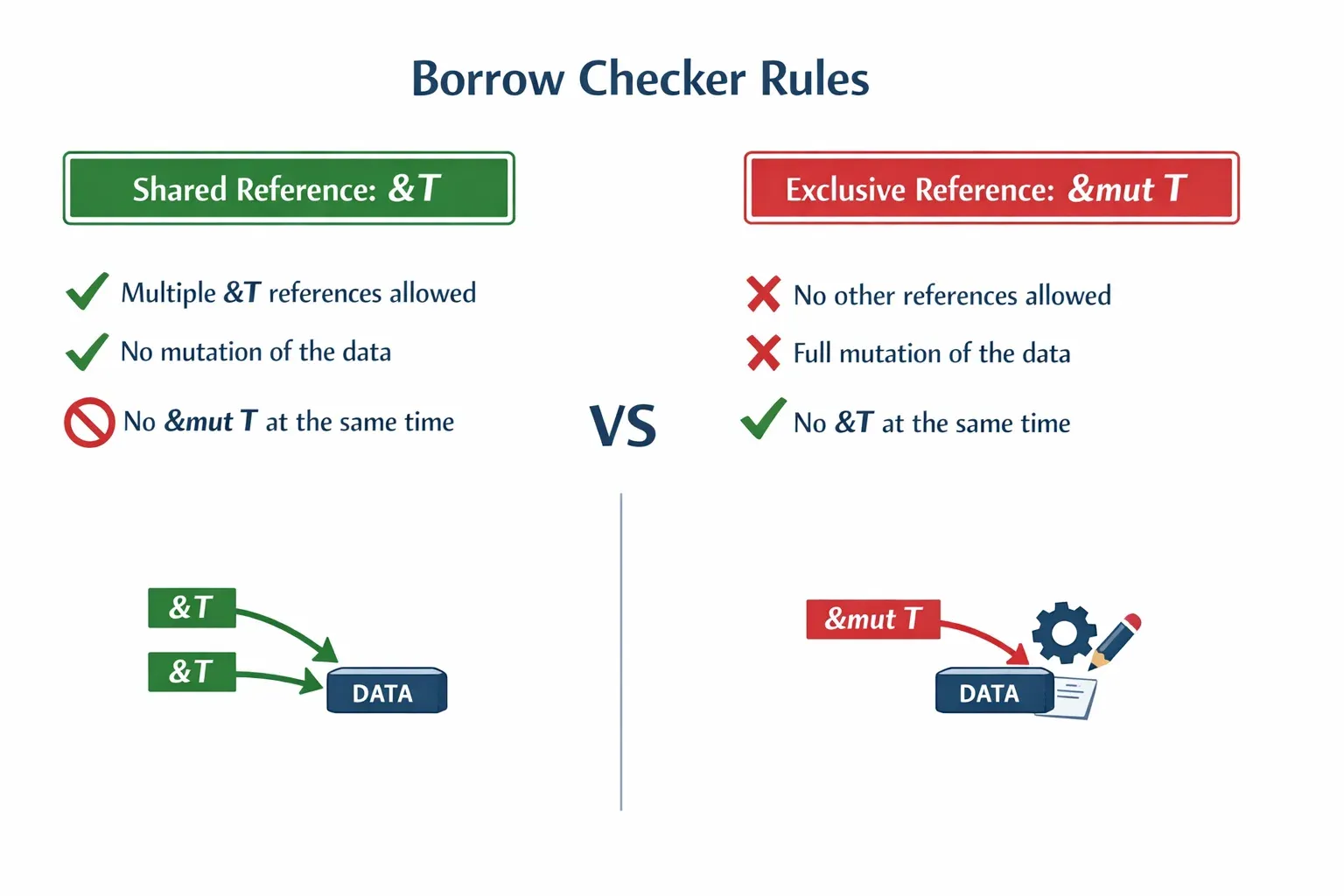
Borrowing and References
Borrowing allows you to use a value without taking ownership.
Rust uses references:
&T     immutable reference
&mut T mutable reference
Example:
fn main() {
    let city = String::from("Lahore");

    print_city(&city);

    println!("{}", city);
}

fn print_city(name: &String) {
    println!("City: {}", name);
}
Explanation:
Line 2
let city = String::from("Lahore");
city owns the string.
Line 4
print_city(&city);
We pass a reference instead of transferring ownership.
Line 8
fn print_city(name: &String)
The function accepts a borrowed reference.
Ownership remains with city, so we can still use it afterward.
Mutable Borrowing
Rust allows mutation through mutable references.
However, Rust enforces strict rules:
- Only one mutable reference at a time
- Or multiple immutable references
Example:
fn main() {
    let mut price = 1000;

    update_price(&mut price);

    println!("{}", price);
}

fn update_price(p: &mut i32) {
    *p += 500;
}
Explanation:
Line 2
let mut price = 1000;
Mutable variable representing PKR price.
Line 4
update_price(&mut price);
Passing a mutable reference.
Line 8
*p += 500;
* dereferences the pointer and updates the value.
Output:
1500
Rust Lifetimes Explained
Lifetimes ensure references remain valid as long as they are used.
Sometimes Rust cannot infer how long references should live, so we must annotate lifetimes.
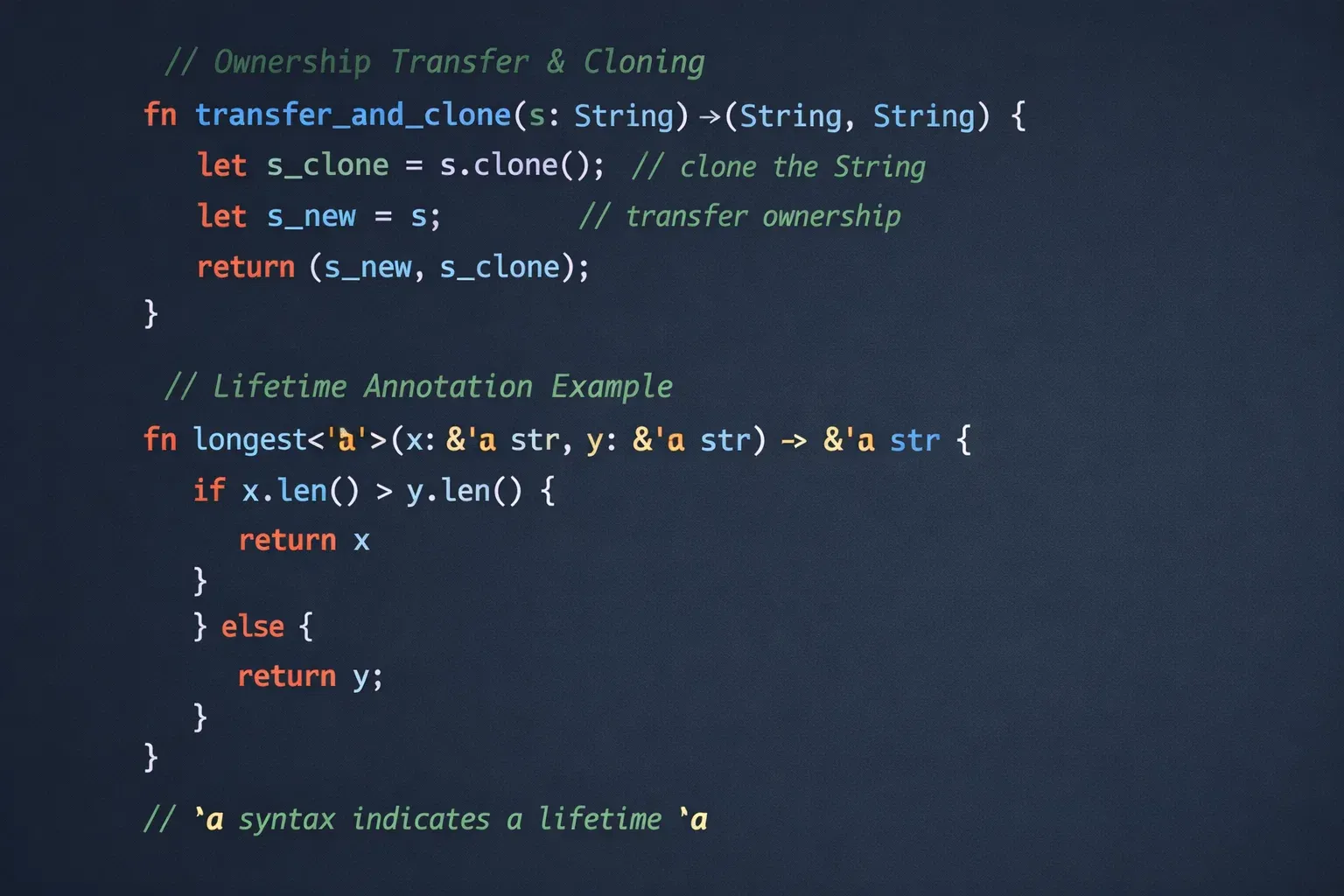
Example:
fn longest<'a>(x: &'a str, y: &'a str) -> &'a str {

    if x.len() > y.len() {
        x
    } else {
        y
    }
}
Explanation:
Line 1
<'a>
Defines a lifetime parameter.
Line 1
x: &'a str
x must live at least as long as lifetime 'a.
Return value
-> &'a str
Returned reference will live at least as long as 'a.
This ensures Rust does not return invalid references.
Practical Code Examples
Example 1: Ownership Transfer in a Function
fn main() {

    let student = String::from("Ahmad");

    process_student(student);

}

fn process_student(name: String) {

    println!("Processing student: {}", name);

}
Explanation:
Line 3
let student = String::from("Ahmad");
Creates a String owned by student.
Line 5
process_student(student);
Ownership moves to the function.
Inside the function
name becomes the new owner.
After this call, student is invalid in main.
Example 2: Real-World Application — Managing Product Prices
Imagine Fatima building a small e-commerce Rust backend in Lahore.
struct Product {
    name: String,
    price: i32,
}

fn apply_discount(product: &mut Product) {
    product.price -= 200;
}

fn main() {

    let mut laptop = Product {
        name: String::from("Laptop"),
        price: 120000,
    };

    apply_discount(&mut laptop);

    println!("Price after discount: {} PKR", laptop.price);

}
Explanation:
Struct
Represents a product with name and price.
Mutable borrow
apply_discount(&mut laptop);
The function borrows laptop mutably.
Inside function
product.price -= 200;
Updates the price safely.
Output example:
Price after discount: 119800 PKR
Common Mistakes & How to Avoid Them
Mistake 1: Using a Value After Move
Incorrect code:
let a = String::from("Islamabad");
let b = a;

println!("{}", a);
Problem:
Ownership moved to b.
Fix:
Use .clone().
let a = String::from("Islamabad");
let b = a.clone();

println!("{}", a);
Now both variables own separate data.
Mistake 2: Multiple Mutable References
Incorrect:
let mut x = 10;

let r1 = &mut x;
let r2 = &mut x;
Rust error:
cannot borrow `x` as mutable more than once
Fix:
Use scopes.
let mut x = 10;

{
    let r1 = &mut x;
}

let r2 = &mut x;
Now borrowing is valid.
Practice Exercises
Exercise 1: Ownership Move
Problem:
Write a function that takes ownership of a String representing a Pakistani city name and prints it.
Solution:
fn main() {

    let city = String::from("Karachi");

    print_city(city);

}

fn print_city(name: String) {

    println!("City: {}", name);

}
Explanation:
Ownership moves from city to name.
Exercise 2: Borrowing Reference
Problem:
Create a function that receives a reference to a student's name and prints it without taking ownership.
Solution:
fn main() {

    let student = String::from("Ali");

    display_student(&student);

}

fn display_student(name: &String) {

    println!("Student: {}", name);

}
Explanation:
&student passes a borrowed reference, so student remains valid.
Frequently Asked Questions
What is Rust ownership?
Rust ownership is a memory management system where each value has a single owner responsible for its lifetime. When the owner goes out of scope, Rust automatically frees the memory.
What is borrowing in Rust?
Borrowing allows functions to use values without taking ownership. It uses references (&T or &mut T) so the original owner retains control.
Why are Rust lifetimes needed?
Lifetimes ensure references remain valid for as long as they are used. They help the compiler prevent dangling references.
When should I use .clone() in Rust?
Use .clone() when you need multiple independent copies of heap data. However, cloning can be expensive, so borrowing is usually preferred.
Is Rust ownership difficult to learn?
Initially yes, but once understood it becomes intuitive. Rust’s ownership model helps developers write safe, high-performance code without runtime memory errors.
Summary & Key Takeaways
- Rust ownership ensures safe memory management without garbage collection
- Borrowing allows functions to use data without transferring ownership
- Mutable references enable controlled data modification
- Lifetimes guarantee references never outlive their data
- Rust’s borrow checker prevents data races and invalid memory access
- Mastering these concepts is essential for professional Rust development
Next Steps & Related Tutorials
To continue learning Rust on theiqra.edu.pk, explore these tutorials:
- Rust Tutorial for Beginners — learn syntax, variables, and functions
- Rust Error Handling Explained — working with
ResultandOption - Rust Concurrency with Threads and Channels — safe parallel programming
- Building REST APIs in Rust with Actix Web
These tutorials will help Pakistani students progress from Rust fundamentals to real-world backend development.
Test Your Python Knowledge!
Finished reading? Take a quick quiz to see how much you've learned from this tutorial.